Citrullus colocynthis, with many common names including colocynth, bitter apple, bitter cucumber, desert gourd,[citation needed] egusi, vine of Sodom, or wild gourd, is a desert viny plant native to the
Citrullus colocynthis, with many common names including colocynth, bitter apple, bitter cucumber, desert gourd,[citation needed] egusi, vine of Sodom, or wild gourd, is a desert viny plant native to the Mediterranean Basin and Asia, especially Turkey (especially in regions such as İzmir), and Nubia.
It resembles a common watermelon vine, but bears small, hard fruits with a bitter pulp. It originally bore the scientific name Colocynthis citrullus.
Origin, distribution, and ecology
colocynthis is a desert viny plant that grows in sandy, arid soils. It is native to the Mediterranean Basin and Asia, and is distributed among the west coast of northern Africa, eastward through the Sahara, Egypt until India, and reaches also the north coast of the Mediterranean and the Caspian Seas. It grows also in southern European countries as in Spain and on the islands of the Grecian archipelago. On the island of Cyprus, it is cultivated on a small scale; it has been an income source since the 14th century and is still exported today. It is an annual or a perennial plant (in wild) in Indian arid zones and has a great survival rate under extreme xeric conditions.[4] In fact, it can tolerate annual precipitation of 250 to 1500 mm and an annual temperature of 14.8 to 27.8 °C. It grows from sea level up to 1500 meters above sea level on sandy loam, subdesert soils, and sandy sea coasts with a pH range between 5.0 and 7.8.
Characteristics and morphology
Roots and stems
The roots are large, fleshy, and perennial, leading to a high survival rate due to the long tap root. The vine-like stems spread in all directions for a few meters looking for something over which to climb. If present, shrubs and herbs are preferred and climbed by means of axiliary branching tendrils.[4]
Leaves
Very similar to watermelon, the leaves are palmate and angular with three to seven divided lobes.
Flowers
The flowers are yellow and solitary in the axes of leaves and are borne by yellow-greenish peduncles. Each has a subcampanulated five-lobed corolla and a five-parted calyx. They are monoecious, so the male (stamens) and the female reproductive parts (pistils and ovary) are borne in different flowers on the same plant. The male flowers’ calyx is shorter than the corolla. They have five stamens, four of which are coupled and one is single with monadelphous anther. The female flowers have three staminoids and a three-carpel ovary. The two sexes are distinguishable by observing the globular and hairy inferior ovary of the female flowers.[4]
Fruits
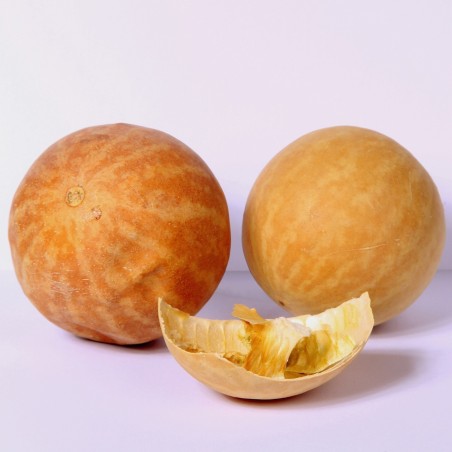
The fruit is smooth, spheric with a 5– to 10-cm-diameter and extremely bitter taste. The calyx englobe the yellow-green fruit which becomes marble (yellow stripes) at maturity. The mesocarp is filled with a soft, dry, and spongy white pulp, in which the seeds are embedded. Each of the three carpels bears six seeds. Each plant produces 15 to 30 fruits.[5]
Seeds
The seeds are grey and 5 mm long by 3 mm wide. They are edible but similarly bitter, nutty-flavored, and rich in fat and protein. They are eaten whole or used as an oilseed. The oil content of the seeds is 17–19% (w/w), consisting of 67–73% linoleic acid, 10–16% oleic acid, 5–8% stearic acid, and 9–12% palmitic acid. The oil yield is about 400 l/hectare.[6] In addition, the seeds contain a high amount of arginine, tryptophan, and the sulfur-containing amino acids.[7]
Cultivation
colocynthis, a perennial plant, can propagate both by generative and vegetative means. However, seed germination is poor due to the extreme xeric conditions, so vegetative propagation is more common and successful in nature. In the Indian arid zone, growth takes place between January and October, but the most favorable period for the vegetative growth is during summer, which coincides with the rainy season. Growth declines as soon as the rains and the temperature decrease and almost stops during the cold and dry months of December and January. Colocynth prefers sandy soils and is a good example of good water management which may be useful also on research to better understand how desert plants react to water stress.[8][9] To enhance production, an organic fertilizer can be applied.[10] Colocynth is also commonly cultivated together with cassava (intercropping) in Nigeria.
Cultivated colocynth suffers of climatic stress and diseases such as cucumber mosaic virus, melon mosaic virus, Fusarium wilt, etc. as any other crop. To improve it, a relatively new protocol for regeneration has been developed with the aim of incorporating disease and stress resistance to increase yield potential and security avoiding interspecific hybridization barriers.[11]
Uses
colocynthis can be eaten or elaborated for further uses in medicine and as energy source, e.g. oilseed and biofuel. The characteristic small seed of the colocynth have been found in several early archeological sites in northern Africa and the Near East, specifically at Neolithic Armant, Nagada in Egypt; at sites dating from 3800 BC to Roman times in Libya; and the prepottery Neolithic levels of the Nahal Hemar caves in Israel.[12] Zohary and Hopf speculate, "these finds indicate that the wild colocynth was very probably used by humans prior to its domestication."[12]
Traditional medicine and research
Colocynth has been widely used in traditional medicine for centuries.[13] In premodern medicine, it was an ingredient in the electuary called confectio hamech, or diacatholicon, and other laxative pills.[14]
In Arabia the colocynth had numerous uses in traditional medicine, such as a laxative, diuretic, or for insect bites.[15] The powder of colocynth was sometimes used externally with aloes, unguents, or bandages.[14] Troches made of colocynth were called "troches of alhandal" used as an emetic.[14]
In traditional veterinary medicine, colocynth sap was used to treat skin eruptions in camels[15].
Culinary uses
The desert Bedouin are said to make a type of bread from the ground seeds. Some confusion exists between this species and the closely related watermelon (Citrullus lanatus (Thunb)), whose seeds may be used in much the same way. In particular, the name "egusi" may refer to either or both plants (or more generically to other cucurbits) in their capacity as seed crops, or for a soup made from these seeds and popular in West Africa. The seed flour is rich in micronutrients, and could therefore be used in food formulations especially in regions with low milk consumption, such as West Africa.[7]
Practical uses
The oil obtained from the seeds (47%) can be used for soap production.[5] The production is not very time- and energy-consuming due to the ability of colocynth to grow on poor soils with just a little moisture and organic fertilizer. The fruits are harvested still unripe by hand, the rind is removed by peeling and the inner pulp filled with seeds is dried in the sun or in ovens. The seeds yield is about 6.7-10 t/ha, which means that for an oil profit of 31-47%, oil yields may reach up to 3 t/ha.[5][16]
Oleic and linoleic acids isolated from C. colocynthis petroleum ether extracts show larvicidal activity against mosquitoes.[17]
Dangers
Ingestion may cause irritation of the mucous membranes in the gastrointestinal tract, bloody diarrhea, or kidney damage. The ill effects are caused by cytotoxic and antimitotic cucurbitacins. The active substances pass into urine and breast milk and can lead to abortions in pregnant women. Other symptoms of poisoning include ulcers, wall perforation, peritonitis, kidney bleeding and bladder inflammation. Often brain hyperemia, delirium and collapse occur. Death may occur as a result of respiratory arrest. Cross-fertilization of colocynth with watermelon or zucchini sometimes leads to cases of poisoning. Cases of poisoning have also been observed in animals that consumed the fruits. The intake of just 3 g of colocynth and be fatal. Exposure of the skin to the active substances may cause blistering.
Wysyłamy na cały świat z Unii Europejskiej przesyłką lotniczą poleconą z potwierdzeniem odbioru (podpis przy doręczeniu).
📦Śledzenie Twojego zamówienia Zaloguj się na swoje konto i przejdź doHistoria zamówień > Szczegóły aby znaleźć numer śledzenia.
Otrzymasz powiadomienia e-mailowe na każdym etapie twojego zamówienia. Jeśli nie widzisz tych wiadomości, sprawdź folder Spam/Junk lub skontaktuj się z dostawcą poczty. Alternatywnie wyszukaj w Internecie, jak odblokować adresy e-mail nadawców.
NASZA USŁUGA E-MAILOWA DZIAŁA
Otrzymasz powiadomienia e-mail na każdym etapie realizacji zamówienia. Jeśli nie widzisz tych wiadomości, sprawdź folder Spam/Kosz lub skontaktuj się z dostawcą poczty e-mail.
📧Jak upewnić się, że e-maile z naszego sklepu internetowego zawsze trafiają do Twojego Gmailalub jakikolwiek inny e-maildostawcyOdebrane i nie oznaczone jako spam ani zablokowane:
Dodaj nadawcę do kontaktów w Google lub u dowolnego innego dostawcy poczty e-mail. Nie możemy ci pomóc, jeśli twoje ustawienia nie wyglądają w ten sposób. Skontaktuj się z dostawcą poczty e-mail, aby uzyskać pomoc.
Krok 1: Otwórz Gmail i znajdź e-mail od nas xxxxxxxxxxxx@xxx.com Nie próbuj wysyłać do nas wiadomości e-mail bezpośrednio na ten adres; nie otrzymamy jej. Kontakt odbywa się wyłącznie przez formularz kontaktowy w naszym sklepie internetowym! Jeśli nie możesz znaleźć naszej wiadomości e-mail, mogła zostać zablokowana. W takim przypadku przejdź do Kroku 4 poniżej.
Krok 2: Najedź kursorem na nazwę nadawcy lub adres e-mail u góry wiadomości.
Krok 3: Kliknij ikonę "Dodaj do kontaktów" (mała ikona osoby).
To pomoże Gmailowi rozpoznać nas jako zaufanego nadawcę, dzięki czemu nasze e-maile trafią prosto do Twojej skrzynki odbiorczej, a nie do spamu.
Utwórz filtr, aby zapobiec oznaczaniu wiadomości e-mail jako spam lub ich blokowaniu
Krok 1: Otwórz Gmail i kliknij ikonę koła zębatego w prawym górnym rogu, a następnie wybierz "Zobacz wszystkie ustawienia".
Krok 2: Przejdź do zakładki „Filtry i zablokowane adresy”.
Krok 3: Kliknij "Utwórz nowy filtr".
Krok 4: W polu "From" wpisz adres e-mail, który chcesz dodać do białej listy (e.g., adres e-mail naszego sklepu).
Krok 5: Kliknij "Utwórz filtr".
Krok 6: W następnym oknie zaznacz pole oznaczone "Nigdy nie wysyłaj tego do spamu".
Krok 7: Kliknij "Utwórz filtr", aby zapisać.
To zapewni, że nasze e-maile zawsze trafią do Twojej skrzynki odbiorczej i nie zostaną omyłkowo oznaczone jako spam ani zablokowane.
Śledź swoją przesyłkę przez:
Aftership
17Track
Posta.hr (dla numerów śledzenia takich jak RGxxxxxxHR)
⚠️Ważne informacje
Płatność za pobraniem toNIE dostępne.
Zawsze podaj ważny numer telefonu komórkowego z kodem kraju podczas składania zamówienia (e.g., +365 456 7686 576).
Nie rozkazuj, aby P.O. Pudełka, lub jeśli nie możesz być w domu, aby podpisać odbiór przesyłki, paczki nie mogą być zostawiane u sąsiadów.
Jeśli paczka wysłana do P.O. Jeżeli paczka zostanie zgubiona lub nie doręczona, zwrot pieniędzy nie zostanie wydany.
⚖️Odpowiedzialność klienta za przestrzeganie przepisów prawa Klient jest odpowiedzialny za zapewnienie, że produkt jest legalny do importu do jego kraju, w tym za przestrzeganie wszystkich przepisów importowych, uzyskanie niezbędnych pozwoleń oraz uiszczenie należnych ceł, podatków i innych opłat. Proszę sprawdzić lokalne przepisy przed złożeniem zamówienia, aby uniknąć problemów z odprawą celną lub dostawą.
📦Zaginione, Zwrócone & Ponownie Wysyłane Przesyłki
Klienci Brazylii & Meksyku:Nie możemy zwrócić pieniędzy za przesyłki zagubione lub zniszczone przez służby celne.
Jeśli twoja przesyłka zostanie zwrócona, zwrócimy tylko koszt produktu — koszty wysyłki nie podlegają zwrotowi.
Koszty odesłania (€2) oraz wszelkie koszty ponownej wysyłki muszą zostać pokryte przez klienta.
Jeśli paczka zostanie do nas zwrócona z jakiegokolwiek powodu, jesteś odpowiedzialny za opłacenie kosztów wysyłki zwrotnej (€2) oraz kosztu ponownej wysyłki paczki.
Jeśli w systemie śledzenia widać, że paczka nadal znajduje się w urzędzie pocztowym nadania, to znaczy, że jest w drodze — skontaktuj się ze swoim lokalnym urzędem pocztowym, aby uzyskać aktualizacje.
Niestety ani my, ani poczta, przez którą zostało wysłane Twoje zamówienie, nie jesteśmy w stanie pomóc Ci w ustaleniu, gdzie ono się znajduje. Kiedy zobaczysz, że Twoja paczka jest w Twoim kraju, ,MUSISZ skontaktować się z urzędem pocztowym, podając numer śledzeniaI omówić tę sprawę z nimi. Wysyłamy wszystkie zamówienia pocztą państwową.
Nie ponosimy odpowiedzialności za terminy dostawy i nie możemy śledzić przesyłek w Państwa imieniu.
📅Opcje Dostawy & Szacowane Czasy
Opcja dostawy
Czas Przetwarzania
Notatki
Dostawa Priorytetowa
Wysyłka w ciągu 1–7 dni roboczych
Priorytetowo traktuje realizację zamówień (nie gwarantuje szybszej dostawy); w okresie świątecznym możliwe opóźnienia (3–10 dni)
Bezpieczna Dostawa
Wysyłka w ciągu 1–7 dni roboczych
Dostępne dla zamówień do €150; zwrot w przypadku zagubienia
Dostawa standardowa
Wysyłka w ciągu 7–10 dni roboczych
Bardziej ekonomiczna; w okresie świątecznym możliwe opóźnienia (7–14 dni)
Szacowany czas dostawy:
W UE: 3–20 dni
Na całym świecie:5–30 dni
Przykłady USA:Dostarczone w ciągu 13, 17, 19, 22 lub 27 dni.
Uwaga:Czasy dostawy zależą od Twojej lokalizacji i lokalnego systemu pocztowego. COVID-19 lub okresy świąteczne mogą powodować dodatkowe opóźnienia.
💰Koszty wysyłki Opłaty za wysyłkę i obsługę są obliczane automatycznie podczas finalizacji zamówienia na podstawie wagi przesyłki i miejsca przeznaczenia.
⏰Godziny realizacji zamówień Nie przetwarzamy ani nie wysyłamy zamówień w soboty ani w niedziele.
💳Opcje płatności
Przelew bankowy (SEPA / IBAN / SWIFT-BIC) Umieść numer zamówienia w opisie płatności (e.g., "SGS-19811702"). Zamówienia bez dokonanej płatności w ciągu 7 dni zostaną automatycznie anulowane.
PayPal Płatności akceptowane są wyłącznie w euro. Proszę wybrać euro podczas finalizacji zamówienia.
Płatność kartą Akceptujemy karty Visa, MasterCard, American Express, CB, Diners Club, Discover, China UnionPay, JCB oraz Discover.
⚠️Opłaty transakcyjne Klienci ponoszą wszelkie opłaty transakcyjne pobierane przez bank lub PayPal. Proszę upewnić się, że dane płatnicze są poprawne, aby przyspieszyć przetwarzanie zamówienia.
📢Uwagi końcowe Przed złożeniem zamówienia zawsze sprawdź naszą stronę internetową pod kątem specjalnych komunikatów, harmonogramów świątecznych lub szczególnych warunków wysyłki, które mogą wpłynąć na twój zakup.
Ważne zawiadomienie: Faktury elektroniczne
Aby ograniczyć ilość odpadów papierowych, nie dołączamy do zamówienia wydrukowanej faktury. Fakturę możesz łatwo pobrać i wydrukować w dowolnym momencie, odwiedzając swojeHistoria zamówień w profilu twojego konta