De kamferboom (Cinnamomum camphora) is een groenblijvende boom die 20-30 m hoog wordt. De kamferboom komt voor in Taiwan, het zuiden van Japan, zuidoost China en Indochina.
De kamferboom (Cinnamomum camphora) is een groenblijvende boom die 20-30 m hoog wordt. De kamferboom komt voor in Taiwan, het zuiden van Japan, zuidoost China en Indochina. Uit de kamferboom werd de stof kamfer gewonnen die als specerij en vooral als medicament werd toegepast.
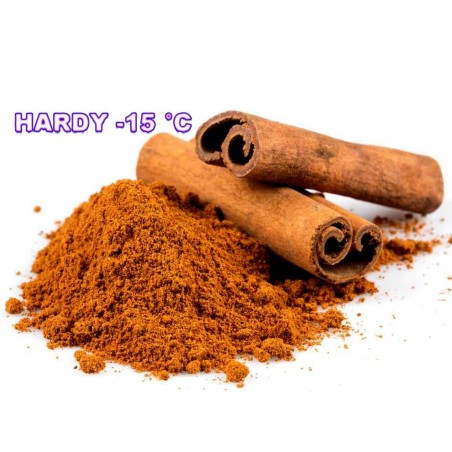
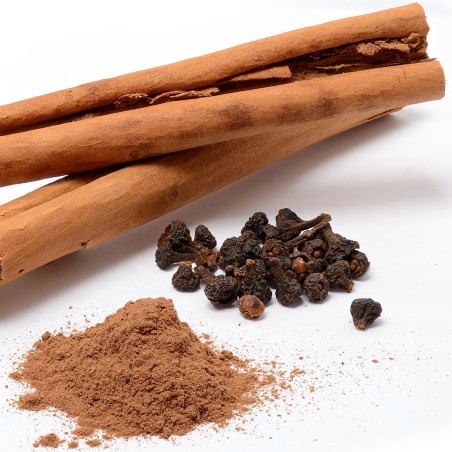
Cinnamon (sɪnəmən SIN-ə-mən) is a spice obtained from the inner bark of several tree species from the genus Cinnamomum. Cinnamon is used mainly as an aromatic condiment and flavoring additive in a wide variety of cuisines, sweet and savoury dishes, breakfast cereals, snackfoods, and traditional foods. The aroma and flavor of cinnamon derive from its essential oil and principal component, cinnamaldehyde, as well as numerous other constituents, including eugenol.
The term "cinnamon" also refers to its mid-brown colour. Cinnamon is the name for several species of trees and the commercial spice products that some of them produce. All are members of the genus Cinnamomum in the family Lauraceae.[1] Only a few Cinnamomum species are grown commercially for spice. Cinnamomum verum is sometimes considered to be "true cinnamon", but most cinnamon in international commerce is derived from related species, also referred to as "cassia".
The English word "cinnamon", attested in English since the 15th century, derives from the Greek κιννάμωμον kinnámōmon (later kínnamon), via Latin and medieval French intermediate forms. The Greek was borrowed from a Phoenician word, which was similar to the related Hebrew קינמון (qinnamon).
The name "cassia", first recorded in English around AD 1000, was borrowed via Latin and ultimately derives from Hebrew q'tsīʿāh, a form of the verb qātsaʿ, "to strip off bark".
Early Modern English also used the names canel and canella, similar to the current names of cinnamon in several other European languages, which are derived from the Latin word cannella, a diminutive of canna, "tube", from the way the bark curls up as it dries.
Ancient history
Cinnamon has been known from remote antiquity. It was imported to Egypt as early as 2000 BCE, but those who report it had come from China confuse it with cassia.[3] Cinnamon was so highly prized among ancient nations that it was regarded as a gift fit for monarchs and even for a god; a fine inscription records the gift of cinnamon and cassia to the temple of Apollo at Miletus.[7] Though its source was kept mysterious in the Mediterranean world for centuries by the middlemen who handled the spice trade, to protect their monopoly as suppliers, cinnamon is native to India, Sri Lanka, Bangladesh, and Myanmar.
The first Greek reference to kasia is found in a poem by Sappho in the seventh century BCE. According to Herodotus, both cinnamon and cassia grew in Arabia, together with incense, myrrh, and labdanum, and were guarded by winged serpents.
Egyptian recipes for kyphi, an aromatic used for burning, included cinnamon and cassia from Hellenistic times onward. The gifts of Hellenistic rulers to temples sometimes included cassia and cinnamon. In ancient Egypt, cinnamon was used to embalm mummies.
Cinnamon was brought around the Arabian peninsula on "rafts without rudders or sails or oars", taking advantage of the winter trade winds.[10] Pliny the Elder also mentions cassia as a flavouring agent for wine.
According to Pliny the Elder, a Roman pound (327 grams (11.5 oz)) of cassia, cinnamon, or serichatum cost up to 300 denarii, the wage of ten months' labour. Diocletian's Edict on Maximum Prices[12] from 301 AD gives a price of 125 denarii for a pound of cassia, while an agricultural labourer earned 25 denarii per day. Cinnamon was too expensive to be commonly used on funeral pyres in Rome, but the Emperor Nero is said to have burned a year's worth of the city's supply at the funeral for his wife Poppaea Sabina in AD 65.
Malabathrum leaves (folia) were used in cooking and for distilling an oil used in a caraway sauce for oysters by the Roman gourmet Gaius Gavius Apicius.[14] Malabathrum is among the spices that, according to Apicius, any good kitchen should contain.
Middle Ages
Through the Middle Ages, the source of cinnamon was a mystery to the Western world. From reading Latin writers who quoted Herodotus, Europeans had learned that cinnamon came up the Red Sea to the trading ports of Egypt, but where it came from was less than clear. When the Sieur de Joinville accompanied his king to Egypt on crusade in 1248, he reported – and believed – what he had been told: that cinnamon was fished up in nets at the source of the Nile out at the edge of the world (i.e., Ethiopia). Marco Polo avoided precision on the topic.[15] Herodotus and other authors named Arabia as the source of cinnamon: they recounted that giant cinnamon birds collected the cinnamon sticks from an unknown land where the cinnamon trees grew and used them to construct their nests, and that the Arabs employed a trick to obtain the sticks. Pliny the Elder wrote in the first century that traders had made this up to charge more, but the story remained current in Byzantium as late as 1310.
The first mention that the spice grew in Sri Lanka was in Zakariya al-Qazwini's Athar al-bilad wa-akhbar al-‘ibad ("Monument of Places and History of God's Bondsmen") about 1270.[16] This was followed shortly thereafter by John of Montecorvino in a letter of about 1292.
Indonesian rafts transported cinnamon directly from the Moluccas to East Africa (see also Rhapta), where local traders then carried it north[18][19][20] to Alexandria in Egypt. Venetian traders from Italy held a monopoly on the spice trade in Europe, distributing cinnamon from Alexandria. The disruption of this trade by the rise of other Mediterranean powers, such as the Mamluk sultans and the Ottoman Empire, was one of many factors that led Europeans to search more widely for other routes to Asia.
Early modern period
During the 1500s, Ferdinand Magellan was searching for spices on behalf of Spain, and in the Philippines found Cinnamomum mindanaense which was closely related to C. zeylanicum, the cinnamon found in Sri Lanka. This cinnamon eventually competed with Sri Lankan cinnamon, which was controlled by the Portuguese.
In 1638, Dutch traders established a trading post in Sri Lanka, took control of the manufactories by 1640, and expelled the remaining Portuguese by 1658. "The shores of the island are full of it," a Dutch captain reported, "and it is the best in all the Orient. When one is downwind of the island, one can still smell cinnamon eight leagues out to sea." [22]:15 The Dutch East India Company continued to overhaul the methods of harvesting in the wild and eventually began to cultivate its own trees.
In 1767, Lord Brown of the British East India Company established Anjarakkandy Cinnamon Estate near Anjarakkandy in the Cannanore district of Kerala; it became Asia's largest cinnamon estate. The British took control of Ceylon from the Dutch in 1796.
Cultivation
Cinnamon is an evergreen tree characterized by oval-shaped leaves, thick bark, and a berry fruit. When harvesting the spice, the bark and leaves are the primary parts of the plant used.[9] Cinnamon is cultivated by growing the tree for two years, then coppicing it, i.e., cutting the stems at ground level. The following year, about a dozen new shoots form from the roots, replacing those that were cut. A number of pests such as Colletotrichum gloeosporioides, Diplodia spp., and Phytophthora cinnamomi (stripe canker) can affect the growing plants.
The stems must be processed immediately after harvesting while the inner bark is still wet. The cut stems are processed by scraping off the outer bark, then beating the branch evenly with a hammer to loosen the inner bark, which is then pried off in long rolls. Only 0.5 mm (0.02 in) of the inner bark is used;[citation needed] the outer, woody portion is discarded, leaving metre-long cinnamon strips that curl into rolls ("quills") on drying. The processed bark dries completely in four to six hours, provided it is in a well-ventilated and relatively warm environment. Once dry, the bark is cut into 5- to 10-cm (2- to 4-in) lengths for sale. A less than ideal drying environment encourages the proliferation of pests in the bark, which may then require treatment by fumigation. Fumigated bark is not considered to be of the same premium quality as untreated bark.
Production
Indonesia and China contribute 76% of the world's production of cinnamon. In 2014, global production of cinnamon was 213,678 tonnes, with four countries combining for 99% of the world total: Indonesia (43%), China (33%), Vietnam (15%), and Sri Lanka (8%).
Food uses
Cinnamon bark is used as a spice. It is principally employed in cookery as a condiment and flavouring material. It is used in the preparation of chocolate, especially in Mexico. Cinnamon is often used in savoury dishes of chicken and lamb. In the United States, cinnamon and sugar are often used to flavour cereals, bread-based dishes, such as toast, and fruits, especially apples; a cinnamon-sugar mixture is sold separately for such purposes. It is also used in Turkish cuisine for both sweet and savoury dishes. Cinnamon can also be used in pickling and Christmas drinks such as eggnog. Cinnamon powder has long been an important spice in enhancing the flavour of Persian cuisine, used in a variety of thick soups, drinks, and sweets.
Nutrition
Ground cinnamon is composed of around 11% water, 81% carbohydrates (including 53% dietary fiber), 4% protein, and 1% fat (table). In a 100 gram reference amount (100 g allows comparison to other foods and spices; typical serving size is one teaspoon or 2.6 grams),[31] ground cinnamon is a rich source (20% of more of the Daily Value, DV) of vitamin K, calcium and iron, while providing moderate amounts (10 to 19% DV) of vitamin B6, vitamin E, magnesium, and zinc (table).
Flavour, aroma, and taste
The flavour of cinnamon is due to an aromatic essential oil that makes up 0.5 to 1% of its composition. This essential oil is prepared by roughly pounding the bark, macerating it in sea water, and then quickly distilling the whole. It is of a golden-yellow colour, with the characteristic odour of cinnamon and a very hot aromatic taste. The pungent taste and scent come from cinnamaldehyde (about 90% of the essential oil from the bark) and, by reaction with oxygen as it ages, it darkens in colour and forms resinous compounds.
Cinnamon constituents include some 80 compounds,[33] including eugenol found in the oil from leaves or bark of cinnamon trees.
Alcohol flavourant
Cinnamon is a popular flavouring in numerous alcoholic beverages,[35][36] such as Fireball Cinnamon Whisky.
Cinnamon brandy concoctions, called "cinnamon liqueur" and made with distilled alcohol, are popular in parts of Greece. In Europe, popular examples of such beverages are Maiwein (white wine with woodruff) and Żubrówka (vodka flavoured with bison grass).
Traditional medicine
Cinnamon has a long history of use in traditional medicine. It has been tested in a variety of clinical conditions, such as bronchitis or diabetes, but there is no scientific evidence that consuming cinnamon has any health benefits.
We verzenden wereldwijd vanuit de Europese Unie per aangetekende luchtpost met handtekeningbevestiging bij bezorging.
📦Uw bestelling volgen Log in op je account en navigeer naarBestelgeschiedenis > Details om uw trackingnummer te vinden.
Je ontvangt e-mailmeldingen voor elke fase van je bestelling. Als je deze berichten niet ziet, controleer dan je map Spam/Ongewenste e-mail of neem contact op met je e-mailprovider. Als alternatief kun je online zoeken naar hoe je e-mails van een afzender kunt deblokkeren.
ONZE E-MAILDIENST WERKT
U ontvangt e-mailmeldingen voor elke fase van uw bestelling. Als u deze berichten niet ziet, controleer dan uw map Spam/Ongewenste e-mail of neem contact op met uw e-mailprovider.
📧Hoe u ervoor zorgt dat e-mails van onze webshop altijd in uw Gmail terechtkomenof een andere e-mailvan de providerIn de inbox en niet als spam gemarkeerd of geblokkeerd:
Voeg de Afzender toe aan de contacten van uw Google-account of van een andere e-mailprovider. We kunnen u niet helpen als uw instellingen er niet zo uitzien. Neem contact op met uw e-mailprovider voor hulp.
Stap 1: Open Gmail en zoek een e-mail van ons xxxxxxxxxxxx@xxx.com Probeer ons niet rechtstreeks een e-mail naar dit adres te sturen; we zullen die niet ontvangen. Elk contact verloopt uitsluitend via het contactformulier in onze online shop! Als je onze e-mail niet kunt vinden, is deze mogelijk geblokkeerd. Ga in dat geval verder met Stap 4 hieronder.
Stap 2: Beweeg de muisaanwijzer over de naam van de afzender of het e-mailadres bovenaan de e-mail.
Stap 3Klik op het pictogram "Toevoegen aan contacten" (het pictogram van een klein persoonnetje).
Dit helpt Gmail ons te herkennen als een vertrouwde afzender, zodat onze e-mails rechtstreeks in je inbox terechtkomen en niet in de spam.
Maak een filter om te voorkomen dat e-mails als spam worden gemarkeerd of geblokkeerd
Stap 1: Open Gmail en klik op het tandwielpictogram rechtsboven, selecteer vervolgens "Alle instellingen bekijken".
Stap 2: Ga naar het tabblad "Filters en geblokkeerde adressen".
Stap 3: Klik op "Maak een nieuw filter aan".
Stap 4: Voer in het veld "From" het e-mailadres in dat u op de witte lijst wilt zetten (e.g., het e-mailadres van onze winkel).
Stap 5: Klik op "Filter maken".
Stap 6: Vink in het volgende venster het vakje met het label "Nooit naar Spam sturen" aan.
Stap 7: Klik op "Filter maken" om op te slaan.
Dit zorgt ervoor dat onze e-mails altijd in uw inbox terechtkomen en niet per ongeluk als spam worden gemarkeerd of geblokkeerd.
Volg uw pakket via:
Aftership
17Track
Posta.hr (voor trackingnummers zoals RGxxxxxxHR)
⚠️Belangrijke mededelingen
Contant bij aflevering isNIETBeschikbaar.
Geef bij het bestellen altijd een geldig mobiel nummer met landcode op (e.g., +365 456 7686 576).
Beveel niet om P.O. Dozen, of als u niet thuis kunt zijn om voor het pakket te tekenen, mogen pakketten niet bij buren worden achtergelaten.
Als een pakket gestuurd naar een P.O. Als de doos verloren is gegaan of niet is afgeleverd, wordt er geen terugbetaling verleend.
⚖️Verantwoordelijkheid van de klant voor naleving van wet- en regelgeving De klant is verantwoordelijk ervoor te zorgen dat het product legaal in hun land kan worden geïmporteerd, inclusief het naleven van alle importvoorschriften, het verkrijgen van de benodigde vergunningen en het betalen van toepasselijke douaneheffingen, belastingen en andere kosten. Controleer alstublieft uw lokale wetgeving voordat u bestelt om eventuele problemen met de douane of levering te voorkomen.
📦Verloren, Geretourneerde & Opnieuw Verzonden Pakketten
Brazilië & Mexico Klanten:We kunnen geen restitutie geven voor pakketten die door de douane verloren zijn gegaan of vernietigd zijn.
Als uw pakket wordt geretourneerd, zullen wij alleen de productkosten terugbetalen — verzendkosten zijn niet restitueerbaar.
Retourporto (€2) en eventuele kosten voor herverzending moeten door de klant worden betaald.
Als een pakket om welke reden dan ook naar ons wordt teruggestuurd, bent u verantwoordelijk voor het betalen van de retourverzendkosten (€2) plus de kosten om het pakket opnieuw te verzenden.
🚚Levering van zending Aangetekende zendingen vereisen een handtekening.
Als uw tracking aangeeft dat het pakket nog bij het postkantoor van vertrek is, is het onderweg — neem contact op met uw plaatselijke postkantoor voor updates.
Helaas kunnen noch wij, noch het postkantoor waarmee je bestelling is verzonden, je helpen met de vraag waar je bestelling is. Wanneer je ziet dat je pakket in je land is,je MOET contact opnemen met je postkantoor met het track & trace-nummerEn bespreek de zaak met hen. Wij verzenden alle bestellingen per officiële staatspost.
Wij zijn niet verantwoordelijk voor levertijden en kunnen zendingen niet voor u volgen.
📅Bezorgopties & Geschatte Tijden
Bezorgoptie
Verwerkingstijd
Notities
Prioritaire levering
Wordt verzonden binnen 1–7 werkdagen
Prioriteert orderverwerking (geen gegarandeerd snellere levering); vertragingen mogelijk tijdens feestdagen (3–10 dagen)
Beveiligde Levering
Wordt verzonden binnen 1–7 werkdagen
Beschikbaar voor bestellingen tot €150; terugbetaling bij verlies
Standaard levering
Verzending binnen 7–10 werkdagen
Goedkoper; tijdens feestdagen kunnen vertragingen optreden (7–14 dagen)
Geschatte levertijd:
Binnen de EU: 3–20 dagen
Wereldwijd: 5–30 dagen
Voorbeelden uit de VS:Geleverd in 13, 17, 19, 22, of 27 dagen.
Opmerking:De levertijden zijn afhankelijk van uw locatie en de lokale postdienst. COVID-19 of de feestdagen kunnen extra vertragingen veroorzaken.
💰Verzendkosten Verzend- en afhandelingskosten worden automatisch berekend bij het afrekenen op basis van het gewicht van het pakket en de bestemming.
⏰Verwerkingstijden voor bestellingen We verwerken of verzenden geen bestellingen op zaterdag of zondag.
💳 Betaalopties
Bankoverschrijving (SEPA / IBAN / SWIFT-BIC) Vermeld uw bestelreferentie in de betalingsomschrijving (e.g., "SGS-19811702"). Bestellingen zonder betaling binnen 7 dagen worden automatisch geannuleerd.
PayPal Betalingen worden alleen in euro's geaccepteerd. Selecteer alstublieft euro's tijdens het afrekenen.
Kaartbetaling We accepteren Visa, MasterCard, American Express, CB, Diners Club, Discover, China UnionPay, JCB, en Discover.
⚠️Transactiekosten Klanten zijn verantwoordelijk voor eventuele bank- of PayPal-transactiekosten. Zorg alstublieft dat de betalingsgegevens correct zijn voor een snellere verwerking van uw bestelling.
📢Slotopmerkingen Controleer voor het plaatsen van uw bestelling altijd onze website op speciale mededelingen, bezorgschema's tijdens feestdagen of specifieke verzendvoorwaarden die uw aankoop kunnen beïnvloeden.
Belangrijke mededeling: Digitale facturen
Om papierafval te verminderen voegen we geen papieren factuur bij je bestelling. Je kunt je factuur op elk gewenst moment eenvoudig downloaden en afdrukken door je Bestelgeschiedenis in je accountprofiel