Cinnamon (sɪnəmən SIN-ə-mən) is a spice obtained from the inner bark of several tree species from the genus Cinnamomum. Cinnamon is used mainly as an aromatic condiment and flavoring additive in a wide
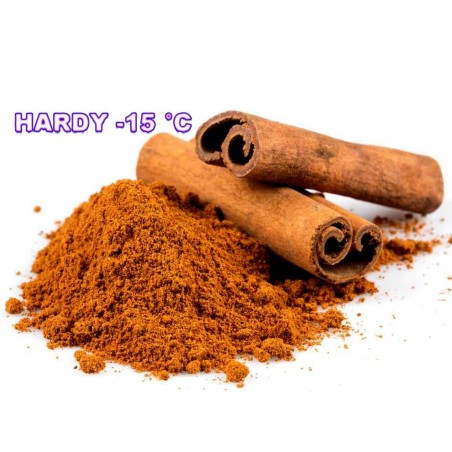
Cinnamon (sɪnəmən SIN-ə-mən) is a spice obtained from the inner bark of several tree species from the genus Cinnamomum. Cinnamon is used mainly as an aromatic condiment and flavoring additive in a wide variety of cuisines, sweet and savoury dishes, breakfast cereals, snackfoods, and traditional foods. The aroma and flavor of cinnamon derive from its essential oil and principal component, cinnamaldehyde, as well as numerous other constituents, including eugenol.
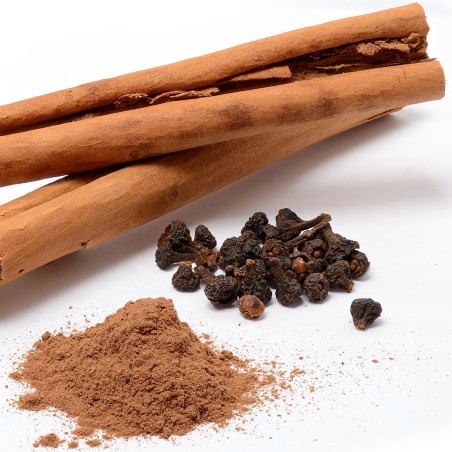
The term "cinnamon" also refers to its mid-brown colour. Cinnamon is the name for several species of trees and the commercial spice products that some of them produce. All are members of the genus Cinnamomum in the family Lauraceae.[1] Only a few Cinnamomum species are grown commercially for spice. Cinnamomum verum is sometimes considered to be "true cinnamon", but most cinnamon in international commerce is derived from related species, also referred to as "cassia".
The English word "cinnamon", attested in English since the 15th century, derives from the Greek κιννάμωμον kinnámōmon (later kínnamon), via Latin and medieval French intermediate forms. The Greek was borrowed from a Phoenician word, which was similar to the related Hebrew קינמון (qinnamon).
The name "cassia", first recorded in English around AD 1000, was borrowed via Latin and ultimately derives from Hebrew q'tsīʿāh, a form of the verb qātsaʿ, "to strip off bark".
Early Modern English also used the names canel and canella, similar to the current names of cinnamon in several other European languages, which are derived from the Latin word cannella, a diminutive of canna, "tube", from the way the bark curls up as it dries.
Ancient history
Cinnamon has been known from remote antiquity. It was imported to Egypt as early as 2000 BCE, but those who report it had come from China confuse it with cassia.[3] Cinnamon was so highly prized among ancient nations that it was regarded as a gift fit for monarchs and even for a god; a fine inscription records the gift of cinnamon and cassia to the temple of Apollo at Miletus.[7] Though its source was kept mysterious in the Mediterranean world for centuries by the middlemen who handled the spice trade, to protect their monopoly as suppliers, cinnamon is native to India, Sri Lanka, Bangladesh, and Myanmar.
The first Greek reference to kasia is found in a poem by Sappho in the seventh century BCE. According to Herodotus, both cinnamon and cassia grew in Arabia, together with incense, myrrh, and labdanum, and were guarded by winged serpents.
Egyptian recipes for kyphi, an aromatic used for burning, included cinnamon and cassia from Hellenistic times onward. The gifts of Hellenistic rulers to temples sometimes included cassia and cinnamon. In ancient Egypt, cinnamon was used to embalm mummies.
Cinnamon was brought around the Arabian peninsula on "rafts without rudders or sails or oars", taking advantage of the winter trade winds.[10] Pliny the Elder also mentions cassia as a flavouring agent for wine.
According to Pliny the Elder, a Roman pound (327 grams (11.5 oz)) of cassia, cinnamon, or serichatum cost up to 300 denarii, the wage of ten months' labour. Diocletian's Edict on Maximum Prices[12] from 301 AD gives a price of 125 denarii for a pound of cassia, while an agricultural labourer earned 25 denarii per day. Cinnamon was too expensive to be commonly used on funeral pyres in Rome, but the Emperor Nero is said to have burned a year's worth of the city's supply at the funeral for his wife Poppaea Sabina in AD 65.
Malabathrum leaves (folia) were used in cooking and for distilling an oil used in a caraway sauce for oysters by the Roman gourmet Gaius Gavius Apicius.[14] Malabathrum is among the spices that, according to Apicius, any good kitchen should contain.
Middle Ages
Through the Middle Ages, the source of cinnamon was a mystery to the Western world. From reading Latin writers who quoted Herodotus, Europeans had learned that cinnamon came up the Red Sea to the trading ports of Egypt, but where it came from was less than clear. When the Sieur de Joinville accompanied his king to Egypt on crusade in 1248, he reported – and believed – what he had been told: that cinnamon was fished up in nets at the source of the Nile out at the edge of the world (i.e., Ethiopia). Marco Polo avoided precision on the topic.[15] Herodotus and other authors named Arabia as the source of cinnamon: they recounted that giant cinnamon birds collected the cinnamon sticks from an unknown land where the cinnamon trees grew and used them to construct their nests, and that the Arabs employed a trick to obtain the sticks. Pliny the Elder wrote in the first century that traders had made this up to charge more, but the story remained current in Byzantium as late as 1310.
The first mention that the spice grew in Sri Lanka was in Zakariya al-Qazwini's Athar al-bilad wa-akhbar al-‘ibad ("Monument of Places and History of God's Bondsmen") about 1270.[16] This was followed shortly thereafter by John of Montecorvino in a letter of about 1292.
Indonesian rafts transported cinnamon directly from the Moluccas to East Africa (see also Rhapta), where local traders then carried it north[18][19][20] to Alexandria in Egypt. Venetian traders from Italy held a monopoly on the spice trade in Europe, distributing cinnamon from Alexandria. The disruption of this trade by the rise of other Mediterranean powers, such as the Mamluk sultans and the Ottoman Empire, was one of many factors that led Europeans to search more widely for other routes to Asia.
Early modern period
During the 1500s, Ferdinand Magellan was searching for spices on behalf of Spain, and in the Philippines found Cinnamomum mindanaense which was closely related to C. zeylanicum, the cinnamon found in Sri Lanka. This cinnamon eventually competed with Sri Lankan cinnamon, which was controlled by the Portuguese.
In 1638, Dutch traders established a trading post in Sri Lanka, took control of the manufactories by 1640, and expelled the remaining Portuguese by 1658. "The shores of the island are full of it," a Dutch captain reported, "and it is the best in all the Orient. When one is downwind of the island, one can still smell cinnamon eight leagues out to sea." [22]:15 The Dutch East India Company continued to overhaul the methods of harvesting in the wild and eventually began to cultivate its own trees.
In 1767, Lord Brown of the British East India Company established Anjarakkandy Cinnamon Estate near Anjarakkandy in the Cannanore district of Kerala; it became Asia's largest cinnamon estate. The British took control of Ceylon from the Dutch in 1796.
Cultivation
Cinnamon is an evergreen tree characterized by oval-shaped leaves, thick bark, and a berry fruit. When harvesting the spice, the bark and leaves are the primary parts of the plant used.[9] Cinnamon is cultivated by growing the tree for two years, then coppicing it, i.e., cutting the stems at ground level. The following year, about a dozen new shoots form from the roots, replacing those that were cut. A number of pests such as Colletotrichum gloeosporioides, Diplodia spp., and Phytophthora cinnamomi (stripe canker) can affect the growing plants.
The stems must be processed immediately after harvesting while the inner bark is still wet. The cut stems are processed by scraping off the outer bark, then beating the branch evenly with a hammer to loosen the inner bark, which is then pried off in long rolls. Only 0.5 mm (0.02 in) of the inner bark is used;[citation needed] the outer, woody portion is discarded, leaving metre-long cinnamon strips that curl into rolls ("quills") on drying. The processed bark dries completely in four to six hours, provided it is in a well-ventilated and relatively warm environment. Once dry, the bark is cut into 5- to 10-cm (2- to 4-in) lengths for sale. A less than ideal drying environment encourages the proliferation of pests in the bark, which may then require treatment by fumigation. Fumigated bark is not considered to be of the same premium quality as untreated bark.
Production
Indonesia and China contribute 76% of the world's production of cinnamon. In 2014, global production of cinnamon was 213,678 tonnes, with four countries combining for 99% of the world total: Indonesia (43%), China (33%), Vietnam (15%), and Sri Lanka (8%).
Food uses
Cinnamon bark is used as a spice. It is principally employed in cookery as a condiment and flavouring material. It is used in the preparation of chocolate, especially in Mexico. Cinnamon is often used in savoury dishes of chicken and lamb. In the United States, cinnamon and sugar are often used to flavour cereals, bread-based dishes, such as toast, and fruits, especially apples; a cinnamon-sugar mixture is sold separately for such purposes. It is also used in Turkish cuisine for both sweet and savoury dishes. Cinnamon can also be used in pickling and Christmas drinks such as eggnog. Cinnamon powder has long been an important spice in enhancing the flavour of Persian cuisine, used in a variety of thick soups, drinks, and sweets.
Nutrition
Ground cinnamon is composed of around 11% water, 81% carbohydrates (including 53% dietary fiber), 4% protein, and 1% fat (table). In a 100 gram reference amount (100 g allows comparison to other foods and spices; typical serving size is one teaspoon or 2.6 grams),[31] ground cinnamon is a rich source (20% of more of the Daily Value, DV) of vitamin K, calcium and iron, while providing moderate amounts (10 to 19% DV) of vitamin B6, vitamin E, magnesium, and zinc (table).
Flavour, aroma, and taste
The flavour of cinnamon is due to an aromatic essential oil that makes up 0.5 to 1% of its composition. This essential oil is prepared by roughly pounding the bark, macerating it in sea water, and then quickly distilling the whole. It is of a golden-yellow colour, with the characteristic odour of cinnamon and a very hot aromatic taste. The pungent taste and scent come from cinnamaldehyde (about 90% of the essential oil from the bark) and, by reaction with oxygen as it ages, it darkens in colour and forms resinous compounds.
Cinnamon constituents include some 80 compounds,[33] including eugenol found in the oil from leaves or bark of cinnamon trees.
Alcohol flavourant
Cinnamon is a popular flavouring in numerous alcoholic beverages,[35][36] such as Fireball Cinnamon Whisky.
Cinnamon brandy concoctions, called "cinnamon liqueur" and made with distilled alcohol, are popular in parts of Greece. In Europe, popular examples of such beverages are Maiwein (white wine with woodruff) and Żubrówka (vodka flavoured with bison grass).
Traditional medicine
Cinnamon has a long history of use in traditional medicine. It has been tested in a variety of clinical conditions, such as bronchitis or diabetes, but there is no scientific evidence that consuming cinnamon has any health benefits.
Z Evropské unie odesíláme do celého světa registrovanou leteckou poštou s potvrzením podpisu při doručení.
📦Sledování vaší objednávky Přihlaste se do svého účtu a přejděte naHistorie objednávek > Podrobnosti najít vaše sledovací číslo.
Obdržíte e-mailová oznámení o každé fázi vaší objednávky. Pokud tyto zprávy nevidíte, zkontrolujte prosím složku Spam/Nežádaná pošta nebo kontaktujte svého poskytovatele e-mailu. Případně vyhledejte na internetu, jak odblokovat e-mailovou adresu odesílatele.
NAŠE E-MAILOVÁ SLUŽBA FUNGUJE
Obdržíte e-mailová upozornění v každé fázi vaší objednávky. Pokud tyto zprávy nevidíte, zkontrolujte prosím složku Spam/Nevyžádaná pošta nebo kontaktujte svého poskytovatele e-mailu.
📧Jak zajistit, aby e-maily z našeho online obchodu vždy dorazily do vašeho Gmailunebo jakýkoli jiný e-mailposkytovateleJsou v doručené poště a nejsou označeny jako nevyžádaná pošta nebo zablokovány:
Přidejte Odesílatele do kontaktů ve svém účtu Google nebo u jakéhokoli jiného poskytovatele e-mailu. Nemůžeme vám pomoci, pokud vaše nastavení není takové. Obraťte se na svého poskytovatele e-mailu pro pomoc.
Krok 1: Otevřete Gmail a najděte e-mail od nás xxxxxxxxxxxx@xxx.com Nezkoušejte nám posílat e-mail přímo na tuto adresu; nedostaneme ho. Veškerý kontakt probíhá výhradně přes kontaktní formulář v našem online obchodě! Pokud nemůžete najít náš e-mail, mohl být zablokován. V tom případě postupujte podle kroku 4 níže.
Krok 2: Umístěte kurzor myši nad jméno odesílatele nebo e-mailovou adresu v horní části e-mailu.
Krok 3: Klikněte na ikonu „Přidat do kontaktů“ (malá ikona osoby).
To pomůže Gmailu rozpoznat nás jako důvěryhodného odesílatele, takže naše e-maily půjdou přímo do vaší doručené pošty a ne do spamu.
Vytvořte filtr, který zabrání tomu, aby byly e-maily označeny jako spam nebo zablokovány.
Krok 1: Otevřete Gmail a klikněte na ikonu ozubeného kola v pravém horním rohu, poté vyberte "Zobrazit všechna nastavení".
Krok 2: Přejděte na kartu "Filtry a zablokované adresy".
Krok 3: Klikněte na "Vytvořit nový filtr".
Krok 4: Do pole "From" zadejte e-mailovou adresu, kterou chcete přidat na bílou listinu (e.g., e-mail našeho obchodu).
Krok 5: Klikněte na "Vytvořit filtr".
Krok 6: V dalším okně zaškrtněte políčko označené "Nikdy to neodesílat do spamu".
Krok 7: Klikněte na "Vytvořit filtr" pro uložení.
To zajistí, že naše e-maily vždy dorazí do vaší doručené pošty a nebudou omylem označeny jako spam ani zablokovány.
Sledujte svou zásilku pomocí:
Aftership
17Track
Posta.hr (pro sledovací čísla jako RGxxxxxxHR)
⚠️Důležitá oznámení
Platba na dobírku jeNE k dispozici.
Při objednávání vždy uveďte platné mobilní číslo s předvolbou země (e.g., +365 456 7686 576).
Nenařizujte, aby P.O. Krabice, nebo pokud nemůžete být doma, abyste podepsali převzetí balíku, zásilky nelze zanechat u sousedů.
Pokud je balíček zaslaný na P.O. Pokud je zásilka ztracena nebo nedoručena, nebude poskytnuto vrácení peněz.
⚖️Zodpovědnost zákazníka za dodržování právních předpisů Zákazník je odpovědný za zajištění, že je dovoz produktu do své země legální, včetně dodržení všech dovozních předpisů, získání nezbytných povolení a zaplacení příslušných celních poplatků, daní a dalších poplatků. Před objednáním si prosím ověřte místní právní předpisy, abyste se vyhnuli problémům s celním odbavením nebo doručením.
Pokud vaše sledování ukazuje, že je balíček stále na poště odesílatele, je na cestě — kontaktujte místní pobočku pošty pro aktuální informace.
Bohužel my ani pošta, přes kterou byla vaše objednávka odeslána, vám nemůžeme pomoci s tím, kde se vaše objednávka nachází. Jakmile uvidíte, že je vaše zásilka ve vaší zemi,MUSÍTE kontaktovat svou poštu s číslem zásilky a projednejte to s nimi. Všechny objednávky odesíláme oficiální státní poštou.
Neodpovídáme za dodací lhůty a nemůžeme za vás sledovat zásilky.
📅Možnosti doručení & odhadované časy
Možnost doručení
Doba zpracování
Poznámky
Přednostní doručení
Odesíláme během 1–7 pracovních dnů.
Upřednostňuje zpracování objednávek (není zaručeno rychlejší doručení); během svátků mohou nastat zpoždění (3–10 dní)
Zabezpečené doručení
Odesíláme během 1–7 pracovních dnů.
Dostupné pro objednávky do €150; vrácení peněz v případě ztráty
Standardní doručení
Odesíláme do 7–10 pracovních dnů.
Levnější; během svátků mohou nastat zpoždění (7–14 dní)
Odhadovaný čas doručení:
V rámci EU: 3–20 dní
Celosvětově:5–30 dní
Příklady USA:Doručeno za 13, 17, 19, 22 nebo 27 dní.
Poznámka:Doba doručení závisí na vaší poloze a na místním poštovním systému. COVID-19 nebo sváteční období mohou způsobit další zpoždění.
💰Náklady na dopravu Poplatky za dopravu a manipulaci se automaticky vypočítají při dokončení objednávky na základě hmotnosti zásilky a místa doručení.
⏰Provozní doba zpracování objednávek V sobotu a v neděli objednávky nevyřizujeme ani neodesíláme.
💳Možnosti platby
Bankovní převod (SEPA / IBAN / SWIFT-BIC) Do popisu platby uveďte referenci vaší objednávky (e.g., "SGS-19811702"). Objednávky bez platby do 7 dnů budou automaticky zrušeny.
PayPal Platby jsou přijímány pouze v eurech. Prosím vyberte eura při placení.
Platba kartou Akceptujeme Visa, MasterCard, American Express, CB, Diners Club, Discover, China UnionPay, JCB a Discover.
⚠️Transakční poplatky Zákazníci hradí veškeré bankovní nebo PayPal transakční poplatky. Prosím, zajistěte přesné platební údaje pro rychlejší zpracování objednávky.
📢Závěrečné poznámky Před zadáním objednávky si vždy zkontrolujte naše webové stránky kvůli zvláštním oznámením, informacím o provozu během svátků nebo konkrétním přepravním podmínkám, které by mohly ovlivnit váš nákup.
Důležité upozornění: Digitální faktury
Abychom snížili množství papírového odpadu, nepřikládáme k vaší objednávce tištěnou fakturu. Fakturu si můžete kdykoli snadno stáhnout a vytisknout návštěvou vašehoHistorie objednávek v profilu vašeho účtu