Lansium parasiticum, also known as langsat (/ˈlɑːŋsɑːt/) or lanzones, is a species of tree in the Mahogany family. The plant, which originates from western Southeast Asia, bears edible fruit.
Lansium parasiticum, also known as langsat (/ˈlɑːŋsɑːt/) or lanzones, is a species of tree in the Mahogany family. The plant, which originates from western Southeast Asia, bears edible fruit. It is the provincial flower for the Indonesian province of South Sumatra.
The tree is average-sized, reaching 30 meters (98 ft) in height and 75 centimeters (30 in) in diameter. Seedling trees 30 years old planted at 8 x 8-meter spacing can have a height of 10 meters and diameter of 25 cm. The trunk grows in an irregular manner, with its buttress roots showing above ground. The tree's bark is a greyish color, with light and dark spots. Its resin is thick and milk colored.
The pinnately compound leaves are odd-numbered, with thin hair, and 6 to 9 buds at intervals. The buds are long and elliptical, approximately 9 to 21 centimeters (3.5 to 8.3 in) by 5 to 10 centimeters (2.0 to 3.9 in) in size. The upper edge shines, and the leaves themselves have pointed bases and tips. The stems of the buds measure 5 to 12 millimeters (0.20 to 0.47 in).
The flowers are located in inflorescences that grow and hang from large branches or the trunk; the bunches may number up to 5 in one place. They are often branched at their base, measure 10 to 30 centimeters (3.9 to 11.8 in) in size, and have short fur.[3] The flowers are small, with short stems, and have two genders. The sheath is shaped like a five-lobed cup and is colored a greenish-yellow. The corona is egg-shaped and hard, measuring 2 to 3 millimeters (0.079 to 0.118 in) by 4 to 5 millimeters (0.16 to 0.20 in). There is one stamen, measuring 2 millimeters (0.079 in) in length. The top of the stamen is round. The pistil is short and thick.
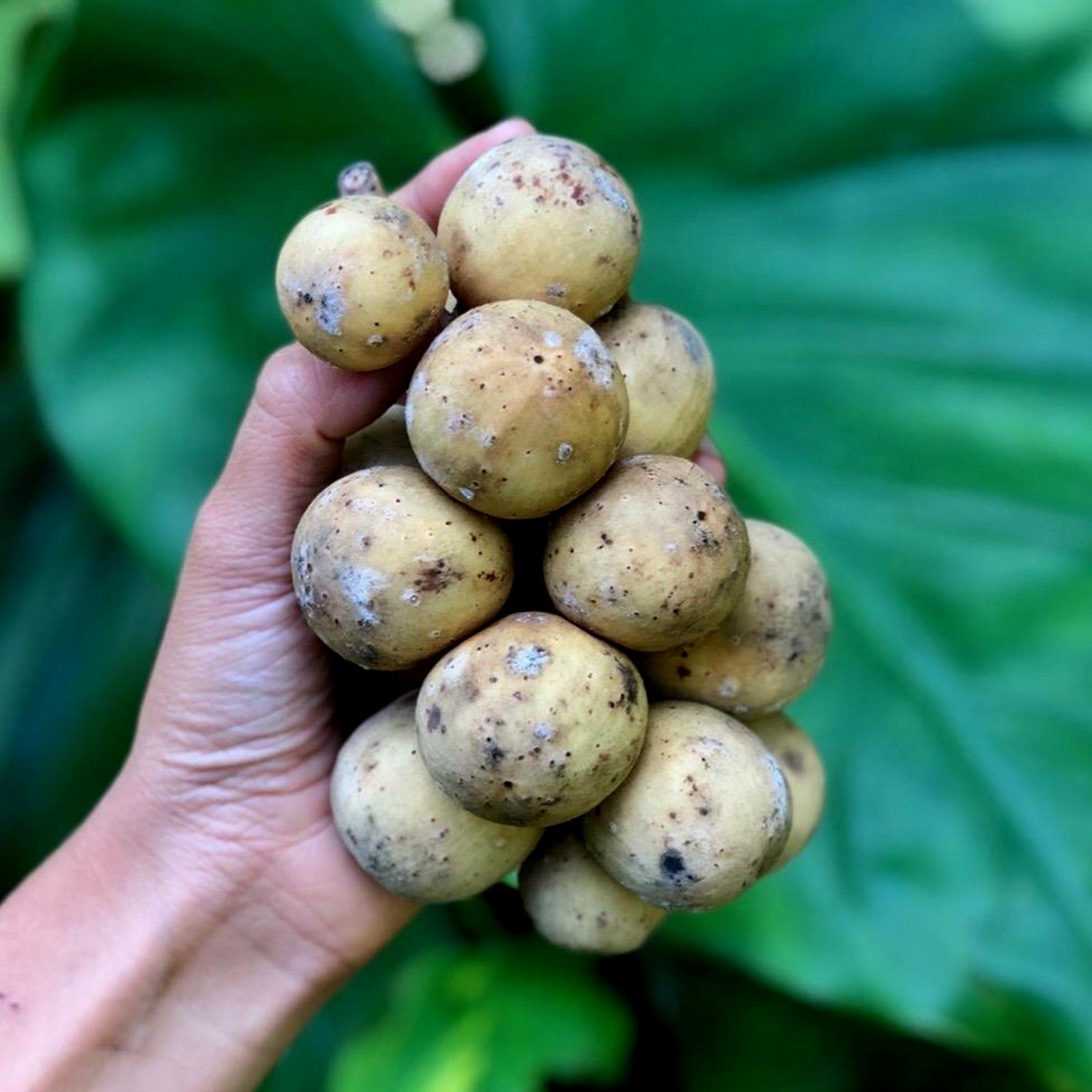
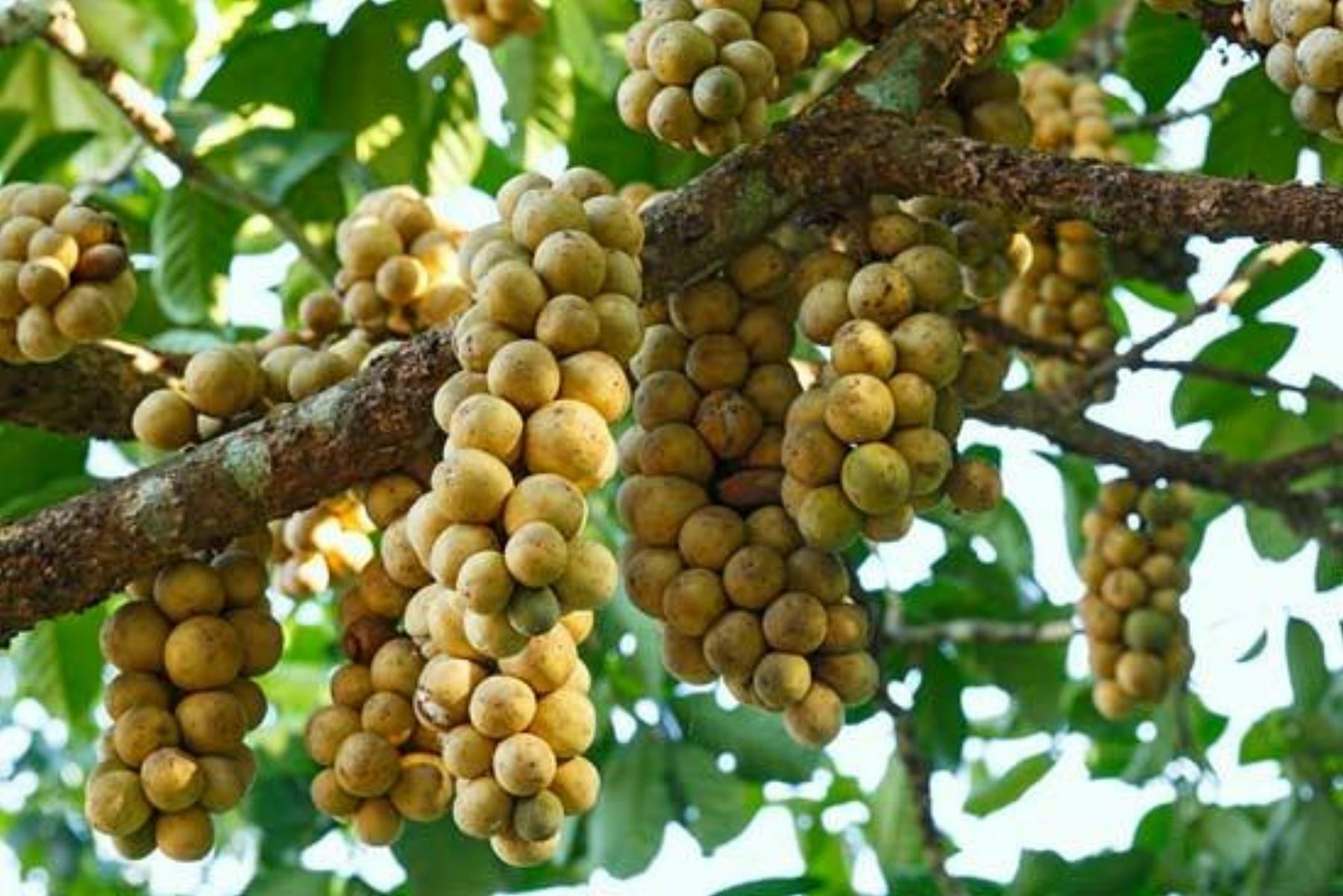
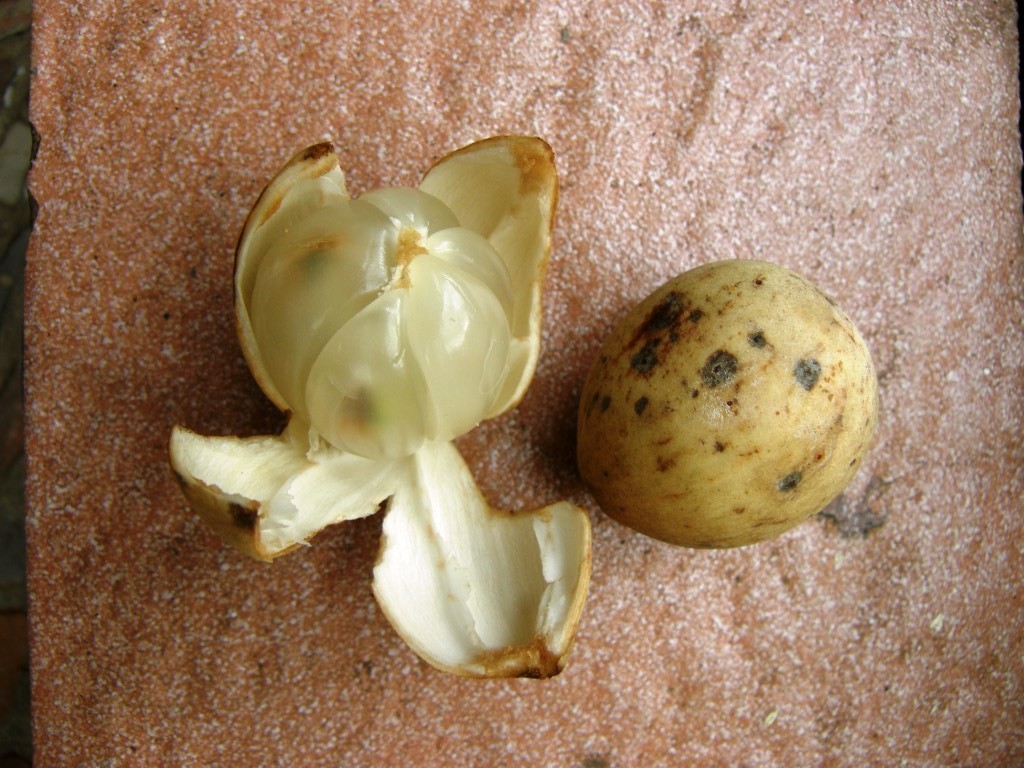
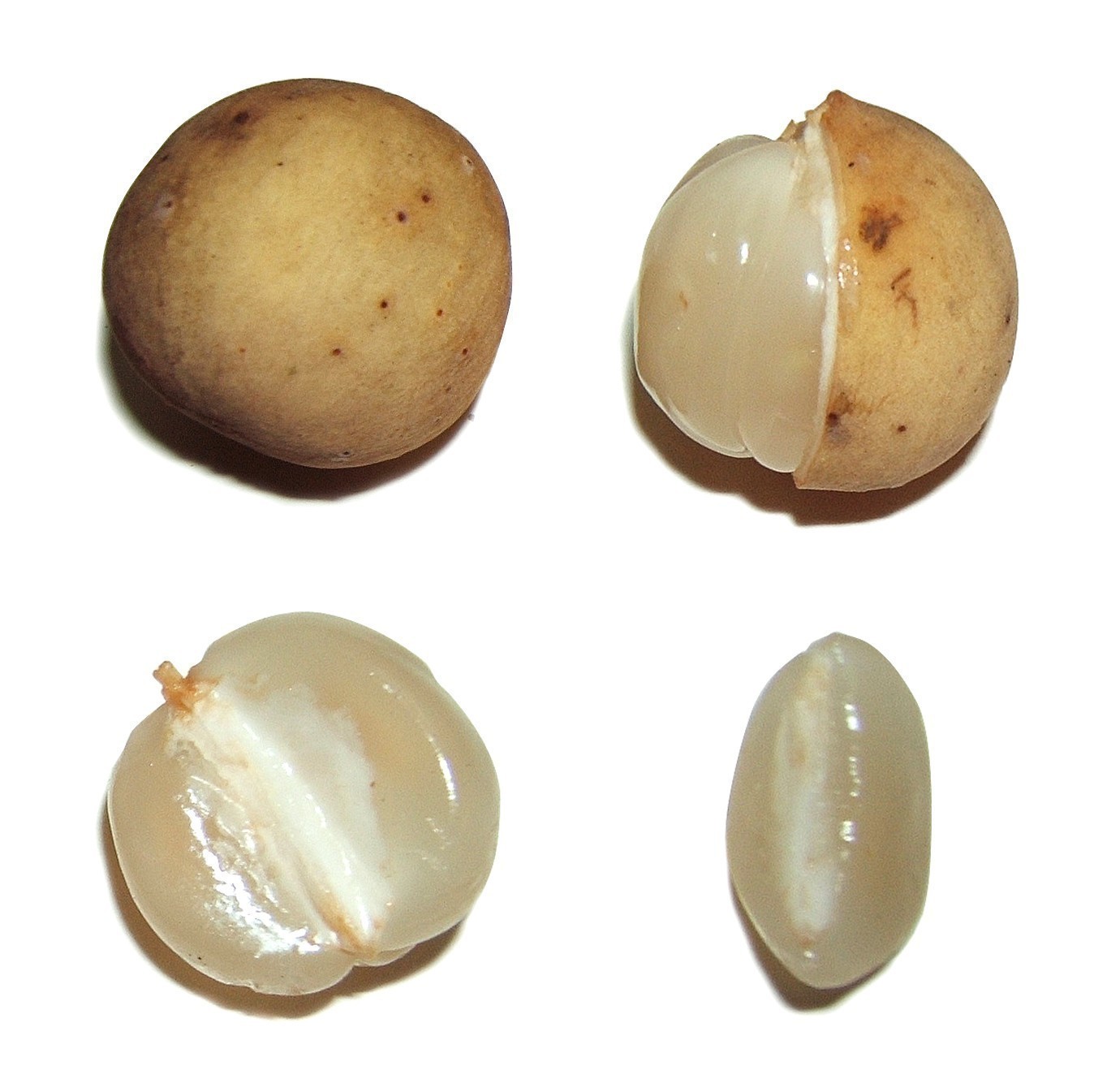
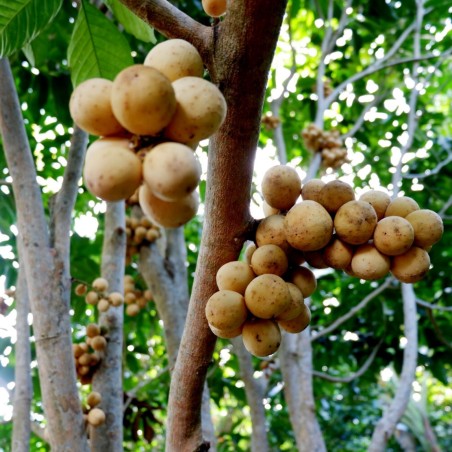
The fruit can be elliptical, ovoid or round, measuring 2 to 7 centimetres (0.79 to 2.76 in) by 1.5 to 5 centimetres (0.59 to 1.97 in) in size. Fruits look much like small potatoes and are borne in clusters similar to grapes. The larger fruits are on the variety known as duku. It is covered by thin, yellow hair giving a slightly fuzzy aspect. The skin thickness varies with the varieties, from 2 millimetres (0.079 in) to approximately 6 millimetres (0.24 in). The fruit contains 1 to 3 seeds, flat, and bitter tasting; the seeds are covered with a thick, clear-white aril that tastes sweet and sour.[2] The taste has been likened to a combination of grape and grapefruit and is considered excellent by most. The sweet juicy flesh contains sucrose, fructose, and glucose.[4] For consumption, cultivars with small or undeveloped seeds and thick aril are preferred.
Uses
L. parasiticum is cultivated mainly for its fruit, which can be eaten raw. The fruit can also be bottled in syrup. The wood is hard, thick, heavy, and resilient, allowing it to be used in the construction of rural houses.
Some parts of the plant are used in making traditional medicine. The bitter seeds can be pounded and mixed with water to make a deworming and ulcer medication. The bark is used to treat dysentery and malaria; the powdered bark can also be used to treat scorpion stings. The fruit's skin is used to treat diarrhea, and in the Philippines the dried skin is burned as a mosquito repellent.
The skin, especially of the langsat variety, can be dried and burned as incense.
The greate producers of Lansium parasiticum are Malaysia, Thailand, the Philippines and Indonesia. The production is mostly for internal consumption, although some is exported to Singapore and Hong Kong.
Cultivars
There are numerous cultivars of L. parasiticum. Overall, there are two main groups of cultivars, those named duku and those named langsat. There are also mixed duku-langsat varieties.
Those called duku generally have a large crown, thick with bright green leaves, with short bunches of few fruit. The individual fruit are large, generally round, and have somewhat thick skin that does not release sap when cooked. The seeds are small, with thick flesh, a sweet scent, and a sweet or sour alin.
Meanwhile, the variant commonly known as langsat generally has thinner trees, with a less dense crown consisting of dark green leaves and stiff branches. The bunches are longer, and each bunch holds between 15 and 25 large, egg-shaped fruit. The skin is thin and releases a white sap when cooked. The flesh is watery and tastes sweet and sour.[2][7] Unlike duku, langsat fruit does not last long after being picked. Three days after being picked, the skin blackens; this does not affect the fruit's taste.
L. domesticum var. aquaeum is distinguished by its hairy leaves, as well as the tightly packed dark yellow fruit on its bunches. The fruit tends to be small, with thin skin and little sap; the skin is difficult to remove. To be eaten, the fruit is bitten and the flesh sucked through the hole created,[2] or rubbed until the skin breaks and the seeds are retrieved. In Indonesia the fruit has several names, including kokosan, pisitan, pijetan, and bijitan.[7] The seeds are relatively large, with thin, sour flesh.
Ecology
L. parasiticum grows well in mixed agroforests. The plant, especially the duku variant, prefers damp, shaded areas. It can be grown in the same agroforest as durian, petai, and jengkol, as well as wood-producing trees.
L. parasiticum is grown from low grounds up to heights of 600 metres (2,000 ft) above sea level, in areas with an average rainfall of 1,500 to 2,500 millimetres (59 to 98 in) a year. The plant can grow and blossom in latosol, yellow podzol, and alluvium.[11] The plant prefers slightly acidic soil with good drainage and rich in mulch. The langsat variant is hardier, and can weather dry seasons with a little shade and water.[2] The plant cannot handle floods.
L. parasiticum generally bears fruit once a year. This period can vary between areas, but blooming is generally after the beginning of the rainy season and fruit production some four months later.
Distribution
Lansium parasiticum was originally native to Southeast Asia. It grows wild in Sumatra forests where a wide and longest river in Indonesia lay across the southern part of Sumatra. The river rises and floods the forest lands for a few months, when it subsides, the flood leaves plenty of fallen leaves and twigs enriching and moistening a large area of the forest bed, resulting in ideal conditions for the plant to grow naturally. Local people will come and harvest it as natural forest produce. They climb up the tree with ripe fruits (after observing it), holding with their hands on the smaller branches and shaking it. Mature fruits will fall easily down to the ground. They will then collect it and transport it on a small boat on a nearby river to the villages and sell it. In a good year a 20-year-old tree can produce 100 kg of fruits, however fruiting is often uneven.
Agriculturally, the tree is grown throughout the entire Southeast asian region, ranging from Southern India to the Philippines for its fruit. In the Philippines, where it is locally referred to as the lanzones or langsa, the plant is grown mostly on the southern parts of the island of Luzon, especially in Paete, Laguna, due to the species' narrow range of conditions favorable to its survival. It is also found in abundance on Northern Mindanao particularly in places as Butuan, Cagayan de Oro, and Camiguin. The Camiguin variety is especially sweet and succulent.
In Indonesia, Langsat is very popular fruit in West Kalimantan (Pontianak, Indonesia), Sulawesi and South Sumatra (also called 'Duku'). In Sarawak, northern Borneo, the name Duku is reserved for the larger-sized varieties of Langsat, near the size of golf balls, claimed sweeter and with less sap in the peel. A variety called Dokong exported to mainland Malaysia from Thailand (this variety is called 'Longkong' Thai: ลองกอง in Thailand) grows tighter in the clusters, giving it a faceted shape, and is preferred by many over the standard Langsat.
Within mainland Asia, the tree is cultivated in Thailand (Thai: ลางสาด, langsat), Cambodia, Vietnam, India, and Malaysia. Outside the region, it has also been successfully transplanted and introduced to Hawaii and Surinam. It grows well in the wetter areas (120 inches/3 meters or more annual rainfall) of Costa Rica, where it is still very rare, having been introduced decades ago by the United Fruit Company. A major hindrance to its acceptance seems to be that it is very slow in bearing, said to take 12 years or more from seed. However, air layering from mature trees, as well as grafting, are said to work well and produce much faster.
We verzenden wereldwijd vanuit de Europese Unie per aangetekende luchtpost met handtekeningbevestiging bij bezorging.
📦Uw bestelling volgen Log in op je account en navigeer naarBestelgeschiedenis > Details om uw trackingnummer te vinden.
Je ontvangt e-mailmeldingen voor elke fase van je bestelling. Als je deze berichten niet ziet, controleer dan je map Spam/Ongewenste e-mail of neem contact op met je e-mailprovider. Als alternatief kun je online zoeken naar hoe je e-mails van een afzender kunt deblokkeren.
ONZE E-MAILDIENST WERKT
U ontvangt e-mailmeldingen voor elke fase van uw bestelling. Als u deze berichten niet ziet, controleer dan uw map Spam/Ongewenste e-mail of neem contact op met uw e-mailprovider.
📧Hoe u ervoor zorgt dat e-mails van onze webshop altijd in uw Gmail terechtkomenof een andere e-mailvan de providerIn de inbox en niet als spam gemarkeerd of geblokkeerd:
Voeg de Afzender toe aan de contacten van uw Google-account of van een andere e-mailprovider. We kunnen u niet helpen als uw instellingen er niet zo uitzien. Neem contact op met uw e-mailprovider voor hulp.
Stap 1: Open Gmail en zoek een e-mail van ons xxxxxxxxxxxx@xxx.com Probeer ons niet rechtstreeks een e-mail naar dit adres te sturen; we zullen die niet ontvangen. Elk contact verloopt uitsluitend via het contactformulier in onze online shop! Als je onze e-mail niet kunt vinden, is deze mogelijk geblokkeerd. Ga in dat geval verder met Stap 4 hieronder.
Stap 2: Beweeg de muisaanwijzer over de naam van de afzender of het e-mailadres bovenaan de e-mail.
Stap 3Klik op het pictogram "Toevoegen aan contacten" (het pictogram van een klein persoonnetje).
Dit helpt Gmail ons te herkennen als een vertrouwde afzender, zodat onze e-mails rechtstreeks in je inbox terechtkomen en niet in de spam.
Maak een filter om te voorkomen dat e-mails als spam worden gemarkeerd of geblokkeerd
Stap 1: Open Gmail en klik op het tandwielpictogram rechtsboven, selecteer vervolgens "Alle instellingen bekijken".
Stap 2: Ga naar het tabblad "Filters en geblokkeerde adressen".
Stap 3: Klik op "Maak een nieuw filter aan".
Stap 4: Voer in het veld "From" het e-mailadres in dat u op de witte lijst wilt zetten (e.g., het e-mailadres van onze winkel).
Stap 5: Klik op "Filter maken".
Stap 6: Vink in het volgende venster het vakje met het label "Nooit naar Spam sturen" aan.
Stap 7: Klik op "Filter maken" om op te slaan.
Dit zorgt ervoor dat onze e-mails altijd in uw inbox terechtkomen en niet per ongeluk als spam worden gemarkeerd of geblokkeerd.
Volg uw pakket via:
Aftership
17Track
Posta.hr (voor trackingnummers zoals RGxxxxxxHR)
⚠️Belangrijke mededelingen
Contant bij aflevering isNIETBeschikbaar.
Geef bij het bestellen altijd een geldig mobiel nummer met landcode op (e.g., +365 456 7686 576).
Beveel niet om P.O. Dozen, of als u niet thuis kunt zijn om voor het pakket te tekenen, mogen pakketten niet bij buren worden achtergelaten.
Als een pakket gestuurd naar een P.O. Als de doos verloren is gegaan of niet is afgeleverd, wordt er geen terugbetaling verleend.
⚖️Verantwoordelijkheid van de klant voor naleving van wet- en regelgeving De klant is verantwoordelijk ervoor te zorgen dat het product legaal in hun land kan worden geïmporteerd, inclusief het naleven van alle importvoorschriften, het verkrijgen van de benodigde vergunningen en het betalen van toepasselijke douaneheffingen, belastingen en andere kosten. Controleer alstublieft uw lokale wetgeving voordat u bestelt om eventuele problemen met de douane of levering te voorkomen.
📦Verloren, Geretourneerde & Opnieuw Verzonden Pakketten
Brazilië & Mexico Klanten:We kunnen geen restitutie geven voor pakketten die door de douane verloren zijn gegaan of vernietigd zijn.
Als uw pakket wordt geretourneerd, zullen wij alleen de productkosten terugbetalen — verzendkosten zijn niet restitueerbaar.
Retourporto (€2) en eventuele kosten voor herverzending moeten door de klant worden betaald.
Als een pakket om welke reden dan ook naar ons wordt teruggestuurd, bent u verantwoordelijk voor het betalen van de retourverzendkosten (€2) plus de kosten om het pakket opnieuw te verzenden.
🚚Levering van zending Aangetekende zendingen vereisen een handtekening.
Als uw tracking aangeeft dat het pakket nog bij het postkantoor van vertrek is, is het onderweg — neem contact op met uw plaatselijke postkantoor voor updates.
Helaas kunnen noch wij, noch het postkantoor waarmee je bestelling is verzonden, je helpen met de vraag waar je bestelling is. Wanneer je ziet dat je pakket in je land is,je MOET contact opnemen met je postkantoor met het track & trace-nummerEn bespreek de zaak met hen. Wij verzenden alle bestellingen per officiële staatspost.
Wij zijn niet verantwoordelijk voor levertijden en kunnen zendingen niet voor u volgen.
📅Bezorgopties & Geschatte Tijden
Bezorgoptie
Verwerkingstijd
Notities
Prioritaire levering
Wordt verzonden binnen 1–7 werkdagen
Prioriteert orderverwerking (geen gegarandeerd snellere levering); vertragingen mogelijk tijdens feestdagen (3–10 dagen)
Beveiligde Levering
Wordt verzonden binnen 1–7 werkdagen
Beschikbaar voor bestellingen tot €150; terugbetaling bij verlies
Standaard levering
Verzending binnen 7–10 werkdagen
Goedkoper; tijdens feestdagen kunnen vertragingen optreden (7–14 dagen)
Geschatte levertijd:
Binnen de EU: 3–20 dagen
Wereldwijd: 5–30 dagen
Voorbeelden uit de VS:Geleverd in 13, 17, 19, 22, of 27 dagen.
Opmerking:De levertijden zijn afhankelijk van uw locatie en de lokale postdienst. COVID-19 of de feestdagen kunnen extra vertragingen veroorzaken.
💰Verzendkosten Verzend- en afhandelingskosten worden automatisch berekend bij het afrekenen op basis van het gewicht van het pakket en de bestemming.
⏰Verwerkingstijden voor bestellingen We verwerken of verzenden geen bestellingen op zaterdag of zondag.
💳 Betaalopties
Bankoverschrijving (SEPA / IBAN / SWIFT-BIC) Vermeld uw bestelreferentie in de betalingsomschrijving (e.g., "SGS-19811702"). Bestellingen zonder betaling binnen 7 dagen worden automatisch geannuleerd.
PayPal Betalingen worden alleen in euro's geaccepteerd. Selecteer alstublieft euro's tijdens het afrekenen.
Kaartbetaling We accepteren Visa, MasterCard, American Express, CB, Diners Club, Discover, China UnionPay, JCB, en Discover.
⚠️Transactiekosten Klanten zijn verantwoordelijk voor eventuele bank- of PayPal-transactiekosten. Zorg alstublieft dat de betalingsgegevens correct zijn voor een snellere verwerking van uw bestelling.
📢Slotopmerkingen Controleer voor het plaatsen van uw bestelling altijd onze website op speciale mededelingen, bezorgschema's tijdens feestdagen of specifieke verzendvoorwaarden die uw aankoop kunnen beïnvloeden.
Belangrijke mededeling: Digitale facturen
Om papierafval te verminderen voegen we geen papieren factuur bij je bestelling. Je kunt je factuur op elk gewenst moment eenvoudig downloaden en afdrukken door je Bestelgeschiedenis in je accountprofiel