Lansium parasiticum, also known as langsat (/ˈlɑːŋsɑːt/) or lanzones, is a species of tree in the Mahogany family. The plant, which originates from western Southeast Asia, bears edible fruit.
Lansium parasiticum, also known as langsat (/ˈlɑːŋsɑːt/) or lanzones, is a species of tree in the Mahogany family. The plant, which originates from western Southeast Asia, bears edible fruit. It is the provincial flower for the Indonesian province of South Sumatra.
The tree is average-sized, reaching 30 meters (98 ft) in height and 75 centimeters (30 in) in diameter. Seedling trees 30 years old planted at 8 x 8-meter spacing can have a height of 10 meters and diameter of 25 cm. The trunk grows in an irregular manner, with its buttress roots showing above ground. The tree's bark is a greyish color, with light and dark spots. Its resin is thick and milk colored.
The pinnately compound leaves are odd-numbered, with thin hair, and 6 to 9 buds at intervals. The buds are long and elliptical, approximately 9 to 21 centimeters (3.5 to 8.3 in) by 5 to 10 centimeters (2.0 to 3.9 in) in size. The upper edge shines, and the leaves themselves have pointed bases and tips. The stems of the buds measure 5 to 12 millimeters (0.20 to 0.47 in).
The flowers are located in inflorescences that grow and hang from large branches or the trunk; the bunches may number up to 5 in one place. They are often branched at their base, measure 10 to 30 centimeters (3.9 to 11.8 in) in size, and have short fur.[3] The flowers are small, with short stems, and have two genders. The sheath is shaped like a five-lobed cup and is colored a greenish-yellow. The corona is egg-shaped and hard, measuring 2 to 3 millimeters (0.079 to 0.118 in) by 4 to 5 millimeters (0.16 to 0.20 in). There is one stamen, measuring 2 millimeters (0.079 in) in length. The top of the stamen is round. The pistil is short and thick.
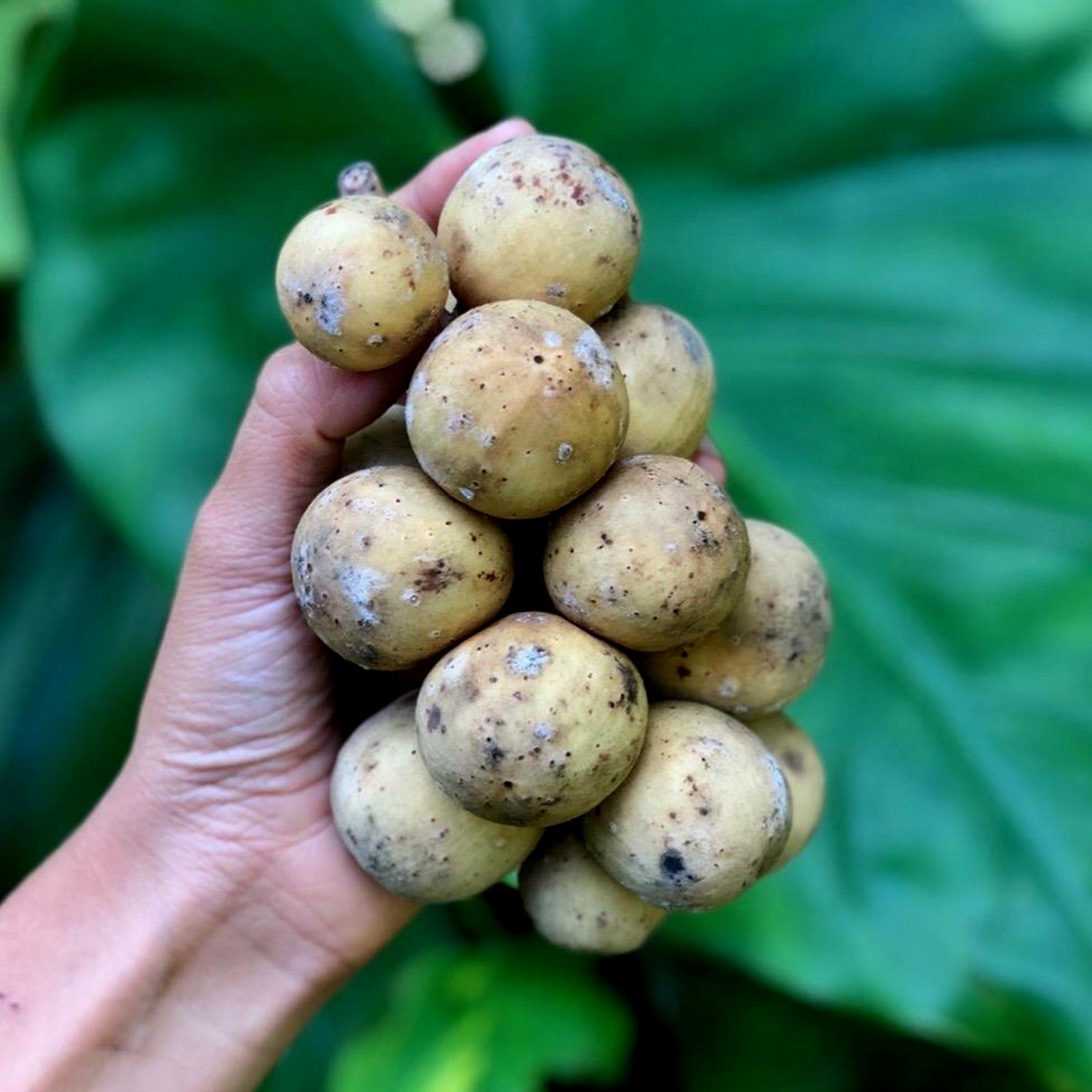
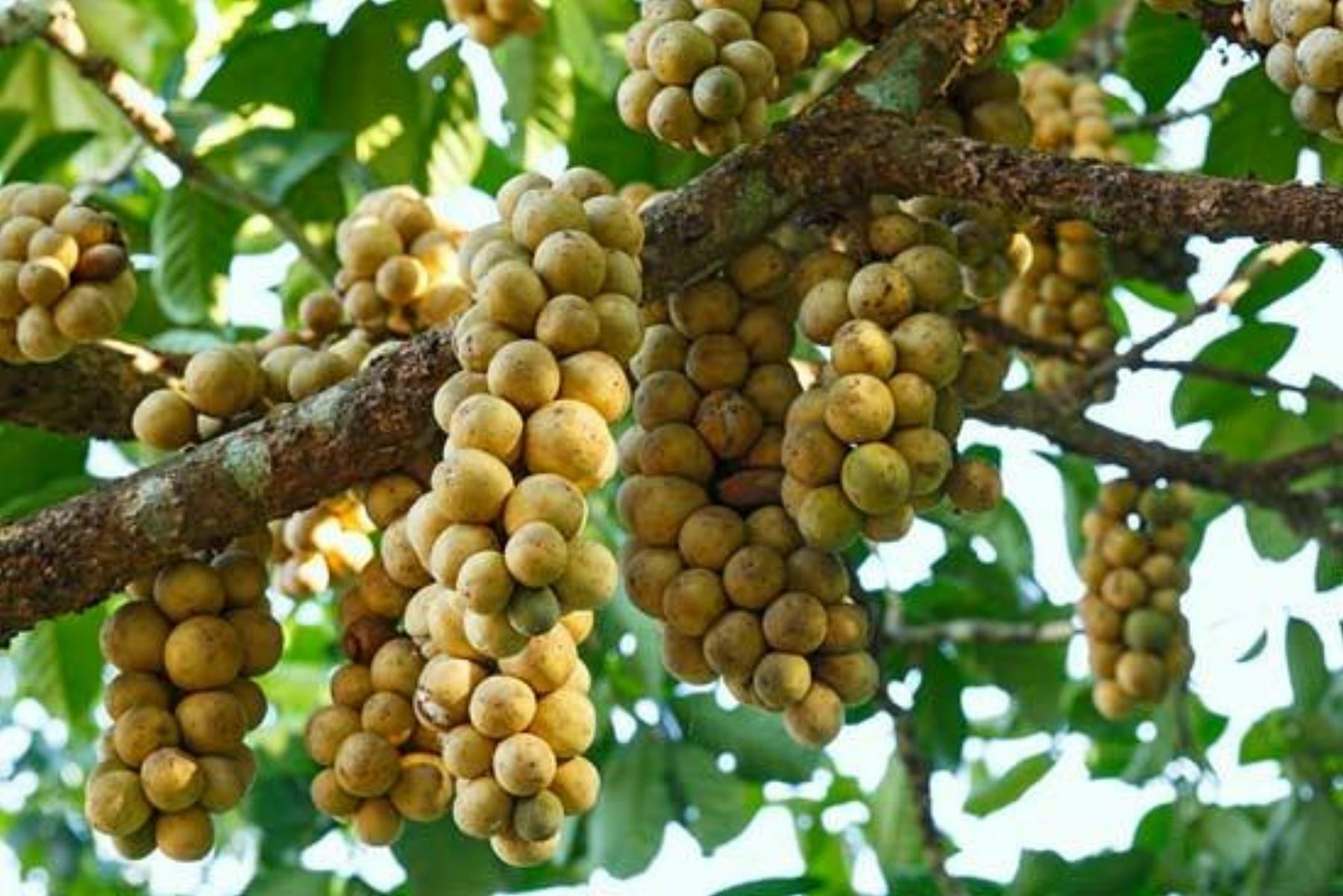
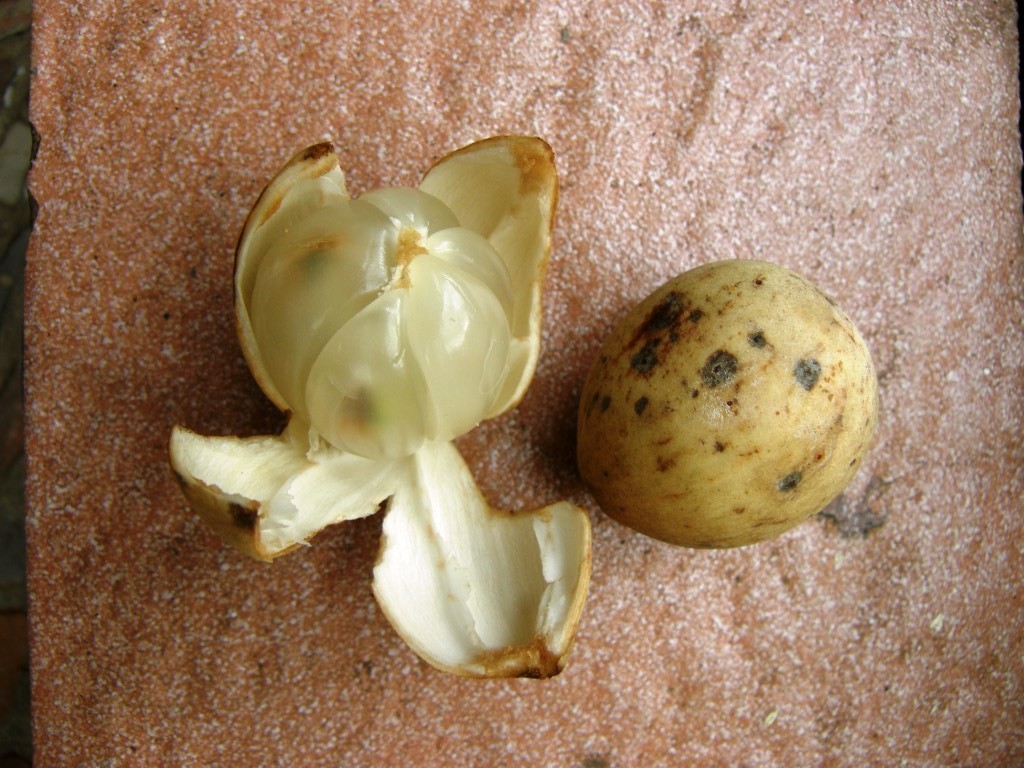
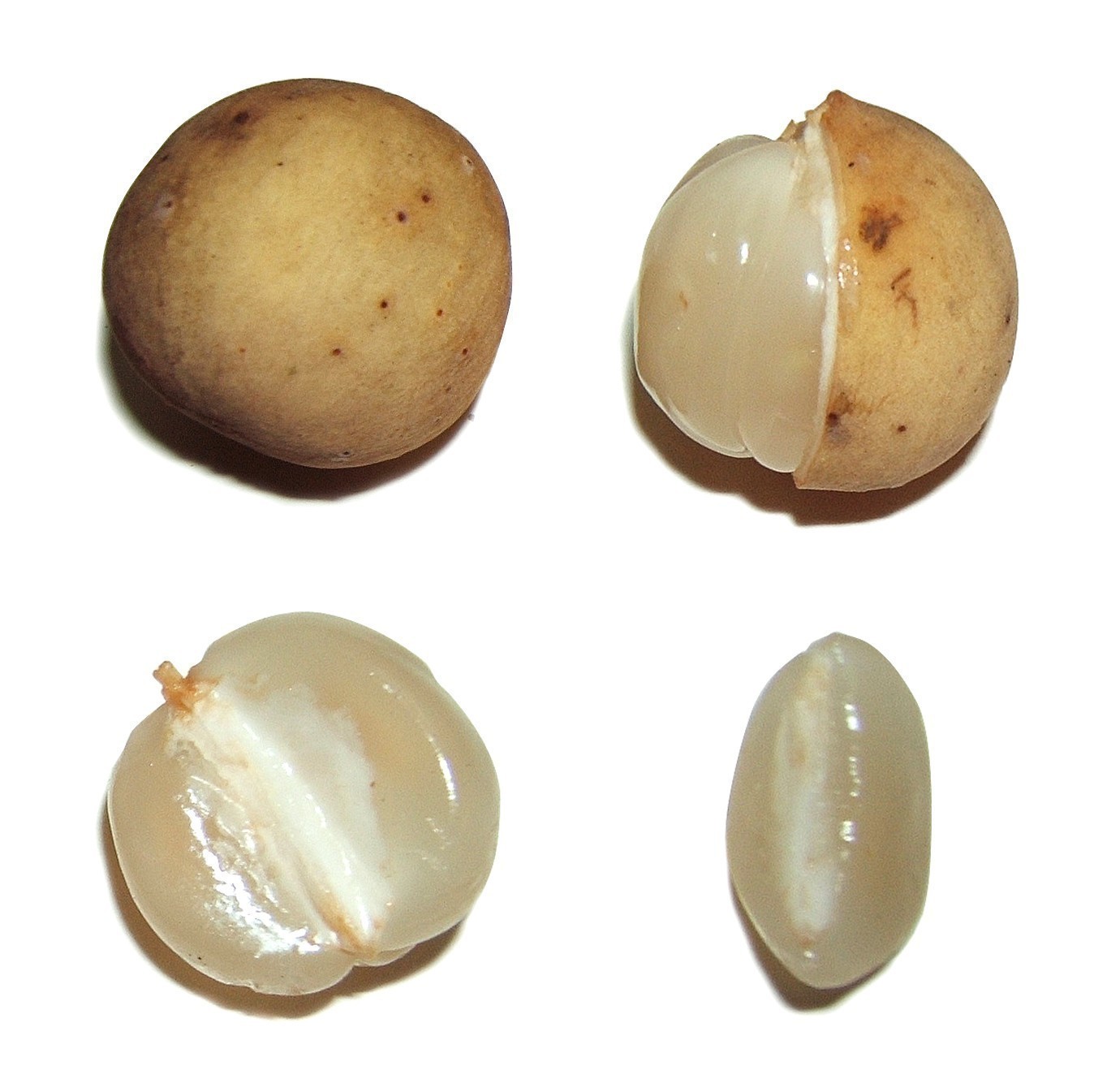
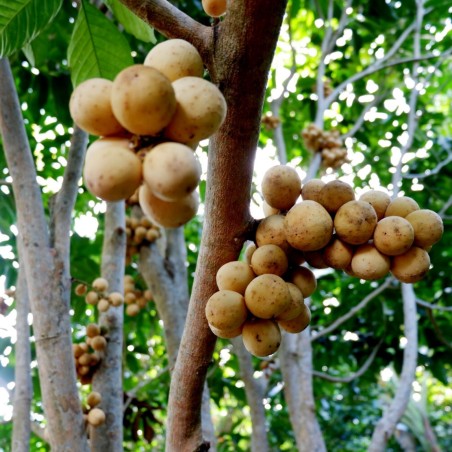
The fruit can be elliptical, ovoid or round, measuring 2 to 7 centimetres (0.79 to 2.76 in) by 1.5 to 5 centimetres (0.59 to 1.97 in) in size. Fruits look much like small potatoes and are borne in clusters similar to grapes. The larger fruits are on the variety known as duku. It is covered by thin, yellow hair giving a slightly fuzzy aspect. The skin thickness varies with the varieties, from 2 millimetres (0.079 in) to approximately 6 millimetres (0.24 in). The fruit contains 1 to 3 seeds, flat, and bitter tasting; the seeds are covered with a thick, clear-white aril that tastes sweet and sour.[2] The taste has been likened to a combination of grape and grapefruit and is considered excellent by most. The sweet juicy flesh contains sucrose, fructose, and glucose.[4] For consumption, cultivars with small or undeveloped seeds and thick aril are preferred.
Uses
L. parasiticum is cultivated mainly for its fruit, which can be eaten raw. The fruit can also be bottled in syrup. The wood is hard, thick, heavy, and resilient, allowing it to be used in the construction of rural houses.
Some parts of the plant are used in making traditional medicine. The bitter seeds can be pounded and mixed with water to make a deworming and ulcer medication. The bark is used to treat dysentery and malaria; the powdered bark can also be used to treat scorpion stings. The fruit's skin is used to treat diarrhea, and in the Philippines the dried skin is burned as a mosquito repellent.
The skin, especially of the langsat variety, can be dried and burned as incense.
The greate producers of Lansium parasiticum are Malaysia, Thailand, the Philippines and Indonesia. The production is mostly for internal consumption, although some is exported to Singapore and Hong Kong.
Cultivars
There are numerous cultivars of L. parasiticum. Overall, there are two main groups of cultivars, those named duku and those named langsat. There are also mixed duku-langsat varieties.
Those called duku generally have a large crown, thick with bright green leaves, with short bunches of few fruit. The individual fruit are large, generally round, and have somewhat thick skin that does not release sap when cooked. The seeds are small, with thick flesh, a sweet scent, and a sweet or sour alin.
Meanwhile, the variant commonly known as langsat generally has thinner trees, with a less dense crown consisting of dark green leaves and stiff branches. The bunches are longer, and each bunch holds between 15 and 25 large, egg-shaped fruit. The skin is thin and releases a white sap when cooked. The flesh is watery and tastes sweet and sour.[2][7] Unlike duku, langsat fruit does not last long after being picked. Three days after being picked, the skin blackens; this does not affect the fruit's taste.
L. domesticum var. aquaeum is distinguished by its hairy leaves, as well as the tightly packed dark yellow fruit on its bunches. The fruit tends to be small, with thin skin and little sap; the skin is difficult to remove. To be eaten, the fruit is bitten and the flesh sucked through the hole created,[2] or rubbed until the skin breaks and the seeds are retrieved. In Indonesia the fruit has several names, including kokosan, pisitan, pijetan, and bijitan.[7] The seeds are relatively large, with thin, sour flesh.
Ecology
L. parasiticum grows well in mixed agroforests. The plant, especially the duku variant, prefers damp, shaded areas. It can be grown in the same agroforest as durian, petai, and jengkol, as well as wood-producing trees.
L. parasiticum is grown from low grounds up to heights of 600 metres (2,000 ft) above sea level, in areas with an average rainfall of 1,500 to 2,500 millimetres (59 to 98 in) a year. The plant can grow and blossom in latosol, yellow podzol, and alluvium.[11] The plant prefers slightly acidic soil with good drainage and rich in mulch. The langsat variant is hardier, and can weather dry seasons with a little shade and water.[2] The plant cannot handle floods.
L. parasiticum generally bears fruit once a year. This period can vary between areas, but blooming is generally after the beginning of the rainy season and fruit production some four months later.
Distribution
Lansium parasiticum was originally native to Southeast Asia. It grows wild in Sumatra forests where a wide and longest river in Indonesia lay across the southern part of Sumatra. The river rises and floods the forest lands for a few months, when it subsides, the flood leaves plenty of fallen leaves and twigs enriching and moistening a large area of the forest bed, resulting in ideal conditions for the plant to grow naturally. Local people will come and harvest it as natural forest produce. They climb up the tree with ripe fruits (after observing it), holding with their hands on the smaller branches and shaking it. Mature fruits will fall easily down to the ground. They will then collect it and transport it on a small boat on a nearby river to the villages and sell it. In a good year a 20-year-old tree can produce 100 kg of fruits, however fruiting is often uneven.
Agriculturally, the tree is grown throughout the entire Southeast asian region, ranging from Southern India to the Philippines for its fruit. In the Philippines, where it is locally referred to as the lanzones or langsa, the plant is grown mostly on the southern parts of the island of Luzon, especially in Paete, Laguna, due to the species' narrow range of conditions favorable to its survival. It is also found in abundance on Northern Mindanao particularly in places as Butuan, Cagayan de Oro, and Camiguin. The Camiguin variety is especially sweet and succulent.
In Indonesia, Langsat is very popular fruit in West Kalimantan (Pontianak, Indonesia), Sulawesi and South Sumatra (also called 'Duku'). In Sarawak, northern Borneo, the name Duku is reserved for the larger-sized varieties of Langsat, near the size of golf balls, claimed sweeter and with less sap in the peel. A variety called Dokong exported to mainland Malaysia from Thailand (this variety is called 'Longkong' Thai: ลองกอง in Thailand) grows tighter in the clusters, giving it a faceted shape, and is preferred by many over the standard Langsat.
Within mainland Asia, the tree is cultivated in Thailand (Thai: ลางสาด, langsat), Cambodia, Vietnam, India, and Malaysia. Outside the region, it has also been successfully transplanted and introduced to Hawaii and Surinam. It grows well in the wetter areas (120 inches/3 meters or more annual rainfall) of Costa Rica, where it is still very rare, having been introduced decades ago by the United Fruit Company. A major hindrance to its acceptance seems to be that it is very slow in bearing, said to take 12 years or more from seed. However, air layering from mature trees, as well as grafting, are said to work well and produce much faster.
Expediem in intreaga lume din Uniunea Europeana, folosind posta aeriana recomandata, cu confirmare prin semnatura la livrare.
📦Urmarirea comenzii tale Conectati-va la contul dvs. si navigati laIstoricul comenzilor > Detalii pentru a gasi numarul dvs. de urmarire.
Veti primi notificari prin e-mail pentru fiecare etapa a comenzii dumneavoastra. Daca nu vedeti aceste mesaje, verificati folderul Spam/mesaje nedorite sau contactati furnizorul dvs. de e-mail. Alternativ, cautati online cum sa deblocati e-mailurile expeditorilor.
SERVICIUL NOSTRU DE EMAIL FUNCTIONEAZA
Veti primi notificari prin e-mail pentru fiecare etapa a comenzii dvs. Daca nu vedeti aceste mesaje, verificati folderul Spam/mesaje nedorite sau contactati furnizorul dvs. de e-mail.
📧Cum sa te asiguri ca e-mailurile de la magazinul nostru online ajung intotdeauna in contul tau Gmailsau orice alt e-mailal furnizoruluiIn Inbox si nu sunt marcate ca spam sau blocate:
Adauga expeditorul in contactele Google sau ale oricarui alt furnizor de e-mail. Nu te putem ajuta daca setarile tale nu sunt astfel. Contacteaza furnizorul tau de e-mail pentru asistenta.
Pasul 1: Deschide Gmail si gaseste un e-mail de la noi xxxxxxxxxxxx@xxx.com Nu incercati sa ne trimiteti un e-mail direct la aceasta adresa; nu il vom primi. Orice contact se face exclusiv prin formularul de contact din magazinul nostru online! Daca nu gasiti e-mailul nostru, este posibil sa fi fost blocat. In acest caz, continuati cu Pasul 4 de mai jos.
Pasul 2: Puneti cursorul peste numele expeditorului sau adresa de e-mail din partea de sus a e-mailului.
Pasul 3: Faceti clic pe pictograma "Adauga la contacte" (mica pictograma cu o persoana).
Acest lucru va ajuta Gmail sa ne recunoasca ca expeditor de incredere, asigurandu-se ca e-mailurile noastre ajung direct in inboxul tau si nu in folderul de spam.
Creati un filtru pentru a preveni ca e-mailurile sa fie marcate ca spam sau blocate
Pasul 1: Deschide Gmail si da clic pe pictograma rotita din coltul din dreapta sus, apoi selecteaza "Vezi toate setarile".
Pasul 2: Accesati fila "Filtre si adrese blocate".
Pasul 3: Faceti clic pe "Creati un filtru nou".
Pasul 4: In campul "From", introduceti adresa de e-mail pe care doriti sa o adaugati pe lista alba (e.g., e-mailul magazinului nostru).
Pasul 5: Faceti clic pe "Creeaza filtru".
Pasul 6: In fereastra urmatoare, bifati caseta etichetata "Nu-l trimite niciodata in Spam".
Pasul 7: Faceti clic pe "Creeaza filtru" pentru a salva.
Acest lucru va asigura ca e-mailurile noastre ajung intotdeauna in inbox-ul tau si nu vor fi marcate ca spam sau blocate din greseala.
Urmareste-ti coletul prin:
Aftership
17Track
Posta.hr (pentru numere de urmarire precum RGxxxxxxHR)
⚠️Notificari importante
Plata la livrare esteNUDisponibil.
Furnizati intotdeauna un numar de telefon mobil valid cu codul tarii cand comandati (e.g., +365 456 7686 576).
Nu ordona sa P.O. Cutii, sau daca nu puteti fi acasa pentru a semna pentru colet, coletele nu pot fi lasate la vecini.
Daca un pachet trimis la P.O. Daca cutia este pierduta sau nedistribuita, nu se va emite nicio rambursare.
⚖️Responsabilitatea clientului privind conformitatea legala Clientul este responsabil sa se asigure ca produsul poate fi importat legal in tara sa, inclusiv prin respectarea tuturor reglementarilor de import, obtinerea permiselor necesare si plata taxelor vamale, impozitelor si a altor taxe aplicabile. Va rugam sa verificati legislatia locala inainte de a comanda pentru a evita orice probleme cu vama sau livrarea.
📦Pachete Pierdute, Returnate & Reexpediate
Clienti din Brazilia si Mexic:Nu putem rambursa coletele pierdute sau distruse de catre autoritatile vamale.
Daca coletul dumneavoastra este returnat, va vom rambursa doar costul produsului — costurile de livrare nu sunt rambursabile.
Costul expedierii de retur (2 €) si orice costuri de reexpediere trebuie acoperite de client.
Daca un pachet ne este returnat din orice motiv, sunteti responsabil pentru plata transportului de retur (€2) plus costul reexpedierii pachetului.
🚚Livrare colet Trimiterile inregistrate necesita o semnatura.
Daca urmarirea arata ca pachetul este inca la oficiul postal de expediere, acesta este in tranzit — contactati oficiul postal local pentru actualizari.
Din pacate, nici noi, nici serviciul postal prin care a fost expediata comanda dumneavoastra nu va putem ajuta sa aflati unde se afla aceasta. Cand vedeti ca pachetul este in tara dumneavoastra,TREBUIE sa contactati oficiul postal cu numarul de urmarire.si discutati problema cu ei. Trimitem toate comenzile prin posta oficiala de stat.
Nu suntem responsabili pentru termenele de livrare si nu putem urmari expedierile in numele dumneavoastra.
📅Optiuni de livrare & timpi estimati
Optiune de livrare
Timp de procesare
Notite
Livrare Prioritara
Se expediaza in 1–7 zile lucratoare
Acorda prioritate procesarii comenzilor (nu garanteaza o livrare mai rapida); pot aparea intarzieri in timpul sarbatorilor (3–10 zile)
Livrare securizata
Se expediaza in 1–7 zile lucratoare
Disponibil pentru comenzi de pana la 150 €; rambursare in caz de pierdere
Livrare standard
Se expediaza in 7–10 zile lucratoare
Mai economic; pot aparea intarzieri in perioada sarbatorilor (7–14 zile)
Timp estimat de livrare:
In UE:3–20 zile
La nivel mondial:5–30 zile
Exemple din SUA:Livrat in 13, 17, 19, 22, sau 27 de zile.
Nota:Timpul de livrare depinde de locatia dvs. si de sistemul postal local. COVID-19 sau perioadele de sarbatori pot provoca intarzieri suplimentare.
💰Costuri de livrare Taxele de expediere si manipulare sunt calculate automat la finalizarea comenzii, in functie de greutatea coletului si de destinatie.
⏰Ore de procesare a comenzilor Nu procesam si nu expediem comenzile in zilele de sambata si duminica.
💳Optiuni de plata
Transfer bancar (SEPA / IBAN / SWIFT-BIC) Includeti referinta comenzii dvs. in descrierea platii (e.g., "SGS-19811702"). Comenzile care nu sunt platite in termen de 7 zile vor fi anulate automat.
PayPal Platile sunt acceptate numai in euro. Va rugam sa selectati euro la finalizarea comenzii.
Plata cu cardul Acceptam Visa, MasterCard, American Express, CB, Diners Club, Discover, China UnionPay, JCB, si Discover.
⚠️Taxe de tranzactie Clientii sunt responsabili pentru orice comisioane de tranzactie bancare sau PayPal. Va rugam sa va asigurati ca detaliile de plata sunt corecte pentru o procesare mai rapida a comenzii.
📢Note finale Inainte de a plasa comanda, verificati intotdeauna site-ul nostru pentru anunturi speciale, programul din perioada sarbatorilor sau conditii specifice de livrare care ar putea afecta achizitia dumneavoastra.
Notificare importanta: Facturi digitale
Pentru a contribui la reducerea risipei de hartie, nu includem o factura tiparita impreuna cu comanda dvs. Puteti descarca si imprima cu usurinta factura dvs. in orice moment accesand contul dvs.Istoric comenzi in profilul contului tau