Lansium parasiticum, also known as langsat (/ˈlɑːŋsɑːt/) or lanzones, is a species of tree in the Mahogany family. The plant, which originates from western Southeast Asia, bears edible fruit.
Lansium parasiticum, also known as langsat (/ˈlɑːŋsɑːt/) or lanzones, is a species of tree in the Mahogany family. The plant, which originates from western Southeast Asia, bears edible fruit. It is the provincial flower for the Indonesian province of South Sumatra.
The tree is average-sized, reaching 30 meters (98 ft) in height and 75 centimeters (30 in) in diameter. Seedling trees 30 years old planted at 8 x 8-meter spacing can have a height of 10 meters and diameter of 25 cm. The trunk grows in an irregular manner, with its buttress roots showing above ground. The tree's bark is a greyish color, with light and dark spots. Its resin is thick and milk colored.
The pinnately compound leaves are odd-numbered, with thin hair, and 6 to 9 buds at intervals. The buds are long and elliptical, approximately 9 to 21 centimeters (3.5 to 8.3 in) by 5 to 10 centimeters (2.0 to 3.9 in) in size. The upper edge shines, and the leaves themselves have pointed bases and tips. The stems of the buds measure 5 to 12 millimeters (0.20 to 0.47 in).
The flowers are located in inflorescences that grow and hang from large branches or the trunk; the bunches may number up to 5 in one place. They are often branched at their base, measure 10 to 30 centimeters (3.9 to 11.8 in) in size, and have short fur.[3] The flowers are small, with short stems, and have two genders. The sheath is shaped like a five-lobed cup and is colored a greenish-yellow. The corona is egg-shaped and hard, measuring 2 to 3 millimeters (0.079 to 0.118 in) by 4 to 5 millimeters (0.16 to 0.20 in). There is one stamen, measuring 2 millimeters (0.079 in) in length. The top of the stamen is round. The pistil is short and thick.
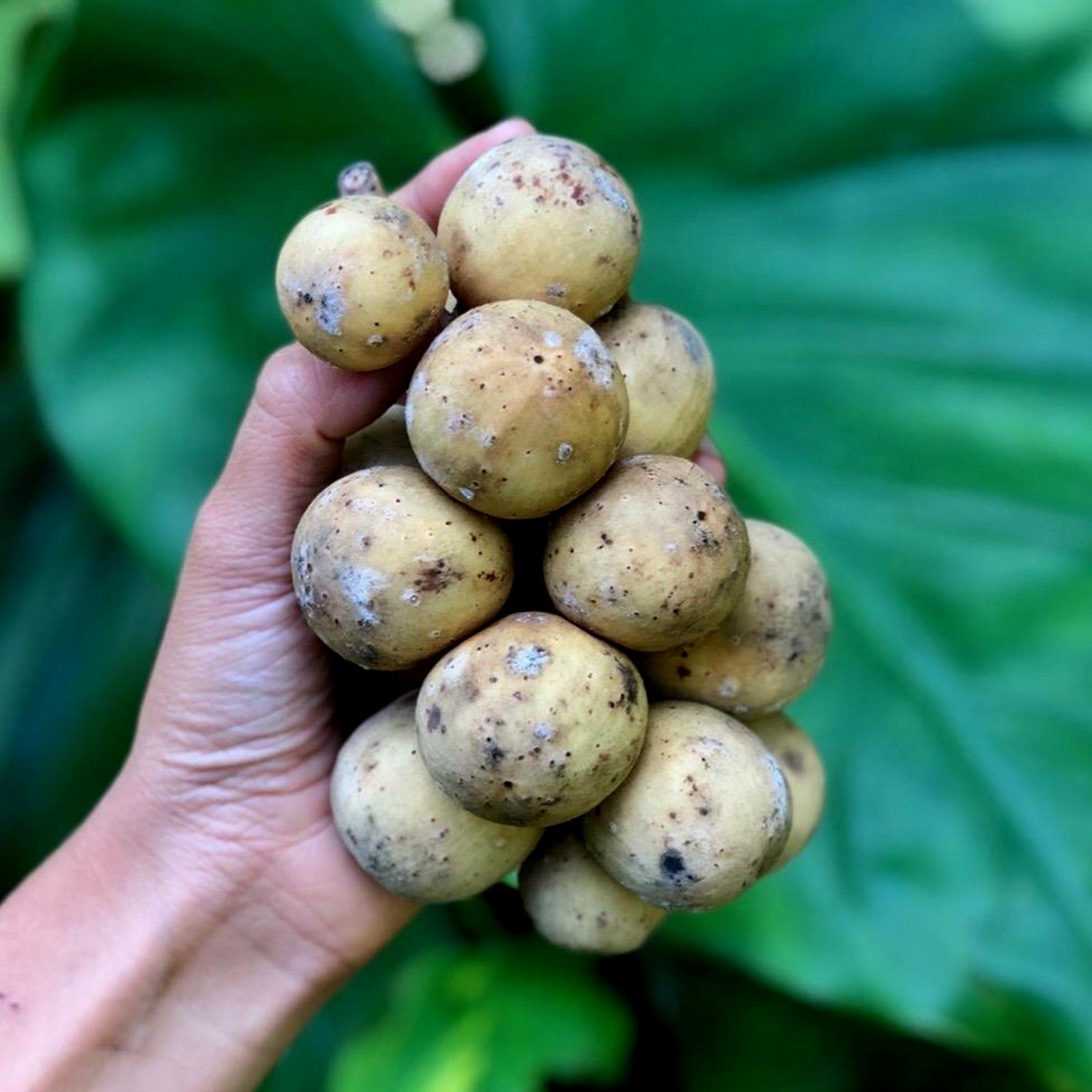
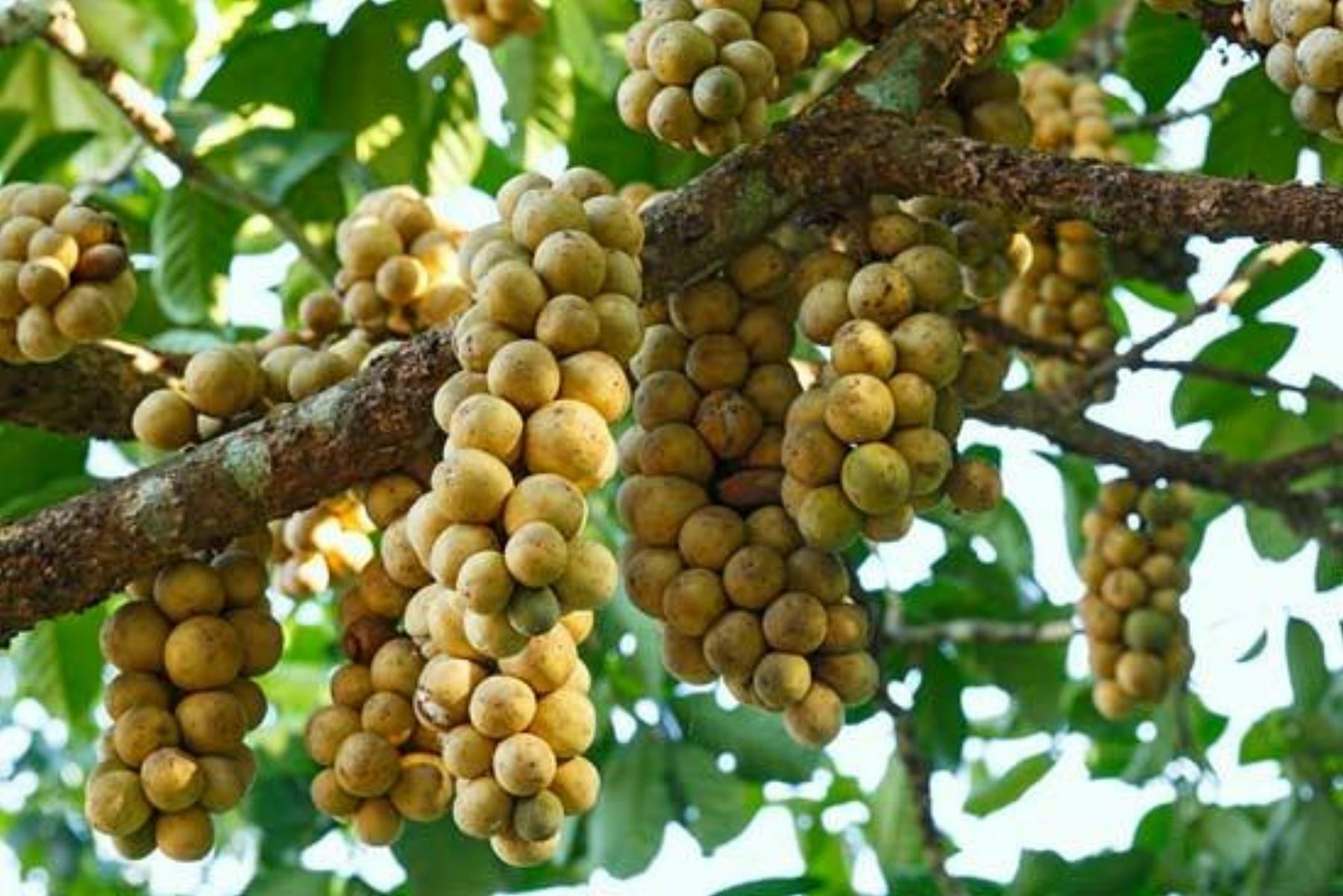
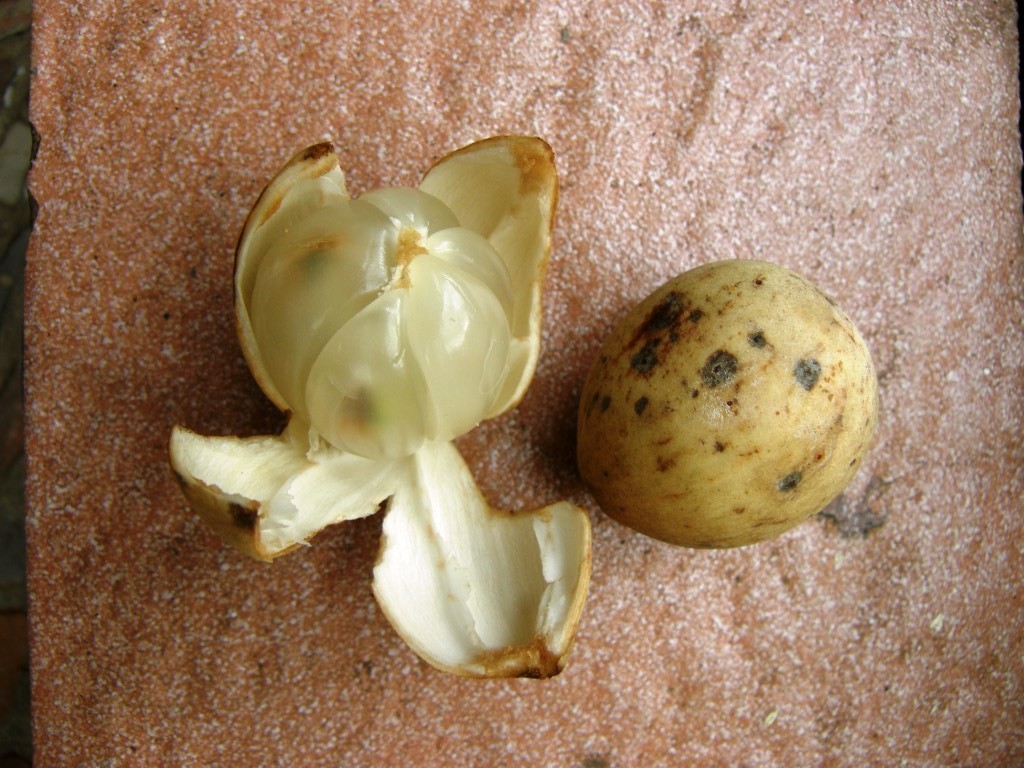
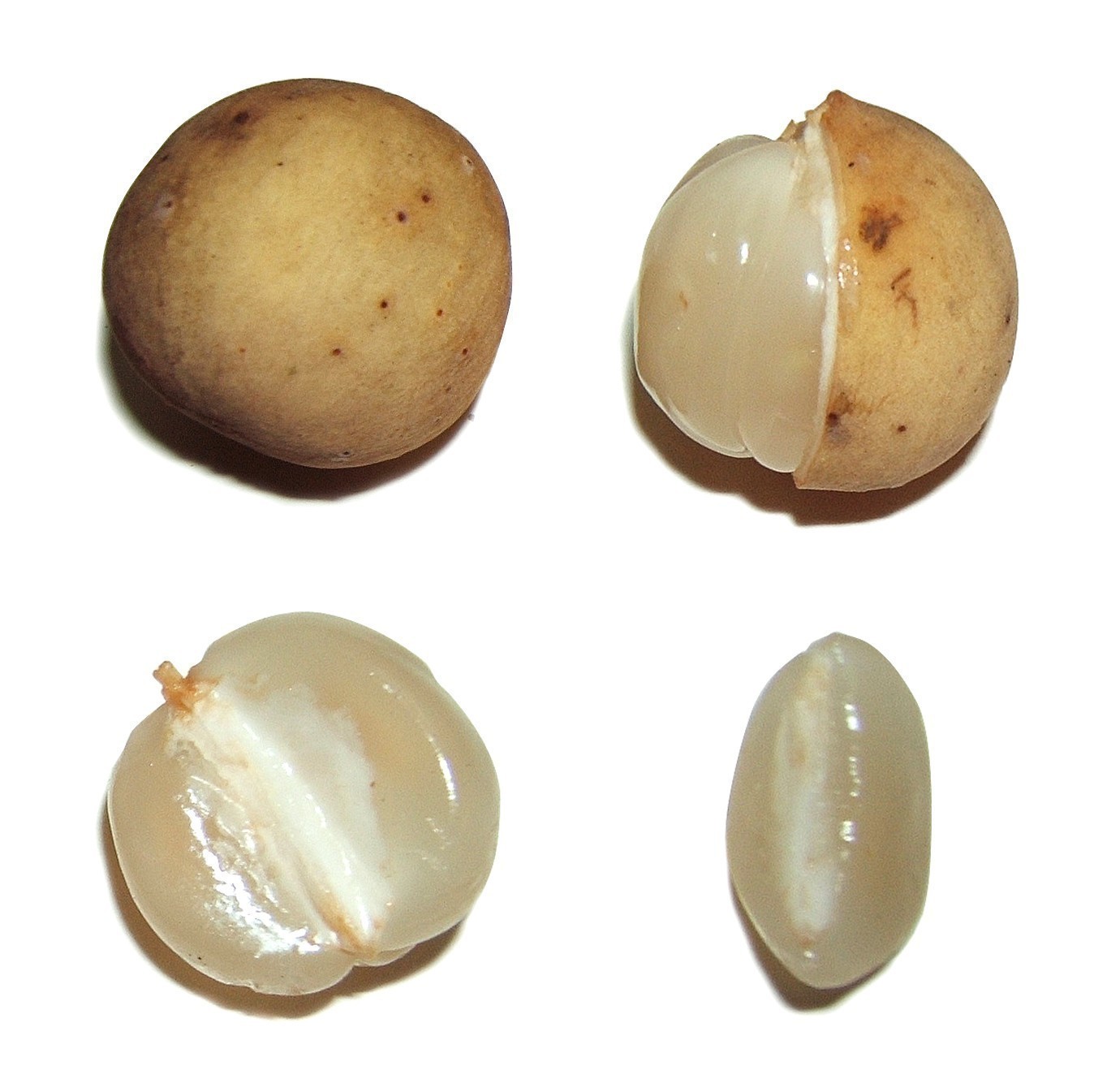
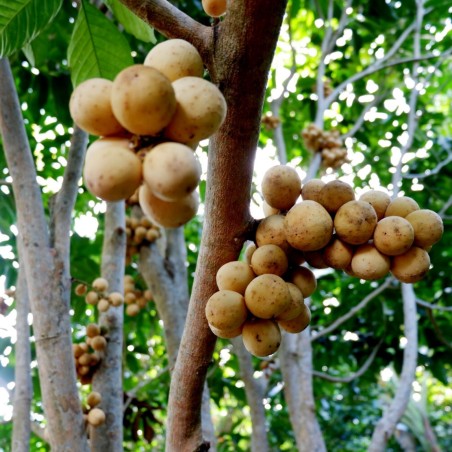
The fruit can be elliptical, ovoid or round, measuring 2 to 7 centimetres (0.79 to 2.76 in) by 1.5 to 5 centimetres (0.59 to 1.97 in) in size. Fruits look much like small potatoes and are borne in clusters similar to grapes. The larger fruits are on the variety known as duku. It is covered by thin, yellow hair giving a slightly fuzzy aspect. The skin thickness varies with the varieties, from 2 millimetres (0.079 in) to approximately 6 millimetres (0.24 in). The fruit contains 1 to 3 seeds, flat, and bitter tasting; the seeds are covered with a thick, clear-white aril that tastes sweet and sour.[2] The taste has been likened to a combination of grape and grapefruit and is considered excellent by most. The sweet juicy flesh contains sucrose, fructose, and glucose.[4] For consumption, cultivars with small or undeveloped seeds and thick aril are preferred.
Uses
L. parasiticum is cultivated mainly for its fruit, which can be eaten raw. The fruit can also be bottled in syrup. The wood is hard, thick, heavy, and resilient, allowing it to be used in the construction of rural houses.
Some parts of the plant are used in making traditional medicine. The bitter seeds can be pounded and mixed with water to make a deworming and ulcer medication. The bark is used to treat dysentery and malaria; the powdered bark can also be used to treat scorpion stings. The fruit's skin is used to treat diarrhea, and in the Philippines the dried skin is burned as a mosquito repellent.
The skin, especially of the langsat variety, can be dried and burned as incense.
The greate producers of Lansium parasiticum are Malaysia, Thailand, the Philippines and Indonesia. The production is mostly for internal consumption, although some is exported to Singapore and Hong Kong.
Cultivars
There are numerous cultivars of L. parasiticum. Overall, there are two main groups of cultivars, those named duku and those named langsat. There are also mixed duku-langsat varieties.
Those called duku generally have a large crown, thick with bright green leaves, with short bunches of few fruit. The individual fruit are large, generally round, and have somewhat thick skin that does not release sap when cooked. The seeds are small, with thick flesh, a sweet scent, and a sweet or sour alin.
Meanwhile, the variant commonly known as langsat generally has thinner trees, with a less dense crown consisting of dark green leaves and stiff branches. The bunches are longer, and each bunch holds between 15 and 25 large, egg-shaped fruit. The skin is thin and releases a white sap when cooked. The flesh is watery and tastes sweet and sour.[2][7] Unlike duku, langsat fruit does not last long after being picked. Three days after being picked, the skin blackens; this does not affect the fruit's taste.
L. domesticum var. aquaeum is distinguished by its hairy leaves, as well as the tightly packed dark yellow fruit on its bunches. The fruit tends to be small, with thin skin and little sap; the skin is difficult to remove. To be eaten, the fruit is bitten and the flesh sucked through the hole created,[2] or rubbed until the skin breaks and the seeds are retrieved. In Indonesia the fruit has several names, including kokosan, pisitan, pijetan, and bijitan.[7] The seeds are relatively large, with thin, sour flesh.
Ecology
L. parasiticum grows well in mixed agroforests. The plant, especially the duku variant, prefers damp, shaded areas. It can be grown in the same agroforest as durian, petai, and jengkol, as well as wood-producing trees.
L. parasiticum is grown from low grounds up to heights of 600 metres (2,000 ft) above sea level, in areas with an average rainfall of 1,500 to 2,500 millimetres (59 to 98 in) a year. The plant can grow and blossom in latosol, yellow podzol, and alluvium.[11] The plant prefers slightly acidic soil with good drainage and rich in mulch. The langsat variant is hardier, and can weather dry seasons with a little shade and water.[2] The plant cannot handle floods.
L. parasiticum generally bears fruit once a year. This period can vary between areas, but blooming is generally after the beginning of the rainy season and fruit production some four months later.
Distribution
Lansium parasiticum was originally native to Southeast Asia. It grows wild in Sumatra forests where a wide and longest river in Indonesia lay across the southern part of Sumatra. The river rises and floods the forest lands for a few months, when it subsides, the flood leaves plenty of fallen leaves and twigs enriching and moistening a large area of the forest bed, resulting in ideal conditions for the plant to grow naturally. Local people will come and harvest it as natural forest produce. They climb up the tree with ripe fruits (after observing it), holding with their hands on the smaller branches and shaking it. Mature fruits will fall easily down to the ground. They will then collect it and transport it on a small boat on a nearby river to the villages and sell it. In a good year a 20-year-old tree can produce 100 kg of fruits, however fruiting is often uneven.
Agriculturally, the tree is grown throughout the entire Southeast asian region, ranging from Southern India to the Philippines for its fruit. In the Philippines, where it is locally referred to as the lanzones or langsa, the plant is grown mostly on the southern parts of the island of Luzon, especially in Paete, Laguna, due to the species' narrow range of conditions favorable to its survival. It is also found in abundance on Northern Mindanao particularly in places as Butuan, Cagayan de Oro, and Camiguin. The Camiguin variety is especially sweet and succulent.
In Indonesia, Langsat is very popular fruit in West Kalimantan (Pontianak, Indonesia), Sulawesi and South Sumatra (also called 'Duku'). In Sarawak, northern Borneo, the name Duku is reserved for the larger-sized varieties of Langsat, near the size of golf balls, claimed sweeter and with less sap in the peel. A variety called Dokong exported to mainland Malaysia from Thailand (this variety is called 'Longkong' Thai: ลองกอง in Thailand) grows tighter in the clusters, giving it a faceted shape, and is preferred by many over the standard Langsat.
Within mainland Asia, the tree is cultivated in Thailand (Thai: ลางสาด, langsat), Cambodia, Vietnam, India, and Malaysia. Outside the region, it has also been successfully transplanted and introduced to Hawaii and Surinam. It grows well in the wetter areas (120 inches/3 meters or more annual rainfall) of Costa Rica, where it is still very rare, having been introduced decades ago by the United Fruit Company. A major hindrance to its acceptance seems to be that it is very slow in bearing, said to take 12 years or more from seed. However, air layering from mature trees, as well as grafting, are said to work well and produce much faster.
Z Evropské unie odesíláme do celého světa registrovanou leteckou poštou s potvrzením podpisu při doručení.
📦Sledování vaší objednávky Přihlaste se do svého účtu a přejděte naHistorie objednávek > Podrobnosti najít vaše sledovací číslo.
Obdržíte e-mailová oznámení o každé fázi vaší objednávky. Pokud tyto zprávy nevidíte, zkontrolujte prosím složku Spam/Nežádaná pošta nebo kontaktujte svého poskytovatele e-mailu. Případně vyhledejte na internetu, jak odblokovat e-mailovou adresu odesílatele.
NAŠE E-MAILOVÁ SLUŽBA FUNGUJE
Obdržíte e-mailová upozornění v každé fázi vaší objednávky. Pokud tyto zprávy nevidíte, zkontrolujte prosím složku Spam/Nevyžádaná pošta nebo kontaktujte svého poskytovatele e-mailu.
📧Jak zajistit, aby e-maily z našeho online obchodu vždy dorazily do vašeho Gmailunebo jakýkoli jiný e-mailposkytovateleJsou v doručené poště a nejsou označeny jako nevyžádaná pošta nebo zablokovány:
Přidejte Odesílatele do kontaktů ve svém účtu Google nebo u jakéhokoli jiného poskytovatele e-mailu. Nemůžeme vám pomoci, pokud vaše nastavení není takové. Obraťte se na svého poskytovatele e-mailu pro pomoc.
Krok 1: Otevřete Gmail a najděte e-mail od nás xxxxxxxxxxxx@xxx.com Nezkoušejte nám posílat e-mail přímo na tuto adresu; nedostaneme ho. Veškerý kontakt probíhá výhradně přes kontaktní formulář v našem online obchodě! Pokud nemůžete najít náš e-mail, mohl být zablokován. V tom případě postupujte podle kroku 4 níže.
Krok 2: Umístěte kurzor myši nad jméno odesílatele nebo e-mailovou adresu v horní části e-mailu.
Krok 3: Klikněte na ikonu „Přidat do kontaktů“ (malá ikona osoby).
To pomůže Gmailu rozpoznat nás jako důvěryhodného odesílatele, takže naše e-maily půjdou přímo do vaší doručené pošty a ne do spamu.
Vytvořte filtr, který zabrání tomu, aby byly e-maily označeny jako spam nebo zablokovány.
Krok 1: Otevřete Gmail a klikněte na ikonu ozubeného kola v pravém horním rohu, poté vyberte "Zobrazit všechna nastavení".
Krok 2: Přejděte na kartu "Filtry a zablokované adresy".
Krok 3: Klikněte na "Vytvořit nový filtr".
Krok 4: Do pole "From" zadejte e-mailovou adresu, kterou chcete přidat na bílou listinu (e.g., e-mail našeho obchodu).
Krok 5: Klikněte na "Vytvořit filtr".
Krok 6: V dalším okně zaškrtněte políčko označené "Nikdy to neodesílat do spamu".
Krok 7: Klikněte na "Vytvořit filtr" pro uložení.
To zajistí, že naše e-maily vždy dorazí do vaší doručené pošty a nebudou omylem označeny jako spam ani zablokovány.
Sledujte svou zásilku pomocí:
Aftership
17Track
Posta.hr (pro sledovací čísla jako RGxxxxxxHR)
⚠️Důležitá oznámení
Platba na dobírku jeNE k dispozici.
Při objednávání vždy uveďte platné mobilní číslo s předvolbou země (e.g., +365 456 7686 576).
Nenařizujte, aby P.O. Krabice, nebo pokud nemůžete být doma, abyste podepsali převzetí balíku, zásilky nelze zanechat u sousedů.
Pokud je balíček zaslaný na P.O. Pokud je zásilka ztracena nebo nedoručena, nebude poskytnuto vrácení peněz.
⚖️Zodpovědnost zákazníka za dodržování právních předpisů Zákazník je odpovědný za zajištění, že je dovoz produktu do své země legální, včetně dodržení všech dovozních předpisů, získání nezbytných povolení a zaplacení příslušných celních poplatků, daní a dalších poplatků. Před objednáním si prosím ověřte místní právní předpisy, abyste se vyhnuli problémům s celním odbavením nebo doručením.
Pokud vaše sledování ukazuje, že je balíček stále na poště odesílatele, je na cestě — kontaktujte místní pobočku pošty pro aktuální informace.
Bohužel my ani pošta, přes kterou byla vaše objednávka odeslána, vám nemůžeme pomoci s tím, kde se vaše objednávka nachází. Jakmile uvidíte, že je vaše zásilka ve vaší zemi,MUSÍTE kontaktovat svou poštu s číslem zásilky a projednejte to s nimi. Všechny objednávky odesíláme oficiální státní poštou.
Neodpovídáme za dodací lhůty a nemůžeme za vás sledovat zásilky.
📅Možnosti doručení & odhadované časy
Možnost doručení
Doba zpracování
Poznámky
Přednostní doručení
Odesíláme během 1–7 pracovních dnů.
Upřednostňuje zpracování objednávek (není zaručeno rychlejší doručení); během svátků mohou nastat zpoždění (3–10 dní)
Zabezpečené doručení
Odesíláme během 1–7 pracovních dnů.
Dostupné pro objednávky do €150; vrácení peněz v případě ztráty
Standardní doručení
Odesíláme do 7–10 pracovních dnů.
Levnější; během svátků mohou nastat zpoždění (7–14 dní)
Odhadovaný čas doručení:
V rámci EU: 3–20 dní
Celosvětově:5–30 dní
Příklady USA:Doručeno za 13, 17, 19, 22 nebo 27 dní.
Poznámka:Doba doručení závisí na vaší poloze a na místním poštovním systému. COVID-19 nebo sváteční období mohou způsobit další zpoždění.
💰Náklady na dopravu Poplatky za dopravu a manipulaci se automaticky vypočítají při dokončení objednávky na základě hmotnosti zásilky a místa doručení.
⏰Provozní doba zpracování objednávek V sobotu a v neděli objednávky nevyřizujeme ani neodesíláme.
💳Možnosti platby
Bankovní převod (SEPA / IBAN / SWIFT-BIC) Do popisu platby uveďte referenci vaší objednávky (e.g., "SGS-19811702"). Objednávky bez platby do 7 dnů budou automaticky zrušeny.
PayPal Platby jsou přijímány pouze v eurech. Prosím vyberte eura při placení.
Platba kartou Akceptujeme Visa, MasterCard, American Express, CB, Diners Club, Discover, China UnionPay, JCB a Discover.
⚠️Transakční poplatky Zákazníci hradí veškeré bankovní nebo PayPal transakční poplatky. Prosím, zajistěte přesné platební údaje pro rychlejší zpracování objednávky.
📢Závěrečné poznámky Před zadáním objednávky si vždy zkontrolujte naše webové stránky kvůli zvláštním oznámením, informacím o provozu během svátků nebo konkrétním přepravním podmínkám, které by mohly ovlivnit váš nákup.
Důležité upozornění: Digitální faktury
Abychom snížili množství papírového odpadu, nepřikládáme k vaší objednávce tištěnou fakturu. Fakturu si můžete kdykoli snadno stáhnout a vytisknout návštěvou vašehoHistorie objednávek v profilu vašeho účtu