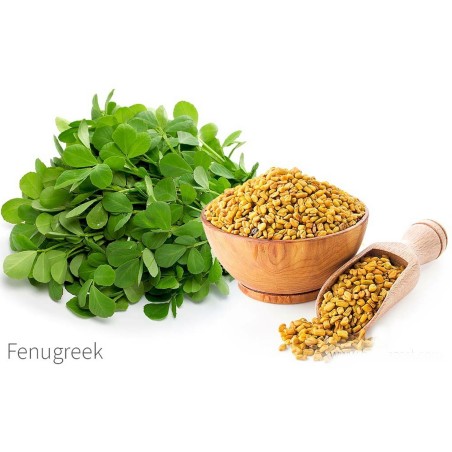
Fenugreek (Trigonella foenum-graecum) is an annual plant in the family Fabaceae, with leaves consisting of three small obovate to oblong leaflets. It is cultivated worldwide as a semiarid crop, and its seeds are
Fenugreek (Trigonella foenum-graecum) is an annual plant in the family Fabaceae, with leaves consisting of three small obovate to oblong leaflets. It is cultivated worldwide as a semiarid crop, and its seeds are a common ingredient in dishes from South Asia.
Uses
Fenugreek is used as an herb (dried or fresh leaves), spice (seeds), and vegetable (fresh leaves, sprouts, and microgreens). Sotolon is the chemical responsible for fenugreek's distinctive sweet smell. Cuboid-shaped, yellow- to amber-colored fenugreek seeds are frequently encountered in the cuisines of the Indian subcontinent, used both whole and powdered in the preparation of pickles, vegetable dishes, daals, and spice mixes such as panch phoron and sambar powder. They are often roasted to reduce bitterness and enhance flavor.
Cooking
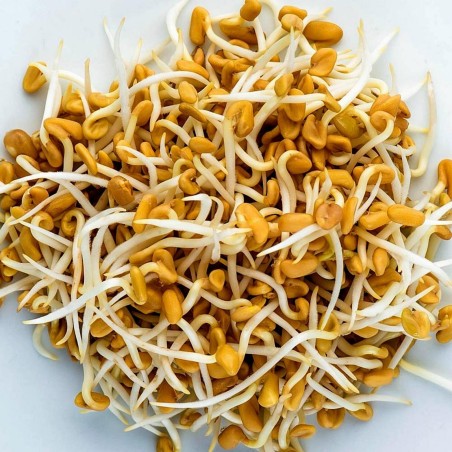
Fresh fenugreek leaves are an ingredient in some Indian curries. Sprouted seeds and microgreens are used in salads. When harvested as microgreens, fenugreek is known as samudra methi in Maharashtra, especially in and around Mumbai, where it is often grown near the sea in the sandy tracts, hence the name samudra, "ocean" in Sanskrit. Samudra methi is also grown in dry river beds in the Gangetic plains. When sold as a vegetable in India, the young plants are harvested with their roots still attached and sold in small bundles in the markets and bazaars. Any remaining soil is washed off to extend their shelf life.
In Turkish cuisine, fenugreek seeds are used for making a paste known as çemen. Cumin, black pepper, and other spices are added into it, especially to make pastırma.
In Persian cuisine, fenugreek leaves are called "شنبلیله" (shanbalile). They are the key ingredient and one of several greens incorporated into ghormeh sabzi and eshkeneh, often said to be the Iranian national dishes.
In Egyptian cuisine, peasants in Upper Egypt add fenugreek seeds and maize to their pita bread to produce aish merahrah, a staple of their diet.
Fenugreek is used in Eritrean and Ethiopian cuisine. The word for fenugreek in Amharic is abesh (or abish), and the seed is used in Ethiopia as a natural herbal medicine in the treatment of diabetes.
Yemenite Jews following the interpretation of Rabbi Shelomo Yitzchak (Rashi) believe fenugreek, which they call hilbeh, hilba, helba, or halba "חילבה", to be the Talmudic rubia "רוביא". When the seed kernels are ground and mixed with water they greatly expand; hot spices, turmeric and lemon juice are added to produce a frothy relish eaten with a sop. The relish is also called hilbeh;[11] it is reminiscent of curry. It is eaten daily and ceremonially during the meal of the first and/or second night of the Jewish New Year, Rosh Hashana.
Nutritional profile
Per 100 g, fenugreek leaves provide 210 kilojoules (49 kcal) and contain 89% water, 6% carbohydrates, 4% protein and less than 1% fat, with calcium at 40% of the Daily Value (DV, table).
Fenugreek seeds (per 100 g) are rich sources of protein (46% of DV), dietary fiber (98% DV), B vitamins, iron (186% DV) and several other dietary minerals.
Safety
Fenugreek sprouts, cultivated from a single specific batch of seeds imported from Egypt into Germany in 2009, were implicated as the source of the 2011 outbreak of Escherichia coli O104:H4 in Germany and France. Identification of a common producer and a single batch of fenugreek seeds supports the epidemiologic evidence implicating them as the source of the outbreaks.
Some people are allergic to fenugreek, and people who have peanut allergy and chickpea allergy may have a reaction to fenugreek.
Fenugreek seeds can cause diarrhea, dyspepsia, abdominal distention, and flatulence.
There is a risk of hypoglycemia particularly in people with diabetes; it may also interfere with the activity of anti-diabetic drugs.
Because of the high content of coumarin-like compounds in fenugreek, it may interfere with the activity and dosing of anticoagulants and antiplatelet drugs.
It causes birth defects in animals and there are reports that it also causes birth defects in humans, and that it can pass through the placenta; it also appears to negatively affect male fertility, female fertility, and the ability of an embryo in animals and humans.
Traditional medicine
In traditional medicine, fenugreek is thought to promote digestion, induce labor, and reduce blood sugar levels in diabetics, although the evidence for these effects is lacking.
Research
Constituents of fenugreek seeds include flavonoids, alkaloids, coumarins, vitamins and saponins; the most prevalent alkaloid is trigonelline and coumarins include cinnamic acid and scopoletin.
A 2016 meta-analysis combining the results of 12 small studies, of which only three were high quality, found that fenugreek may reduce some biomarkers in people with diabetes and with pre-diabetic conditions, but that better quality research would be required in order to draw conclusions.
As of 2016, there was no high-quality evidence for whether fenugreek is safe and effective to relieve dysmenorrhea.
History
Fenugreek is believed to have been brought into cultivation in the Near East. While Zohary and Hopf are uncertain which wild strain of the genus Trigonella gave rise to domesticated fenugreek, charred fenugreek seeds have been recovered from Tell Halal, Iraq, (carbon dated to 4000 BC) and Bronze Age levels of Lachish and desiccated seeds from the tomb of Tutankhamen. Cato the Elder lists fenugreek with clover and vetch as crops grown to feed cattle. In one first-century A.D. recipe, the Romans flavored wine with fenugreek. In the 1st century AD, in Galilee, it was grown as a food staple, as Josephus mentions it in his book, the Wars of the Jews. A compendium of Jewish oral law known as the Mishnah (compiled in the 2nd century) mentions the plant under its Hebrew name, tiltan.
Etymology
The English name derives via Middle French fenugrec from Latin faenugraecum, faenum Greacum meaning "Greek hay".
Production
Major fenugreek-producing countries are Afghanistan, Pakistan, India, Iran, Nepal, Bangladesh, Argentina, Egypt, France, Spain, Turkey, and Morocco. The largest producer is India. Fenugreek production in India is concentrated in the states of Rajasthan, Gujarat, Uttarakhand, Uttar Pradesh, Madhya Pradesh, Maharashtra, Haryana, and Punjab. Rajasthan accounts for over 80% of India's output.
We verzenden wereldwijd vanuit de Europese Unie per aangetekende luchtpost met handtekeningbevestiging bij bezorging.
📦Uw bestelling volgen Log in op je account en navigeer naarBestelgeschiedenis > Details om uw trackingnummer te vinden.
Je ontvangt e-mailmeldingen voor elke fase van je bestelling. Als je deze berichten niet ziet, controleer dan je map Spam/Ongewenste e-mail of neem contact op met je e-mailprovider. Als alternatief kun je online zoeken naar hoe je e-mails van een afzender kunt deblokkeren.
ONZE E-MAILDIENST WERKT
U ontvangt e-mailmeldingen voor elke fase van uw bestelling. Als u deze berichten niet ziet, controleer dan uw map Spam/Ongewenste e-mail of neem contact op met uw e-mailprovider.
📧Hoe u ervoor zorgt dat e-mails van onze webshop altijd in uw Gmail terechtkomenof een andere e-mailvan de providerIn de inbox en niet als spam gemarkeerd of geblokkeerd:
Voeg de Afzender toe aan de contacten van uw Google-account of van een andere e-mailprovider. We kunnen u niet helpen als uw instellingen er niet zo uitzien. Neem contact op met uw e-mailprovider voor hulp.
Stap 1: Open Gmail en zoek een e-mail van ons xxxxxxxxxxxx@xxx.com Probeer ons niet rechtstreeks een e-mail naar dit adres te sturen; we zullen die niet ontvangen. Elk contact verloopt uitsluitend via het contactformulier in onze online shop! Als je onze e-mail niet kunt vinden, is deze mogelijk geblokkeerd. Ga in dat geval verder met Stap 4 hieronder.
Stap 2: Beweeg de muisaanwijzer over de naam van de afzender of het e-mailadres bovenaan de e-mail.
Stap 3Klik op het pictogram "Toevoegen aan contacten" (het pictogram van een klein persoonnetje).
Dit helpt Gmail ons te herkennen als een vertrouwde afzender, zodat onze e-mails rechtstreeks in je inbox terechtkomen en niet in de spam.
Maak een filter om te voorkomen dat e-mails als spam worden gemarkeerd of geblokkeerd
Stap 1: Open Gmail en klik op het tandwielpictogram rechtsboven, selecteer vervolgens "Alle instellingen bekijken".
Stap 2: Ga naar het tabblad "Filters en geblokkeerde adressen".
Stap 3: Klik op "Maak een nieuw filter aan".
Stap 4: Voer in het veld "From" het e-mailadres in dat u op de witte lijst wilt zetten (e.g., het e-mailadres van onze winkel).
Stap 5: Klik op "Filter maken".
Stap 6: Vink in het volgende venster het vakje met het label "Nooit naar Spam sturen" aan.
Stap 7: Klik op "Filter maken" om op te slaan.
Dit zorgt ervoor dat onze e-mails altijd in uw inbox terechtkomen en niet per ongeluk als spam worden gemarkeerd of geblokkeerd.
Volg uw pakket via:
Aftership
17Track
Posta.hr (voor trackingnummers zoals RGxxxxxxHR)
⚠️Belangrijke mededelingen
Contant bij aflevering isNIETBeschikbaar.
Geef bij het bestellen altijd een geldig mobiel nummer met landcode op (e.g., +365 456 7686 576).
Beveel niet om P.O. Dozen, of als u niet thuis kunt zijn om voor het pakket te tekenen, mogen pakketten niet bij buren worden achtergelaten.
Als een pakket gestuurd naar een P.O. Als de doos verloren is gegaan of niet is afgeleverd, wordt er geen terugbetaling verleend.
⚖️Verantwoordelijkheid van de klant voor naleving van wet- en regelgeving De klant is verantwoordelijk ervoor te zorgen dat het product legaal in hun land kan worden geïmporteerd, inclusief het naleven van alle importvoorschriften, het verkrijgen van de benodigde vergunningen en het betalen van toepasselijke douaneheffingen, belastingen en andere kosten. Controleer alstublieft uw lokale wetgeving voordat u bestelt om eventuele problemen met de douane of levering te voorkomen.
📦Verloren, Geretourneerde & Opnieuw Verzonden Pakketten
Brazilië & Mexico Klanten:We kunnen geen restitutie geven voor pakketten die door de douane verloren zijn gegaan of vernietigd zijn.
Als uw pakket wordt geretourneerd, zullen wij alleen de productkosten terugbetalen — verzendkosten zijn niet restitueerbaar.
Retourporto (€2) en eventuele kosten voor herverzending moeten door de klant worden betaald.
Als een pakket om welke reden dan ook naar ons wordt teruggestuurd, bent u verantwoordelijk voor het betalen van de retourverzendkosten (€2) plus de kosten om het pakket opnieuw te verzenden.
🚚Levering van zending Aangetekende zendingen vereisen een handtekening.
Als uw tracking aangeeft dat het pakket nog bij het postkantoor van vertrek is, is het onderweg — neem contact op met uw plaatselijke postkantoor voor updates.
Helaas kunnen noch wij, noch het postkantoor waarmee je bestelling is verzonden, je helpen met de vraag waar je bestelling is. Wanneer je ziet dat je pakket in je land is,je MOET contact opnemen met je postkantoor met het track & trace-nummerEn bespreek de zaak met hen. Wij verzenden alle bestellingen per officiële staatspost.
Wij zijn niet verantwoordelijk voor levertijden en kunnen zendingen niet voor u volgen.
📅Bezorgopties & Geschatte Tijden
Bezorgoptie
Verwerkingstijd
Notities
Prioritaire levering
Wordt verzonden binnen 1–7 werkdagen
Prioriteert orderverwerking (geen gegarandeerd snellere levering); vertragingen mogelijk tijdens feestdagen (3–10 dagen)
Beveiligde Levering
Wordt verzonden binnen 1–7 werkdagen
Beschikbaar voor bestellingen tot €150; terugbetaling bij verlies
Standaard levering
Verzending binnen 7–10 werkdagen
Goedkoper; tijdens feestdagen kunnen vertragingen optreden (7–14 dagen)
Geschatte levertijd:
Binnen de EU: 3–20 dagen
Wereldwijd: 5–30 dagen
Voorbeelden uit de VS:Geleverd in 13, 17, 19, 22, of 27 dagen.
Opmerking:De levertijden zijn afhankelijk van uw locatie en de lokale postdienst. COVID-19 of de feestdagen kunnen extra vertragingen veroorzaken.
💰Verzendkosten Verzend- en afhandelingskosten worden automatisch berekend bij het afrekenen op basis van het gewicht van het pakket en de bestemming.
⏰Verwerkingstijden voor bestellingen We verwerken of verzenden geen bestellingen op zaterdag of zondag.
💳 Betaalopties
Bankoverschrijving (SEPA / IBAN / SWIFT-BIC) Vermeld uw bestelreferentie in de betalingsomschrijving (e.g., "SGS-19811702"). Bestellingen zonder betaling binnen 7 dagen worden automatisch geannuleerd.
PayPal Betalingen worden alleen in euro's geaccepteerd. Selecteer alstublieft euro's tijdens het afrekenen.
Kaartbetaling We accepteren Visa, MasterCard, American Express, CB, Diners Club, Discover, China UnionPay, JCB, en Discover.
⚠️Transactiekosten Klanten zijn verantwoordelijk voor eventuele bank- of PayPal-transactiekosten. Zorg alstublieft dat de betalingsgegevens correct zijn voor een snellere verwerking van uw bestelling.
📢Slotopmerkingen Controleer voor het plaatsen van uw bestelling altijd onze website op speciale mededelingen, bezorgschema's tijdens feestdagen of specifieke verzendvoorwaarden die uw aankoop kunnen beïnvloeden.
Belangrijke mededeling: Digitale facturen
Om papierafval te verminderen voegen we geen papieren factuur bij je bestelling. Je kunt je factuur op elk gewenst moment eenvoudig downloaden en afdrukken door je Bestelgeschiedenis in je accountprofiel