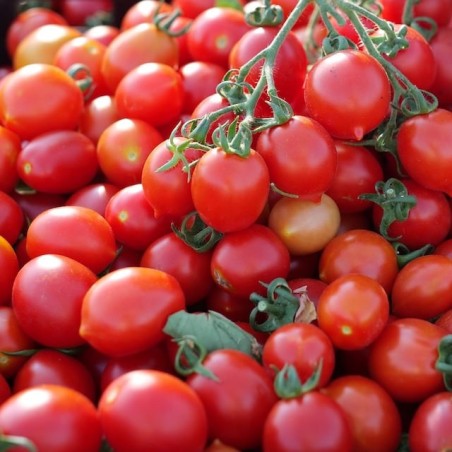
Caramel Datterino Tomato Seeds
€2.70


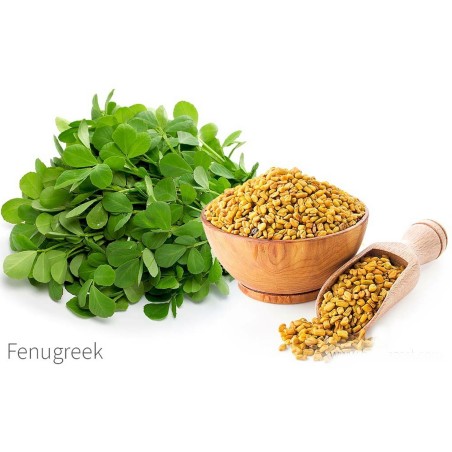
Fenugreek (Trigonella foenum-graecum) is an annual plant in the family Fabaceae, with leaves consisting of three small obovate to oblong leaflets. It is cultivated worldwide as a semiarid crop, and its seeds are
Fenugreek (Trigonella foenum-graecum) is an annual plant in the family Fabaceae, with leaves consisting of three small obovate to oblong leaflets. It is cultivated worldwide as a semiarid crop, and its seeds are a common ingredient in dishes from South Asia.
Uses
Fenugreek is used as an herb (dried or fresh leaves), spice (seeds), and vegetable (fresh leaves, sprouts, and microgreens). Sotolon is the chemical responsible for fenugreek's distinctive sweet smell. Cuboid-shaped, yellow- to amber-colored fenugreek seeds are frequently encountered in the cuisines of the Indian subcontinent, used both whole and powdered in the preparation of pickles, vegetable dishes, daals, and spice mixes such as panch phoron and sambar powder. They are often roasted to reduce bitterness and enhance flavor.
Cooking
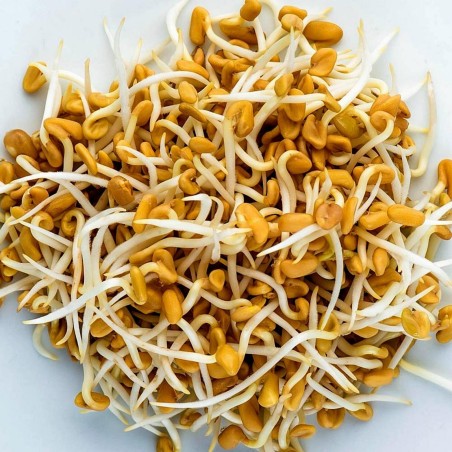
Fresh fenugreek leaves are an ingredient in some Indian curries. Sprouted seeds and microgreens are used in salads. When harvested as microgreens, fenugreek is known as samudra methi in Maharashtra, especially in and around Mumbai, where it is often grown near the sea in the sandy tracts, hence the name samudra, "ocean" in Sanskrit. Samudra methi is also grown in dry river beds in the Gangetic plains. When sold as a vegetable in India, the young plants are harvested with their roots still attached and sold in small bundles in the markets and bazaars. Any remaining soil is washed off to extend their shelf life.
In Turkish cuisine, fenugreek seeds are used for making a paste known as çemen. Cumin, black pepper, and other spices are added into it, especially to make pastırma.
In Persian cuisine, fenugreek leaves are called "شنبلیله" (shanbalile). They are the key ingredient and one of several greens incorporated into ghormeh sabzi and eshkeneh, often said to be the Iranian national dishes.
In Egyptian cuisine, peasants in Upper Egypt add fenugreek seeds and maize to their pita bread to produce aish merahrah, a staple of their diet.
Fenugreek is used in Eritrean and Ethiopian cuisine. The word for fenugreek in Amharic is abesh (or abish), and the seed is used in Ethiopia as a natural herbal medicine in the treatment of diabetes.
Yemenite Jews following the interpretation of Rabbi Shelomo Yitzchak (Rashi) believe fenugreek, which they call hilbeh, hilba, helba, or halba "חילבה", to be the Talmudic rubia "רוביא". When the seed kernels are ground and mixed with water they greatly expand; hot spices, turmeric and lemon juice are added to produce a frothy relish eaten with a sop. The relish is also called hilbeh;[11] it is reminiscent of curry. It is eaten daily and ceremonially during the meal of the first and/or second night of the Jewish New Year, Rosh Hashana.
Nutritional profile
Per 100 g, fenugreek leaves provide 210 kilojoules (49 kcal) and contain 89% water, 6% carbohydrates, 4% protein and less than 1% fat, with calcium at 40% of the Daily Value (DV, table).
Fenugreek seeds (per 100 g) are rich sources of protein (46% of DV), dietary fiber (98% DV), B vitamins, iron (186% DV) and several other dietary minerals.
Safety
Fenugreek sprouts, cultivated from a single specific batch of seeds imported from Egypt into Germany in 2009, were implicated as the source of the 2011 outbreak of Escherichia coli O104:H4 in Germany and France. Identification of a common producer and a single batch of fenugreek seeds supports the epidemiologic evidence implicating them as the source of the outbreaks.
Some people are allergic to fenugreek, and people who have peanut allergy and chickpea allergy may have a reaction to fenugreek.
Fenugreek seeds can cause diarrhea, dyspepsia, abdominal distention, and flatulence.
There is a risk of hypoglycemia particularly in people with diabetes; it may also interfere with the activity of anti-diabetic drugs.
Because of the high content of coumarin-like compounds in fenugreek, it may interfere with the activity and dosing of anticoagulants and antiplatelet drugs.
It causes birth defects in animals and there are reports that it also causes birth defects in humans, and that it can pass through the placenta; it also appears to negatively affect male fertility, female fertility, and the ability of an embryo in animals and humans.
Traditional medicine
In traditional medicine, fenugreek is thought to promote digestion, induce labor, and reduce blood sugar levels in diabetics, although the evidence for these effects is lacking.
Research
Constituents of fenugreek seeds include flavonoids, alkaloids, coumarins, vitamins and saponins; the most prevalent alkaloid is trigonelline and coumarins include cinnamic acid and scopoletin.
A 2016 meta-analysis combining the results of 12 small studies, of which only three were high quality, found that fenugreek may reduce some biomarkers in people with diabetes and with pre-diabetic conditions, but that better quality research would be required in order to draw conclusions.
As of 2016, there was no high-quality evidence for whether fenugreek is safe and effective to relieve dysmenorrhea.
History
Fenugreek is believed to have been brought into cultivation in the Near East. While Zohary and Hopf are uncertain which wild strain of the genus Trigonella gave rise to domesticated fenugreek, charred fenugreek seeds have been recovered from Tell Halal, Iraq, (carbon dated to 4000 BC) and Bronze Age levels of Lachish and desiccated seeds from the tomb of Tutankhamen. Cato the Elder lists fenugreek with clover and vetch as crops grown to feed cattle. In one first-century A.D. recipe, the Romans flavored wine with fenugreek. In the 1st century AD, in Galilee, it was grown as a food staple, as Josephus mentions it in his book, the Wars of the Jews. A compendium of Jewish oral law known as the Mishnah (compiled in the 2nd century) mentions the plant under its Hebrew name, tiltan.
Etymology
The English name derives via Middle French fenugrec from Latin faenugraecum, faenum Greacum meaning "Greek hay".
Production
Major fenugreek-producing countries are Afghanistan, Pakistan, India, Iran, Nepal, Bangladesh, Argentina, Egypt, France, Spain, Turkey, and Morocco. The largest producer is India. Fenugreek production in India is concentrated in the states of Rajasthan, Gujarat, Uttarakhand, Uttar Pradesh, Madhya Pradesh, Maharashtra, Haryana, and Punjab. Rajasthan accounts for over 80% of India's output.
Your review appreciation cannot be sent
Report comment
Report sent
Your report cannot be sent
Review sent
Your review cannot be sent
We ship worldwide from the European Union using registered air mail with signature confirmation upon delivery.
📦 Tracking Your Order
Log in to your account and navigate to Order History > Details to find your tracking number.
You will receive email notifications for each stage of your order.
If you don’t see these messages, please check your Spam/Junk folder or contact your email provider. Alternatively, search online for how to unblock sender emails.
OUR EMAIL SERVICE IS WORKING
You will receive email notifications for each stage of your order. If you don’t see these messages, please check your Spam/Junk folder or contact your email provider.
📧 How to Ensure Emails from Our Online Shop Always Land in Your Gmail or any other email provider's Inbox and Aren't Marked as Spam or Blocked:
Add the Sender to your Google or any other email provider's contacts. We can't help you if your settings are not like this. Contact your email provider for help.
Step 1: Open Gmail and find an email from us [email protected]
Do not try to send us an email directly to this address; we will not receive it. Every contact is exclusively through the contact form in our online shop!
If you can’t find our email, it might have been blocked. In that case, proceed with Step 4 below.
Step 2: Hover over the sender’s name or email address at the top of the email.
Step 3: Click the "Add to Contacts" icon (the little person icon).
This will help Gmail recognize us as a trusted sender, ensuring our emails go straight to your inbox and not to spam.
Create a Filter to Prevent Emails from Being Marked as Spam or Blocked
Step 1: Open Gmail and click on the gear icon in the top-right corner, then select "See all settings".
Step 2: Go to the "Filters and Blocked Addresses" tab.
Step 3: Click "Create a new filter".
Step 4: In the "From" field, enter the email address you want to whitelist (e.g., our shop’s email).
Step 5: Click "Create filter".
Step 6: In the next window, check the box labeled "Never send it to Spam".
Step 7: Click "Create filter" to save.
This will ensure our emails always land in your inbox and won’t get marked as spam or blocked by mistake.
Track your package via:
Aftership
17Track
Posta.hr (for tracking numbers like RGxxxxxxHR)
⚠️ Important Notices
Cash on delivery is NOT available.
Always provide a valid mobile number with country code when ordering (e.g., +365 456 7686 576).
Do not order to P.O. Boxes, or if you cannot be home to sign for the package, parcels cannot be left with neighbors.
If a package sent to a P.O. Box is lost or undelivered, no refund will be issued.
⚖️ Customer Responsibility for Legal Compliance
The customer is responsible for ensuring that the product is legal to import into their country, including complying with all import regulations, obtaining necessary permits, and paying applicable customs duties, taxes, and other fees. Please check your local laws before ordering to avoid any issues with customs or delivery.
📦 Lost, Returned & Reshipping Packages
Brazil & Mexico Customers: We cannot refund packages lost or destroyed by customs.
If your package is returned, we will refund only the product cost — shipping costs are non-refundable.
Return postage (€2) and any reshipping costs must be covered by the customer.
If a package is returned to us for any reason, you are responsible for paying the return shipping (€2) plus the cost to resend the package.
🚚 Shipment Delivery
Registered shipments require a signature.
If your tracking shows that the package is still at the origin post office, it is in transit — contact your local post office for updates.
Unfortunately, neither we nor the post office through which your order was sent can help you with the question of where your order is. When you see that your package is in your country, you MUST contact your post office with the tracking number and discuss the matter with them. We send all orders by official state mail.
We are not responsible for delivery times and cannot track shipments on your behalf.
📅 Delivery Options & Estimated Times
| Delivery Option | Processing Time | Notes |
|---|---|---|
| Priority Delivery | Ships in 1–7 business days | Prioritizes order processing (not guaranteed faster delivery); delays possible during holidays (3–10 days) |
| Secured Delivery | Ships in 1–7 business days | Available for orders up to €150; refund if lost |
| Standard Delivery | Ships in 7–10 business days | More economical; delays possible during holidays (7–14 days) |
Estimated Delivery Time:
Within the EU: 3–20 days
Worldwide: 5–30 days
USA Examples: Delivered in 13, 17, 19, 22, or 27 days.
Note: Delivery times depend on your location and local postal system. COVID-19 or holiday seasons may cause additional delays.
💰 Shipping Costs
Shipping and handling fees are calculated automatically at checkout based on the parcel weight and destination.
⏰ Order Processing Hours
We do not process or ship orders on Saturdays or Sundays.
💳 Payment Options
Bank Transfer (SEPA / IBAN / SWIFT-BIC)
Include your order reference in the payment description (e.g., "SGS-19811702").
Orders without payment within 7 days will be automatically cancelled.
PayPal
Payments are accepted in Euros only.
Please select Euros during checkout.
Card Payment
We accept Visa, MasterCard, American Express, CB, Diners Club, Discover, China UnionPay, JCB, and Discover.
⚠️ Transaction Fees
Customers are responsible for any bank or PayPal transaction fees.
Please ensure accurate payment details for faster order processing.
📢 Final Notes
Before placing your order, always check our website for special notices, holiday schedules, or specific shipping conditions that might affect your purchase.
Important Notice: Digital Invoices
To help reduce paper waste, we do not include a printed invoice with your order. You can easily download and print your invoice at any time by visiting your Order History in your account profile