True Lavender Seeds
€ 2,00

100% NATURAL POPCORN
NON-GMO, NOT GENETICALLY MODIFIED. SIMPLY PURE AND NATURAL!
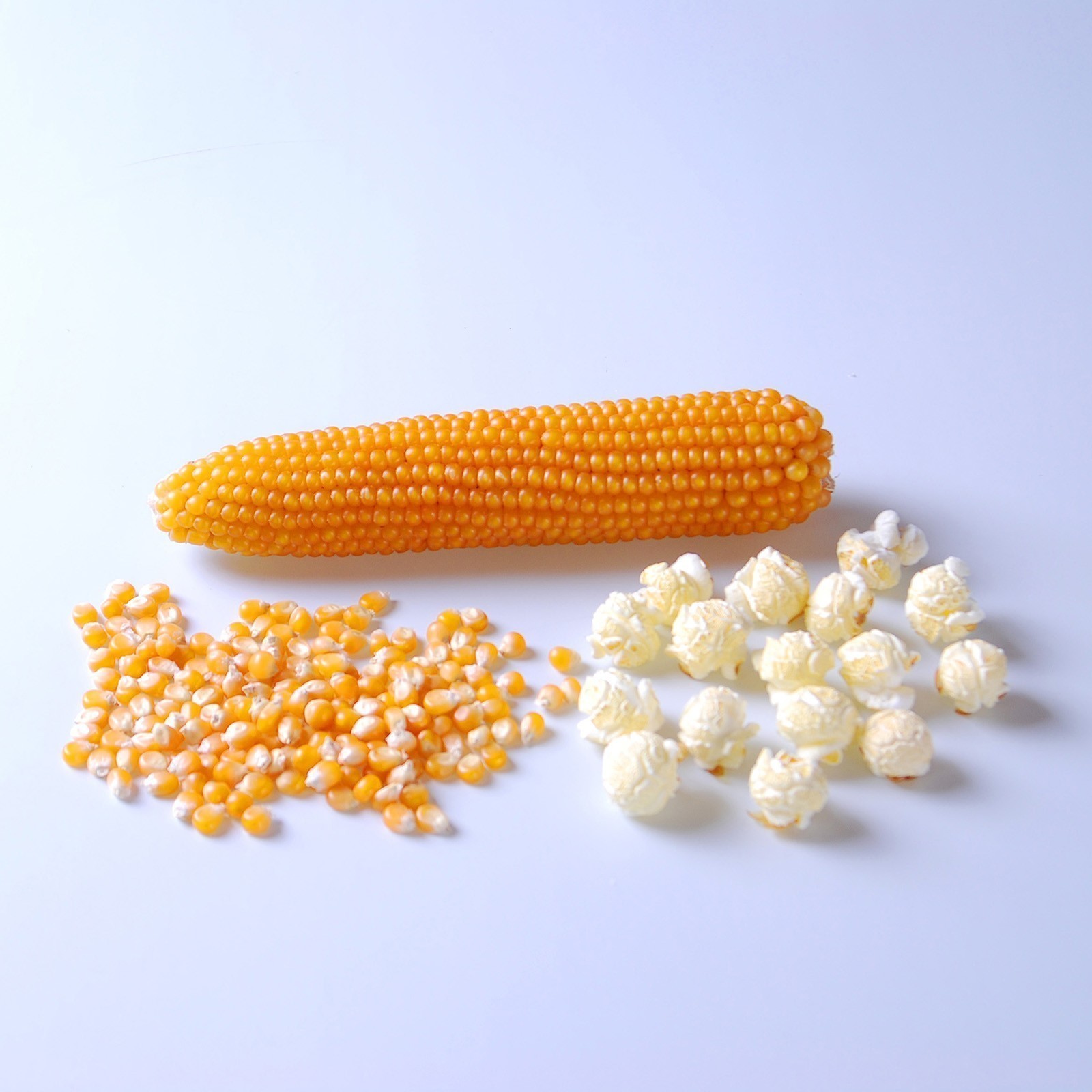
Popcorn (popped corn, popcorns or pop-corn) is a variety of corn kernel, which expands and puffs up when heated.
A popcorn kernel's strong hull contains the seed's hard, starchy endosperm with 14–20% moisture, which turns to steam as the kernel is heated. Pressure from the steam continues to build until the hull ruptures, allowing the kernel to forcefully expand from 20 to 50 times its original size—and finally, cool.[1]
Some strains of corn (taxonomized as Zea mays) are cultivated specifically as popping corns. The Zea mays variety everta, a special kind of flint corn, is the most common of these.
The six major types of corn are dent corn, flint corn, pod corn, popcorn, flour corn, and sweet corn.
Corn was first domesticated about 10,000 years ago in what is now Mexico.[3] Archaeologists discovered that people have known about popcorn for thousands of years. In Mexico, for example, remnants of popcorn have been found that date to around 3600 BC.[4]
Popping of the kernels was achieved by hand on the stove-top through the 19th century. Kernels were sold on the East Coast of the United States under names such as Pearls or Nonpareil. The term popped corn first appeared in John Russell Bartlett's 1848 Dictionary of Americanisms.[5][6] Popcorn is an ingredient in Cracker Jack, and in the early years of the product, it was popped by hand.[5]

Popcorn's accessibility increased rapidly in the 1890s with Charles Cretors' invention of the popcorn maker. Cretors, a Chicago candy store owner, created a number of steam-powered machines for roasting nuts and applied the technology to the corn kernels. By the turn of the century, Cretors had created and deployed street carts equipped with steam-powered popcorn makers.[7]
During the Great Depression, popcorn was fairly inexpensive at 5–10 cents a bag and became popular. Thus, while other businesses failed, the popcorn business thrived and became a source of income for many struggling farmers, including the Redenbacher family, namesake of the famous popcorn brand. During World War II, sugar rations diminished candy production, and Americans compensated by eating three times as much popcorn as they had before.[8] The snack was popular at theaters, much to the initial displeasure of many of the theater owners, who thought it distracted from the films. Their minds eventually changed, however, and in 1938 a Midwestern theater owner named Glen W. Dickson installed popcorn machines in the lobbies of his theaters. The venture was a financial success, and the trend soon spread.[5]

In 1970, Orville Redenbacher's namesake brand of popcorn was launched. In 1981, General Mills received the first patent for a microwave popcorn bag, with popcorn consumption seeing a sharp increase by tens of thousands of pounds in the years following.[7]
At least six localities (all in the Midwestern United States) claim to be the "Popcorn Capital of the World;": Ridgway, Illinois; Valparaiso, Indiana; Van Buren, Indiana; Schaller, Iowa; Marion, Ohio; and North Loup, Nebraska. According to the USDA, corn used for popcorn production is specifically planted for this purpose; most is grown in Nebraska and Indiana, with increasing area in Texas.[9][10] As the result of an elementary school project, popcorn became the official state snack food of Illinois.[11]

Each kernel of popcorn contains a certain amount of moisture and oil. Unlike most other grains, the outer hull of the popcorn kernel is both strong and impervious to moisture and the starch inside consists almost entirely of a hard type.[12]
As the oil and the water within the kernel are heated, they turn the moisture in the kernel into pressurized steam. Under these conditions, the starch inside the kernel gelatinizes, softens, and becomes pliable. The internal pressure of the entrapped steam continues to increase until the breaking point of the hull is reached: a pressure of approximately 135 psi (930 kPa)[12] and a temperature of 180 °C (356 °F). The hull thereupon ruptures rapidly and explodes, causing a sudden drop in pressure inside the kernel and a corresponding rapid expansion of the steam, which expands the starch and proteins of the endosperm into airy foam. As the foam rapidly cools, the starch and protein polymers set into the familiar crispy puff.[12] Special varieties are grown to give improved popping yield. Though the kernels of some wild types will pop, the cultivated strain is Zea mays everta, which is a special kind of flint corn.

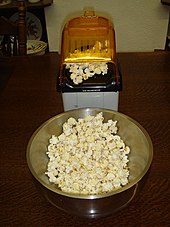
Popcorn can be cooked with butter or oil. Although small quantities can be popped in a stove-top kettle or pot in a home kitchen, commercial sale of freshly popped popcorn employs specially designed popcorn machines, which were invented in Chicago, Illinois, by Charles Cretors in 1885. Cretors successfully introduced his invention at the Columbian Exposition in 1893. At this same world's fair, F.W. Rueckheim introduced a molasses-flavored "Candied Popcorn," the first caramel corn; his brother, Louis Ruekheim, slightly altered the recipe and introduced it as Cracker Jack popcorn in 1896.[13]
Cretors's invention introduced the first patented steam-driven popcorn machine that popped corn in oil. Previously, vendors popped corn by holding a wire basket over an open flame. At best, the result was a hot, dry, unevenly cooked snack. Cretors's machine popped corn in a mixture of one-third clarified butter, two-thirds lard, and salt. This mixture can withstand the 450 °F (232 °C) temperature needed to pop corn and it produces little smoke. A fire under a boiler created steam that drove a small engine; that engine drove the gears, shaft, and agitator that stirred the corn and powered a small automated clown puppet-like figure, "the Toasty Roasty Man," an attention attracting amusement intended to drum up business. A wire connected to the top of the cooking pan allowed the operator to disengage the drive mechanism, lift the cover, and dump popped corn into the storage bin beneath. Exhaust from the steam engine was piped to a hollow pan below the corn storage bin and kept freshly popped corn uniformly warm for the first time. Excess steam was also used to operate a small, shrill whistle to further attract attention.[14]
A very different method of popcorn-making can still be seen on the streets of some Chinese cities and Korea today. The un-popped corn kernels are poured into a large cast-iron canister—sometimes called a 'popcorn hammer'—that is then sealed with a heavy lid and slowly turned over a curbside fire in rotisserie fashion. When a pressure gauge on the canister reaches a certain level, the canister is removed from the fire, a large canvas sack is put over the lid and the seal is released. With a huge boom, all of the popcorn explodes at once and is poured into the sack.[15][16][17] This method is believed to have originally been developed during the Song dynasty as a method of puffing rice.
Individual consumers can also buy and use specialized popping appliances that typically generate no more than a gallon or about four liters of popped corn per batch. Some of these appliances also accept a small volume of oil or melted butter to assist thermal transfer from a stationary heating element, but others are "air poppers" which rapidly circulate heated air up through the interior, keeping the un-popped kernels in motion to avoid burning and then blowing the popped kernels out through the chute. The majority of popcorn sold for home consumption is now packaged in a microwave popcorn bag for use in a microwave oven.[18]
Popping results are sensitive to the rate at which the kernels are heated. If heated too quickly, the steam in the outer layers of the kernel can reach high pressures and rupture the hull before the starch in the center of the kernel can fully gelatinize, leading to partially popped kernels with hard centers. Heating too slowly leads to entirely unpopped kernels: the tip of the kernel, where it attached to the cob, is not entirely moisture-proof, and when heated slowly, the steam can leak out of the tip fast enough to keep the pressure from rising sufficiently to break the hull and cause the pop.[19]
Producers and sellers of popcorn consider two major factors in evaluating the quality of popcorn: what percentage of the kernels will pop, and how much each popped kernel expands. Expansion is an important factor to both the consumer and vendor. For the consumer, larger pieces of popcorn tend to be more tender and are associated with higher quality. For the grower, distributor, and vendor, expansion is closely correlated with profit: vendors such as theaters buy popcorn by weight and sell it by volume. For both these reasons, higher-expansion popcorn fetches a higher profit per unit weight.
Popcorn will pop when freshly harvested, but not well: its high moisture content leads to poor expansion and chewy pieces of popcorn. Kernels with a high moisture content are also susceptible to mold when stored. For these reasons, popcorn growers and distributors dry the kernels until they reach the moisture level at which they expand the most. This differs by variety and conditions, but is generally in the range of 14–15% moisture by weight. If the kernels are over-dried, the expansion rate will suffer and the percentage of kernels that pop at all will decline.
When the popcorn has finished popping, sometimes unpopped kernels remain. Known in the popcorn industry as "old maids,"[20] these kernels fail to pop because they do not have enough moisture to create enough steam for an explosion. Re-hydrating prior to popping usually results in eliminating the unpopped kernels.
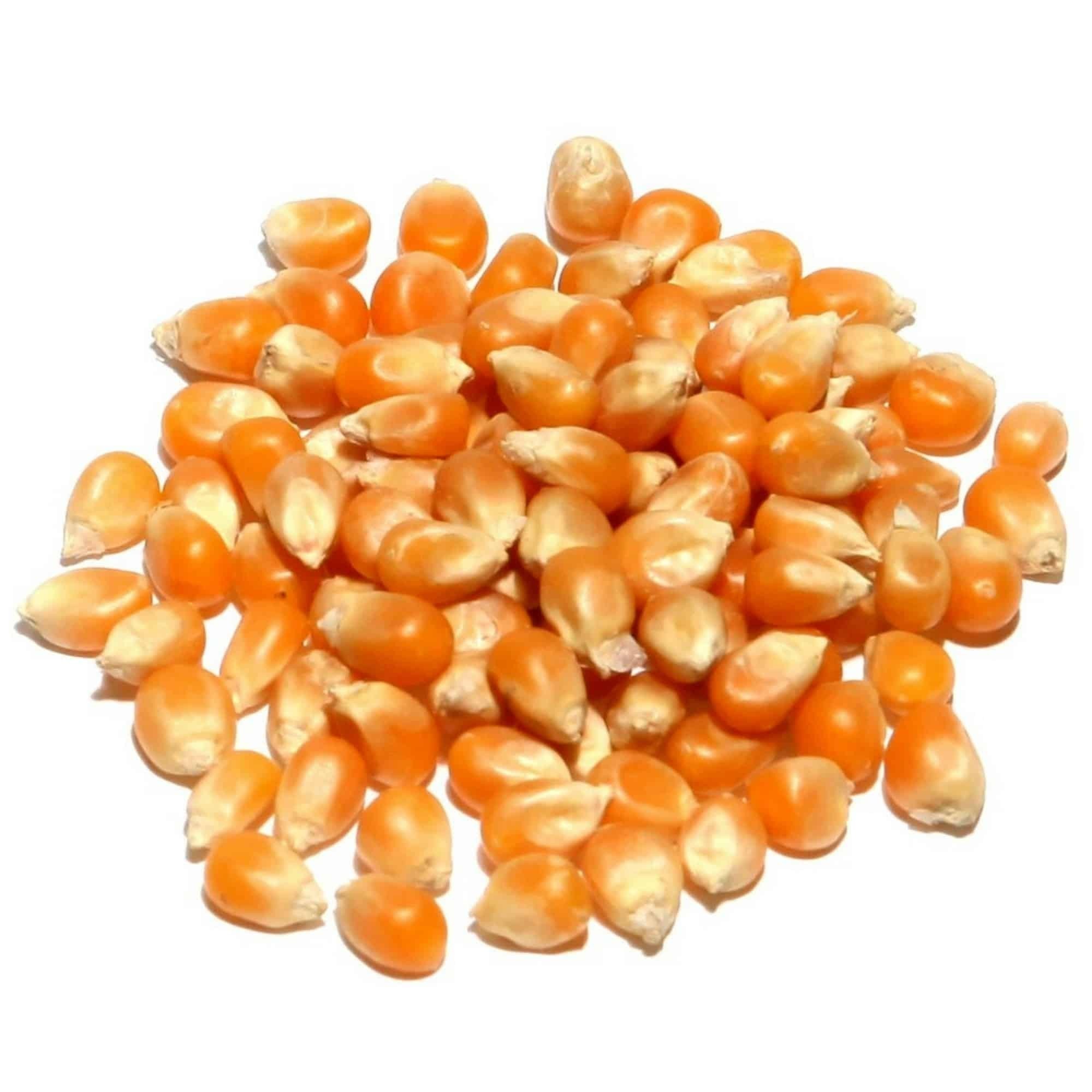
Popcorn varieties are broadly categorized by the shape of the kernels, the color of the kernels, or the shape of the popped corn. While the kernels may come in a variety of colors, the popped corn is always off-yellow or white as it is only the hull (or pericarp) that is colored. "Rice" type popcorn have a long kernel pointed at both ends; "pearl" type kernels are rounded at the top. Commercial popcorn production has moved mostly to pearl types.[21] Historically, pearl popcorn were usually yellow and rice popcorn usually white. Today both shapes are available in both colors, as well as others including black, red, mauve, purple, and variegated. Mauve and purple popcorn usually has smaller and nutty kernels. Commercial production is dominated by white and yellow.[22]

In the popcorn industry, a popped kernel of corn is known as a "flake." Two shapes of flakes are commercially important. "Butterfly" (or "snowflake")[23] flakes are irregular in shape and have a number of protruding "wings". "Mushroom" flakes are largely ball-shaped, with few wings. Butterfly flakes are regarded as having better mouthfeel, with greater tenderness and less noticeable hulls. Mushroom flakes are less fragile than butterfly flakes and are therefore often used for packaged popcorn or confectionery, such as caramel corn.[22] The kernels from a single cob of popcorn may form both butterfly and mushroom flakes; hybrids that produce 100% butterfly flakes or 100% mushroom flakes exist, the latter developed only as recently as 1998.[22] Growing conditions and popping environment can also affect the butterfly-to-mushroom ratio.
When referring to multiple pieces of popcorn, it is acceptable to use the term "popcorn". When referring to a singular piece of popcorn, the accepted terminology is kernel.


Popcorn is a popular snack food at sporting events and in cinemas, where it has been served since the 1930s.[24] Cinemas have come under fire due to their high markup on popcorn; Stuart Hanson, a film historian at De Montfort University in Leicester once said "One of the great jokes in the industry is that popcorn is second only to cocaine or heroin in terms of profit."[25]
Popcorn smell has an unusually attractive quality for human beings. This is largely because it contains high levels of the chemicals 6-acetyl-2,3,4,5-tetrahydropyridine and 2-acetyl-1-pyrroline, very powerful aroma compounds that are used by food and other industries to make products that either smell like popcorn, bread, or other foods containing the compound in nature, or for other purposes.[citation needed]
Popcorn as a breakfast cereal was consumed by Americans in the 1800s and generally consisted of popcorn with milk and a sweetener.[26]
Popcorn balls (popped kernels stuck together with a sugary "glue") were hugely popular around the turn of the 20th century, but their popularity has since waned. Popcorn balls are still served in some places as a traditional Halloween treat. Cracker Jack is a popular, commercially produced candy that consists of peanuts mixed in with caramel-covered popcorn. Kettle corn is a variation of normal popcorn, cooked with white sugar and salt, traditionally in a large copper kettle. Once reserved for specialty shops and county fairs, kettle corn has recently become popular, especially in the microwave popcorn market. The popcorn maker is a relatively new home appliance, and its popularity is increasing because it offers the opportunity to add flavors of the consumer's own choice and to choose healthy-eating popcorn styles.
| Nutritional value per 100 g (3.5 oz) | |
|---|---|
| Energy | 1,598 kJ (382 kcal) |
|
Carbohydrates |
78 g |
| Dietary fiber | 15 g |
|
Fat |
4 g |
|
Protein |
12 g |
| Vitamins | Quantity%DV† |
| Thiamine (B1) |
17% 0.2 mg |
| Riboflavin (B2) |
25% 0.3 mg |
| Minerals | Quantity%DV† |
| Iron |
21% 2.7 mg |
One cup is 8 grams.
|
|
|
|
| †Percentages are roughly approximated using US recommendations for adults. Source: USDA Nutrient Database |
|
Air-popped popcorn is naturally high in dietary fiber and antioxidants,[27] low in calories and fat, and free of sugar and sodium.[28] This can make it an attractive snack to people with dietary restrictions on the intake of calories, fat or sodium. For the sake of flavor, however, large amounts of fat, sugar, and sodium are often added to prepared popcorn, which can quickly convert it to a very poor choice for those on restricted diets.
One particularly notorious example of this first came to public attention in the mid-1990s, when the Center for Science in the Public Interest produced a report about "Movie Popcorn", which became the subject of a widespread publicity campaign. The movie theaters surveyed used coconut oil to pop the corn, and then topped it with butter or margarine. "A medium-size buttered popcorn", the report said, "contains more fat than a breakfast of bacon and eggs, a Big Mac and fries, and a steak dinner combined."[29]The practice continues today. For example, according to DietFacts.com, a small popcorn from Regal Cinema Group (the largest theater chain in the United States)[30] still contains 29 g of saturated fat.[31] the equivalent of a full day-and-a-half's reference daily intake.[32]
However, in studies conducted by the Motion Picture Association of America it was found that the average American only attends six movies a year and that movie theater popcorn and other movie theater snacks are viewed as a treat that is not intended to be part of a regular diet.[33]

Popcorn is included on the list of foods that the American Academy of Pediatrics recommends not serving to children under four, because of the risk of choking.[34]
Microwaveable popcorn represents a special case, since it is designed to be cooked along with its various flavoring agents. One of these formerly common artificial-butter flavorants, diacetyl, has been implicated in causing respiratory illnesses in microwave popcorn factory workers, also known as "popcorn lung." Major manufacturers in the United States have stopped using this chemical, including: Orville Redenbacher's, Act II, Pop Secret and Jolly Time.[citation needed][35][36]
Popcorn, threaded onto a string, is used as a wall or Christmas tree decoration in some parts of North America,[37][38] as well as on the Balkan peninsula.[39]
Some shipping companies have experimented with using popcorn as a biodegradable replacement for expanded polystyrene packing material. However, popcorn has numerous undesirable properties as a packing material, including attractiveness to pests, flammability, and a higher cost and greater density than expanded polystyrene. A more processed form of expanded corn foam has been developed to overcome some of these limitations.[40]
Currently the world's largest popcorn ball (by weight) is located in Sac City, Iowa, and weighs 9,370 pounds (4,250 kg). Former title holders were located in Indianapolis, Indiana, and three more times previously in Sac City.