Chinese Date - Indian Jujube Seeds (Ziziphus mauritiana)
Price for Package of 5 or 10 seeds.
Hardy, Adaptable, Easy to Grow, Fast Growth, Edible Fruit, Fragrant Flowers, Fall Colors, Medicinal, Cold, Heat, Drought, Salt and Wind Tolerant. Ziziphus mauritiana,
Chinese Date - Indian Jujube Seeds (Ziziphus mauritiana)
Price for Package of 5 or 10 seeds.
Hardy, Adaptable, Easy to Grow, Fast Growth, Edible Fruit, Fragrant Flowers, Fall Colors, Medicinal, Cold, Heat, Drought, Salt and Wind Tolerant.
Ziziphus mauritiana, also known as Chinese date, ber, Chinee/Chinkee apple, jujube, Indian plum, พุทรา (Thailand), Regi pandu, Indian jujube, dunks (in Barbados) and masau, is a tropical fruit tree species belonging to the family Rhamnaceae.
Ziziphus mauritiana is a spiny, evergreen shrub or small tree up to 15 m high, with trunk 40 cm or more in diameter; spreading crown; stipular spines and many drooping branches. The fruit is of variable shape and size. It can be oval, obovate, oblong or round, and that can be 1-2.5 in (2.5-6.25 cm) long, depending on the variety. The flesh is white and crisp. When slightly underipe, this fruit is a bit juicy and has a pleasant aroma. The fruit's skin is smooth, glossy, thin but tight.
The species is believed to have originated in Indo-Malaysian region of South-East Asia.[2] It is now widely naturalised throughout the Old World tropics from Southern Africa through the Middle East to the Indian Subcontinent and China, Indomalaya, and into Australasia and the Pacific Islands.[3] It can form dense stands and become invasive in some areas, including Fiji and Australia and has become a serious environmental weed in Northern Australia. It is a fast-growing tree with a medium lifespan, that can quickly reach up to 10–40 ft (3 to 12 m) tall.
In Queensland, Australia, it is known as the Chinee/Chinkee apple as it was believed to be introduced by Chinese miners to areas such as Charters Towers, Ravenswood and Hughenden.
Botany
Ziziphus mauritiana is a medium-sized tree that grows vigorously and has a rapidly developing taproot, a necessary adaptation to drought conditions. The species varies widely in height, from a bushy shrub 1.5 to 2 m tall, to a tree 10 to 12 m tall with a trunk diameter of about 30 cm. Z. mauritiana may be erect or wide-spreading, with gracefully drooping thorny branches, zigzag branchlets, thornless or set with short, sharp straight or hooked spines.
The leaves are alternate, ovate or oblong elliptic with rounded apex, with 3 depressed longitudinal veins at the base. The leaves are about 2.5 to 3.2 cm long and 1.8 to 3.8 cm wide having fine tooth at margin. It is dark-green and glossy on the upper side and pubescent and pale-green to grey-green on the lower side. Depending on the climate, the foliage of the Z. mauritiana may be evergreen or deciduous.
The flowers are tiny, yellow, 5-petalled and are usually in twos and threes in the leaf axils. Flowers are white or greenish white and the fruits are orange to brown, 2–3 cm long, with edible white pulp surrounding a 2-locular pyrene.
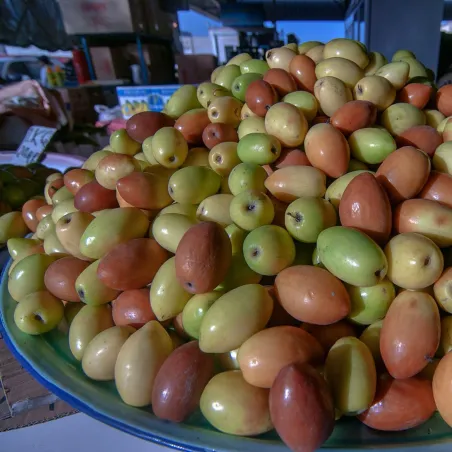
This quick growing tree starts producing fruits within three years. The fruit is a soft, juicy, drupe that is 2.5 cm diameter though with sophisticated cultivation the fruit size may reach up to 6.25 cm long and 4.5 cm wide. The form may be oval, obovate, round or oblong; the skin smooth or rough, glossy, thin but tough. The fruit ripen at different times even on a single tree. Fruits are first green, turning yellow as they ripen. The fully mature fruit is entirely red, soft, juicy with wrinkled skin and has a pleasant aroma. The ripe fruit is sweet and sour in taste. Both flesh texture and taste are reminiscent of apples. When under ripe the flesh is white and crispy, acid to subacid to sweet in taste. Fully ripe fruits are less crisp and somewhat mealy; overripe fruits are wrinkled, the flesh buff-coloured, soft, spongy and musky. At first the aroma is apple like and pleasant but it becomes peculiarly musky when overripe. There is a single, hard, oval or oblate, rough central stone which contains 2 elliptic, brown seeds, 1/4 in (6mm) long.
Ecology
Ziziphus mauritiana is hardy tree that copes with extreme temperatures and thrives under rather dry conditions with an annual rainfall of 6 to 88.5 in (15–225 cm). In Fiji, sometimes naturalised Ber trees grow along roadsides and in agricultural land, usually near sea level but occasionally up to an elevation of about 600 m. It also grows well on laterite, medium black soils with good drainage, or sandy, gravelly, alluvial soil of dry river-beds where it is vigorously spontaneous. In Australia, this species grows on a wide variety of soil types, including cracking clays, solodic soils and deep alluvials, in the tropics and sub-tropics where the average annual rainfall is in the range 470-1200mm. In the drier parts of this range, it grows best in riparian zones.[5] Commercial cultivation usually extends up to 1000 m. Beyond this elevation trees do not perform well, and cultivation becomes less economical.
The tree has a high tolerance to both water-logging and drought and can grow where annual rainfall ranges from 125 to 2,225 mm, but is more widespread in areas with an annual rainfall of 300 to 500 mm. In China and India, wild trees are found up to an elevation of 5,400 ft (1,650 m). In India, the minimum shade temperature for survival is 7–13° and the maximum temperature is 50 °C. Studies report that this species flourishes in alkaline soils with a pH as high as 9.2. However, deep sandy loam to loamy soils with neutral or slightly alkaline pH are considered optimum for growth.[7] In India, the tree grows best on sandy loam, neutral or slightly alkaline.
In India, there are 90 or more cultivars depending on the habit of the tree, leaf shape, fruit form, size, color, flavor, keeping quality, and fruiting season. Among the important cultivars, eleven are described in the encyclopaedic Wealth of India: 'Banarasi (or Banarsi) Pewandi', 'Dandan', 'Kaithli' ('Patham'), 'Muria Mahrara', 'Narikelee', 'Nazuk', 'Sanauri 1', 'Sanauri 5', 'Thornless' and 'Umran' ('Umri'). The skin of most is smooth and greenish-yellow to yellow.
Reproductive biology
Some cultivars attain anthesis early in the morning, others do so later in the day. The flowers are protandrous. Hence, fruit set depends on cross-pollination by insects attracted by the fragrance and nectar. Pollen of the Indian jujube is thick and heavy. It is not airborne but is transferred from flower to flower by honeybees. The flowers are pollinated by ants and other insects, and in the wild state the trees do not set fruits by self-pollination. Ber propagates by seeds, seedlings, direct sowing, root suckers as well as by cuttings. Ber seeds are spread by birds, native animals, stock, feral pigs and humans who eat the fruit and expel the seeds. Seeds may remain viable for 2½ years but the rate of germination declines with age. Cross-incompatibility occurs, and cultivars have to be matched for good fruit set; some cultivars produce good crops parthenocarpically.
Propagation
Ziziphus mauritiana is one of the two Ziziphus species that have considerable horticulture importance, the other being Chinese jujube (Z. zizyphus). Indian jujube is more tropical whereas Chinese jujube is a more cold hardy species.
Propagation is most commonly from seed, where pretreatment is beneficial. Storage of the seed for 4 months to let it after-ripen improves germination. The hard stone restricts germination and cracking the shell or extraction of seeds hastens germination. Without pretreatment the seeds normally germinate within six weeks whereas extracted seeds only need one week to germinate
Seedlings to be used as rootstock can be raised from seed. Several studies indicate that germination can be improved by soaking seeds in sulfuric acid. Germination time can also be shortened to 7 days by carefully cracking the endocarp. Ber seedlings do not tolerate transplanting, therefore the best alternatives are to sow the seeds directly in the field or to use polythene tubes placed in the nursery bed. Seedlings are ready for budding in 3 to 4 months. In addition, seedlings from the wild cultivars can be converted into improved cultivars by top-working and grafting. Nurseries are used for large scale seedling multiplication and graft production. The seedlings should also be given full light. The seedlings may need as long as 15 months in the nursery before planting in the field.
Scientists in India have standardised propagation techniques for Ber establishment. Budding is the easiest method of vegetative propagation used for improved cultivars. Different types of budding techniques have been utilised with ring-budding and shield-budding being the most successful. Wild varieties of ber are usually used as the root-stock. The most common being Z. rotundifolia in India and Z. spina-christi in Africa.
Season and harvesting
Plants are capable of seed production once they reach a height of about 1 metre. Wild-growing plants in northern Australia may take 8 years to reach this size. In Australia, plants growing under natural conditions are capable of producing seeds once they reach a height of about 1m. Plants between 1 and 2m high produce, on average, less than five fruits per season. Large plants (>5m high) can produce 5000 or more fruits in a single season.
In India, some types ripen as early as October, others from mid-February to mid-March, others in March, or mid-March, to the end of April. In the Assiut Governorate, there are 2 crops a year, the main in early spring, the second in the fall. In India the trees flower in July to October and fruits are formed soon after. In February–March the fruits are mature and in some places a second crop is produced in the fall. Pickings are done by hand from ladders and about 110 lbs (50 kg)is harvested per day. The fruits remaining on the tree are shaken down. Only fully mature fruits are picked directly from the tree. They are transported in open bags to avoid fermentation.
Seedling trees bear 5,000 to 10,000 small fruits per year in India. Superior grafted trees may yield as many as 30,000 fruits. The best cultivar in India, with fruits normally averaging 30 to the lb (66 to the kg), yields 175 lbs (77 kg) annually. Special cultural treatment increases both fruit size and yield.
World production and yield
The major production regions for Indian jujube are the arid and semi arid regions of India. From 1984 to 1995 with improved cultivars the production was 0.9 million tonnes on a land of 88,000 ha. The crop is also grown in Pakistan, Bangladesh and parts of Africa. Trees in northern India yield 80 to 200 kg of fresh fruit/tree/year when the trees are in their prime bearing age of 10–20 years.
Uses
The fruit is eaten raw, pickled or used in beverages. It is quite nutritious and rich in vitamin C. It is second only to guava and much higher than citrus or apples. In India, the ripe fruits are mostly consumed raw, but are sometimes stewed. Slightly underripe fruits are candied by a process of pricking, immersing in a salt solution. Ripe fruits are preserved by sun-drying and a powder is prepared for out-of-season purposes. It contains 20 to 30% sugar, up to 2.5% protein and 12.8% carbohydrates. Fruits are also eaten in other forms, such as dried, candied, pickled, as juice, or as ber butter. In Ethiopia, the fruits are used to stupefy fish.
The leaves are readily eaten by camels, cattle and goats and are considered nutritious.
In India and Queensland, the flowers are rated as a minor source of nectar for honeybees. The honey is light and of fair flavor.
Ber timber is hard, strong, fine-grained, fine-textured, tough, durable, and reddish in colour. It has been used to line wells, to make legs for bedsteads, boat ribs, agricultural implements, tool handles, and other lathe-turned items. The branches are used as framework in house construction and the wood makes good charcoal with a heat content of almost 4,900 kcal per kg.[1] In addition, this species is used as firewood in many areas. In tropical Africa, the flexible branches are wrapped as retaining bands around conical thatched roofs of huts, and are twined together to form thorny corral walls to retain livestock.
The fruits are applied on cuts and ulcers; are employed in pulmonary ailments and fevers; and, mixed with salt and chili peppers, are given in indigestion and biliousness. The dried ripe fruit is a mild laxative. The seeds are sedative and are taken, sometimes with buttermilk, to halt nausea, vomiting, and abdominal pains in pregnancy. They check diarrhea, and are poulticed on wounds. Mixed with oil, they are rubbed on rheumatic areas. The leaves are applied as poultices and are helpful in liver troubles, asthma and fever and, together with catechu, are administered when an astringent is needed, as on wounds. The bitter, astringent bark decoction is taken to halt diarrhea and dysentery and relieve gingivitis. The bark paste is applied on sores. The root is purgative. A root decoction is given as a febrifuge, taenicide and emmenagogue, and the powdered root is dusted on wounds. Juice of the root bark is said to alleviate gout and rheumatism. Strong doses of the bark or root may be toxic. An infusion of the flowers serves as an eye lotion.
The fatty-acid methyl ester of Z. mauritiana seed oil meets all of the major biodiesel requirements in the USA (ASTM D 6751-02, ASTM PS 121-99), Germany (DIN V 51606) and European Union (EN 14214). The average oil yield is 4.95 kg oil/tree or 1371 kg oil/hectare, and arid or semi-arid regions may be utilised due to its drought resistance.
Pests and diseases
The greatest enemies of the jujube are fruit flies. Some cultivars are more susceptible than others, the flies preferring the largest, sweetest fruits, 100% of which may be attacked while on a neighbouring tree, bearing a smaller, less-sweet type, only 2% of the crop may be damaged. The larvae pupate in the soil and it has been found that treatment of the ground beneath the tree helps reduce the problem. Control is possible with regular and effective spraying of insecticide.
A leaf-eating caterpillar and the green slug caterpillar attack the foliage. Mites form scale-like galls on twigs, retarding growth and reducing the fruit crop. Lesser pests include a small caterpillar, Meridarches scyrodes, that bores into the fruit.
The tree is subject to shrouding by a parasitic vine . Powdery mildew causes defoliation and fruit-drop, but it can be adequately controlled. Lesser diseases are sooty mould, brown rot and leaf-spot. Leafspot results from infestation by Cercospora spp. and Isariopsis indica var. zizyphi. In 1973, a witches'-broom disease caused by a mycoplasma-like organism was found in jujube plants near Poona University. It proved to be transmitted by grafting or budding diseased scions onto healthy Z. mauritiana seedlings. Leaf rust, caused by Phakopsora zizyphivulgaris, ranges from mild to severe on all commercial cultivars in the Punjab.
In storage, the fruits may be spotted by fungi. Fruit rots are caused by Fusarium spp., Nigrospora oryzae, Epicoccum nigrum, and Glomerella cingulata.
We verzenden wereldwijd vanuit de Europese Unie per aangetekende luchtpost met handtekeningbevestiging bij bezorging.
📦Uw bestelling volgen Log in op je account en navigeer naarBestelgeschiedenis > Details om uw trackingnummer te vinden.
Je ontvangt e-mailmeldingen voor elke fase van je bestelling. Als je deze berichten niet ziet, controleer dan je map Spam/Ongewenste e-mail of neem contact op met je e-mailprovider. Als alternatief kun je online zoeken naar hoe je e-mails van een afzender kunt deblokkeren.
ONZE E-MAILDIENST WERKT
U ontvangt e-mailmeldingen voor elke fase van uw bestelling. Als u deze berichten niet ziet, controleer dan uw map Spam/Ongewenste e-mail of neem contact op met uw e-mailprovider.
📧Hoe u ervoor zorgt dat e-mails van onze webshop altijd in uw Gmail terechtkomenof een andere e-mailvan de providerIn de inbox en niet als spam gemarkeerd of geblokkeerd:
Voeg de Afzender toe aan de contacten van uw Google-account of van een andere e-mailprovider. We kunnen u niet helpen als uw instellingen er niet zo uitzien. Neem contact op met uw e-mailprovider voor hulp.
Stap 1: Open Gmail en zoek een e-mail van ons xxxxxxxxxxxx@xxx.com Probeer ons niet rechtstreeks een e-mail naar dit adres te sturen; we zullen die niet ontvangen. Elk contact verloopt uitsluitend via het contactformulier in onze online shop! Als je onze e-mail niet kunt vinden, is deze mogelijk geblokkeerd. Ga in dat geval verder met Stap 4 hieronder.
Stap 2: Beweeg de muisaanwijzer over de naam van de afzender of het e-mailadres bovenaan de e-mail.
Stap 3Klik op het pictogram "Toevoegen aan contacten" (het pictogram van een klein persoonnetje).
Dit helpt Gmail ons te herkennen als een vertrouwde afzender, zodat onze e-mails rechtstreeks in je inbox terechtkomen en niet in de spam.
Maak een filter om te voorkomen dat e-mails als spam worden gemarkeerd of geblokkeerd
Stap 1: Open Gmail en klik op het tandwielpictogram rechtsboven, selecteer vervolgens "Alle instellingen bekijken".
Stap 2: Ga naar het tabblad "Filters en geblokkeerde adressen".
Stap 3: Klik op "Maak een nieuw filter aan".
Stap 4: Voer in het veld "From" het e-mailadres in dat u op de witte lijst wilt zetten (e.g., het e-mailadres van onze winkel).
Stap 5: Klik op "Filter maken".
Stap 6: Vink in het volgende venster het vakje met het label "Nooit naar Spam sturen" aan.
Stap 7: Klik op "Filter maken" om op te slaan.
Dit zorgt ervoor dat onze e-mails altijd in uw inbox terechtkomen en niet per ongeluk als spam worden gemarkeerd of geblokkeerd.
Volg uw pakket via:
Aftership
17Track
Posta.hr (voor trackingnummers zoals RGxxxxxxHR)
⚠️Belangrijke mededelingen
Contant bij aflevering isNIETBeschikbaar.
Geef bij het bestellen altijd een geldig mobiel nummer met landcode op (e.g., +365 456 7686 576).
Beveel niet om P.O. Dozen, of als u niet thuis kunt zijn om voor het pakket te tekenen, mogen pakketten niet bij buren worden achtergelaten.
Als een pakket gestuurd naar een P.O. Als de doos verloren is gegaan of niet is afgeleverd, wordt er geen terugbetaling verleend.
⚖️Verantwoordelijkheid van de klant voor naleving van wet- en regelgeving De klant is verantwoordelijk ervoor te zorgen dat het product legaal in hun land kan worden geïmporteerd, inclusief het naleven van alle importvoorschriften, het verkrijgen van de benodigde vergunningen en het betalen van toepasselijke douaneheffingen, belastingen en andere kosten. Controleer alstublieft uw lokale wetgeving voordat u bestelt om eventuele problemen met de douane of levering te voorkomen.
📦Verloren, Geretourneerde & Opnieuw Verzonden Pakketten
Brazilië & Mexico Klanten:We kunnen geen restitutie geven voor pakketten die door de douane verloren zijn gegaan of vernietigd zijn.
Als uw pakket wordt geretourneerd, zullen wij alleen de productkosten terugbetalen — verzendkosten zijn niet restitueerbaar.
Retourporto (€2) en eventuele kosten voor herverzending moeten door de klant worden betaald.
Als een pakket om welke reden dan ook naar ons wordt teruggestuurd, bent u verantwoordelijk voor het betalen van de retourverzendkosten (€2) plus de kosten om het pakket opnieuw te verzenden.
🚚Levering van zending Aangetekende zendingen vereisen een handtekening.
Als uw tracking aangeeft dat het pakket nog bij het postkantoor van vertrek is, is het onderweg — neem contact op met uw plaatselijke postkantoor voor updates.
Helaas kunnen noch wij, noch het postkantoor waarmee je bestelling is verzonden, je helpen met de vraag waar je bestelling is. Wanneer je ziet dat je pakket in je land is,je MOET contact opnemen met je postkantoor met het track & trace-nummerEn bespreek de zaak met hen. Wij verzenden alle bestellingen per officiële staatspost.
Wij zijn niet verantwoordelijk voor levertijden en kunnen zendingen niet voor u volgen.
📅Bezorgopties & Geschatte Tijden
Bezorgoptie
Verwerkingstijd
Notities
Prioritaire levering
Wordt verzonden binnen 1–7 werkdagen
Prioriteert orderverwerking (geen gegarandeerd snellere levering); vertragingen mogelijk tijdens feestdagen (3–10 dagen)
Beveiligde Levering
Wordt verzonden binnen 1–7 werkdagen
Beschikbaar voor bestellingen tot €150; terugbetaling bij verlies
Standaard levering
Verzending binnen 7–10 werkdagen
Goedkoper; tijdens feestdagen kunnen vertragingen optreden (7–14 dagen)
Geschatte levertijd:
Binnen de EU: 3–20 dagen
Wereldwijd: 5–30 dagen
Voorbeelden uit de VS:Geleverd in 13, 17, 19, 22, of 27 dagen.
Opmerking:De levertijden zijn afhankelijk van uw locatie en de lokale postdienst. COVID-19 of de feestdagen kunnen extra vertragingen veroorzaken.
💰Verzendkosten Verzend- en afhandelingskosten worden automatisch berekend bij het afrekenen op basis van het gewicht van het pakket en de bestemming.
⏰Verwerkingstijden voor bestellingen We verwerken of verzenden geen bestellingen op zaterdag of zondag.
💳 Betaalopties
Bankoverschrijving (SEPA / IBAN / SWIFT-BIC) Vermeld uw bestelreferentie in de betalingsomschrijving (e.g., "SGS-19811702"). Bestellingen zonder betaling binnen 7 dagen worden automatisch geannuleerd.
PayPal Betalingen worden alleen in euro's geaccepteerd. Selecteer alstublieft euro's tijdens het afrekenen.
Kaartbetaling We accepteren Visa, MasterCard, American Express, CB, Diners Club, Discover, China UnionPay, JCB, en Discover.
⚠️Transactiekosten Klanten zijn verantwoordelijk voor eventuele bank- of PayPal-transactiekosten. Zorg alstublieft dat de betalingsgegevens correct zijn voor een snellere verwerking van uw bestelling.
📢Slotopmerkingen Controleer voor het plaatsen van uw bestelling altijd onze website op speciale mededelingen, bezorgschema's tijdens feestdagen of specifieke verzendvoorwaarden die uw aankoop kunnen beïnvloeden.
Belangrijke mededeling: Digitale facturen
Om papierafval te verminderen voegen we geen papieren factuur bij je bestelling. Je kunt je factuur op elk gewenst moment eenvoudig downloaden en afdrukken door je Bestelgeschiedenis in je accountprofiel