Quinoa (/ˈkiːnwɑː/, from Quechua kinwa or kinuwa ) is a species of the goosefoot genus (Chenopodium quinoa), a grain crop grown primarily for its edible seeds.
Quinoa (/ˈkiːnwɑː/, from Quechua kinwa or kinuwa ) is a species of the goosefoot genus (Chenopodium quinoa), a grain crop grown primarily for its edible seeds. It is a pseudocereal rather than a true cereal, as it is not a member of the true grass family. As a chenopod, quinoa is closely related to species such as beetroots, spinach and tumbleweeds. As a member of the Amaranthaceae family, it is related to and resembles amaranth, which is also a pseudocereal.
It is high in protein, and is tolerant of dry soil.
Quinoa (the name is derived from the Spanish spelling of the Quechua name kinwa) originated in the Andean region of Peru, Bolivia, Ecuador, Chile and Colombia, where it was domesticated 3,000 to 4,000 years ago for human consumption, though archaeological evidence shows a non-domesticated association with pastoral herding some 5,200 to 7,000 years ago.
Similar Chenopodium species, such as pitseed goosefoot (Chenopodium berlandieri) and fat hen (Chenopodium album), were grown and domesticated in North America as part of the Eastern Agricultural Complex before maize agriculture became popular. Fat hen, which has a widespread distribution in the Northern Hemisphere, produces edible seeds and greens much like quinoa, but in smaller quantities.
The nutrient composition is favourable compared with common cereals. Quinoa seeds contain essential amino acids like lysine and acceptable quantities of calcium, phosphorus, and iron.
After harvest, the seeds must be processed to remove the coating containing the bitter-tasting saponins. The seeds are in general cooked the same way as rice and can be used in a wide range of dishes. The leaves are eaten as a leaf vegetable, much like amaranth, but commercial availability of quinoa greens is limited.
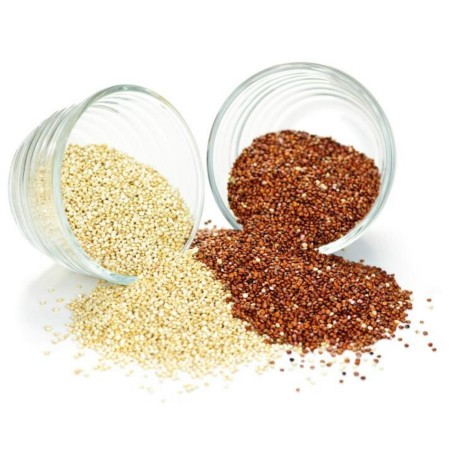
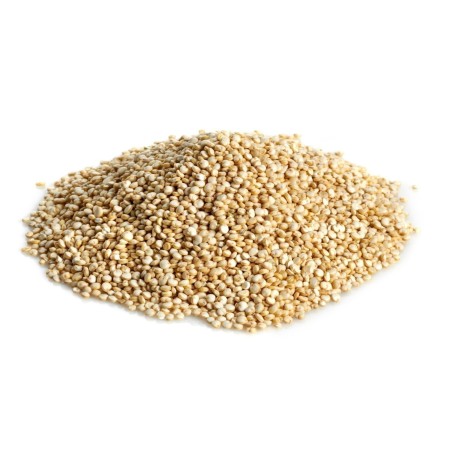
Chenopodium quinoa is a dicotyledonous annual plant usually about 1–2 metres (3.3–6.6 ft) high. It has broad, generally pubescent, powdery, smooth (rarely) to lobed leaves normally arranged alternately. The woody central stem is branched or unbranched depending on the variety and may be green, red or purple. The flowering panicles arise from the top of the plant or from leaf axils along the stem. Each panicle has a central axis from which a secondary axis emerges either with flowers (amaranthiform) or bearing a tertiary axis carrying the flowers (glomeruliform). The green hypogynous flowers have a simple perianth and are generally bisexual and self-fertilizing. The fruits are about 2 millimetres (0.079 in) in diameter and of various colours—from white to red or black, depending on the cultivar.
Natural distribution
Chenopodium quinoa is believed to have been domesticated in the Peruvian Andes from wild or weed populations of the same species. There are non-cultivated quinoa plants (Chenopodium quinoa var. melanospermum) that grow in the area it is cultivated; these may either be related to wild predecessors, or they could be descendants of cultivated plants.
Saponin content
In their natural state, the seeds have a coating of bitter-tasting saponins, making them unpalatable. Most of the grain sold commercially has been processed to remove this coating. This bitterness has beneficial effects during cultivation, as it is unpopular with birds and therefore requires minimal protection. The genetic control of bitterness involves quantitative inheritance; lowering the saponin content through selective breeding to produce sweeter, more palatable varieties is complicated by about 10% cross-pollination.
The toxicity category rating of quinoa saponins treats them as mild eye and respiratory irritants and as a low gastrointestinal irritant. The saponin is a toxic glycoside, a main contributor to its hemolytic effects when combined directly with blood cells. In South America, quinoa saponin has many uses, including as a detergent for clothing and washing and as an antiseptic for skin injuries. High levels of oxalic acid are in the leaves and stems of all species of the Chenopodium genus, and are also in the related genera of the Amaranthaceae family. The risks associated with quinoa are minimal, provided it is properly prepared and the leaves are not eaten to excess.
Nutritional value
Quinoa was important to the diet of pre-Columbian Andean civilizations. Quinoa grain has been called a superfood, a term which is not in common use by dietitians and nutrition scientists. Protein content is very high for a cereal/pseudo-cereal (14% by mass), but not as high as most beans and legumes. This includes a "low gluten content" that appears to be well tolerated when consumed at normal levels by people with celiac disease. The protein content per 100 calories is higher than brown rice, potatoes, barley and millet, but is less than wild rice and oats. Nutritional evaluations indicate that quinoa is a source of complete protein. Other sources claim its protein is not complete but relatively high in essential amino acids. Other pseudo grains derived from seeds are similar in complete protein levels; buckwheat is 18% protein compared to 14% for Quinoa; Amaranth, a related species to Quinoa, ranges from 12% to 17.5%.
Quinoa is a rich source (>20% of the Daily value, DV) of the B vitamins thiamine, riboflavin, vitamin B6, and folate and is a rich source of the dietary minerals iron, magnesium, phosphorus, and zinc. Quinoa is also a good source (10-19% of DV) of the B vitamins niacin and pantothenic acid, vitamin E, and the dietary mineral potassium. The pseudo cereal contains a modest amount of calcium, and thus is useful for vegans and those who are lactose intolerant. It is gluten-free and considered easy to digest. Because of these characteristics, it is being considered a possible crop in NASA's Controlled Ecological Life Support System for long-duration human occupied space flights.
The grain may be germinated in its raw form to boost its nutritional value, provided that the grains are rinsed thoroughly to remove any saponin.[26] It has a notably short germination period: only 2–4 hours in a glass of clean water is enough to make it sprout and release gases, as opposed to 12 hours with wheat. This process, besides its nutritional enhancements, softens the seeds, making them suitable to be added to salads and other cold foods.
Cultivation
The plant's growth is highly variable due to a high complexity of different subspecies, varieties and landraces (domesticated plants or animals adapted to the environment in which they originated). However, in general it is undemanding and altitude-hardy. It is grown from coastal regions to over 4,000 m (13,000 ft) in the Andes near the equator, with most of the cultivars being grown between 2,500 metres (8,200 ft) and 4,000 metres (13,000 ft). Depending on the variety, optimal growing conditions are in cool climates with temperatures that vary between −4 °C (25 °F) during the night to near 35 °C (95 °F) during the day. Some cultivars can withstand lower temperatures without damage. Light frosts normally do not affect the plants at any stage of development, except during flowering. Mid-summer frosts during flowering, often occurring in the Andes, lead to sterilization of the pollen. Rainfall conditions are highly variable between the different cultivars, ranging from 300 to 1,000 millimetres (12 to 39 in) during growing season. Growth is optimal with well-distributed rainfall during early growth and development and dry conditions during seed maturation and harvesting.
Quinoa has been cultivated in the United States, primarily in the high elevation San Luis Valley (SLV) of Colorado where it was introduced in 1982. In this high-altitude desert valley, maximum summer temperatures rarely exceed 30 °C (86 °F) and night temperatures are about 7 °C (45 °F). Due to the short growing season, North American cultivation requires short-maturity varieties, typically of Bolivian origin.
Sowing
Quinoa plants do best in sandy, well-drained soils with a low nutrient content, moderate salinity, and a soil pH of 6 to 8.5.
The seedbed must be well prepared and drained to avoid waterlogging. In the Andes, the seeds are normally broadcast over the land and raked into the soil. Sometimes it is sown in containers of soil and transplanted later.
Cultivation management
Yields are maximised when 170 to 200 kg (370 to 440 lb) N/hectare is available.[citation needed] The addition of phosphorus does not improve yield. In eastern North America, it is susceptible to a leaf miner that may reduce crop success and which also affects the common weed and close relative Chenopodium album, but C. album is much more resistant.
History and culture
Early history
Quinoa was first domesticated by Andean peoples around 3,000 to 4,000 years ago. It has been an important staple in the Andean cultures where the plant is indigenous but relatively obscure in the rest of the world. The Incas, who held the crop to be sacred, referred to it as chisaya mama or "mother of all grains", and it was the Inca emperor who would traditionally sow the first seeds of the season using "golden implements". During the Spanish conquest of South America, the colonists scorned it as "food for Indians", and suppressed its cultivation, due to its status within indigenous religious ceremonies. The conquistadors forbade quinoa cultivation for a time and the Incas were forced to grow wheat instead.
The grain has become increasingly popular in the United States, Canada, Europe, Australia, China and Japan where it is not typically grown, increasing crop value. Between 2006 and early 2013 quinoa crop prices tripled. In 2011, the average price was US$3,115 per ton with some varieties selling as high as $8,000 per ton. This compares with wheat prices of $9 per bushel (about $340 per ton). Since the 1970s, producers’ associations and cooperatives have worked toward greater producer control of the market. The higher prices make it harder for people to purchase, but also brings a livable income for farmers and enables many urban refugees to return to working the land.
The popularity of quinoa grain in non-indigenous regions has raised concerns over food security. Due to continued widespread poverty in regions where it is produced and because few other crops are compatible with the soil and climate in these regions, it has been suggested that the inflated price disrupts local access to food supplies. In 2013, The Guardian compared it to asparagus cultivated in Peru, a cash crop criticized for excessive water use, as "feeding our apparently insatiable 365-day-a-year hunger for this luxury vegetable" It has been suggested that, as people rise above subsistence-level income, they choose higher-status Western processed foods. However, anthropologist Pablo Laguna states that farmers are still saving a portion of the quinoa crop for their own use, and that the high prices affect nearby city dwellers more, but consumption in cities has traditionally been lower. According to Laguna, the net benefit of increased revenue for farmers outweighs the costs, saying that it is "very good news for small, indigenous farmers". The transformation from a healthy staple food for farming families and communities into a product that is held to be worth too much to keep for oneself and one's family is an ongoing process. It is seen as a valuable resource that can bring in far greater amounts[clarification needed] of cheap, low nutrient foods such as pasta and rice. It used to be seen as a peasant food that provided farming families with a very important source of nutrition, but now occupies a spectrum from an everyday food of urban Bolivia's middle class to a luxury food in the Peruvian capital of Lima where "it sells at a higher per pound price than chicken, and four times as much as rice". Efforts are being made in some areas to distribute it more widely and ensure that farming and poorer populations have access to it and have an understanding of its nutritional importance. These include incorporating it into free school breakfasts and in government provisions distributed to pregnant and nursing women in need.
Kosher controversy
Quinoa has become popular in the Jewish community as a substitute for the leavened grains that are forbidden during the Passover holiday. Several kosher certification organizations refuse to certify it as being kosher for Passover, citing reasons including its resemblance to prohibited grains or fear of cross-contamination of the product from nearby fields of prohibited grain or during packaging.
In December 2013, the Orthodox Union, the world's largest kosher certification agency, announced it would begin certifying quinoa as kosher for Passover.
International Year of Quinoa
The United Nations General Assembly declared 2013 as the "International Year of Quinoa" in recognition of ancestral practices of the Andean people, who have preserved it as food for present and future generations, through knowledge and practices of living in harmony with nature. The objective is to draw the world’s attention to the role that quinoa could play in providing food security, nutrition and poverty eradication, in support of achieving Millennium Development Goals.
The Food and Agriculture Organization of the United Nations is as the Secretariat of the international year. Bolivia has the presidency of the Coordination Committee and Ecuador, Peru and Chile share the vice presidency, with the rapporteurship in the hands of Argentina and France.
KategóriaKezdőlapCikkszámVE-232-CKészleten9922 Elemek
A jelentésed beküldve, és egy moderátor megvizsgálja.
Jelentésed beküldése nem lehetséges
Vélemény elküldve
A hozzászólásodat elküldtük és elérhető lesz, amint egy moderátor jóváhagyja.
Véleményed nem lehet elküldeni
🌍Szállítás világszerte az EU-ból
A világ minden tájára szállítunk az Európai Unióból, ajánlott légipostával, kézbesítéskor aláírásos visszaigazolással.
📦Rendelés követése Jelentkezz be a fiókodba, és navigálj aRendelési előzmények > Részletek hogy megtalálja a nyomonkövetési számát.
A rendelésed minden szakaszáról e-mail értesítést kapsz. Ha nem látod ezeket az üzeneteket, kérjük, ellenőrizd a Spam/Kéretlen levelek mappádat, vagy lépj kapcsolatba az e-mail szolgáltatóddal. Alternatívaként keress az interneten útmutatót arról, hogyan szüntetheted meg egy feladó e-mailjeinek blokkolását.
AZ E-MAIL SZOLGÁLTATÁSUNK MŰKÖDIK
Rendelésed minden egyes szakaszáról e-mail értesítést fogsz kapni. Ha nem látod ezeket az üzeneteket, kérjük, ellenőrizd a Spam/Junk mappádat, vagy lépj kapcsolatba az e-mail szolgáltatóddal.
📧Hogyan biztosítsuk, hogy a webshopunkból érkező e-mailek mindig a Gmail-fiókodba érkezzenekvagy bármely más e-mailszolgáltatóéMegérkeznek a Beérkező mappába, és nincsenek spamként megjelölve vagy blokkolva:
Adja hozzá a Feladót a Google- vagy bármely más e-mail szolgáltató névjegyeihez. Nem tudunk segíteni, ha a beállításai nem ilyenek. Forduljon segítségért az e-mail szolgáltatójához.
1. lépés: Nyisd meg a Gmailt, és keresd meg tőlünk érkező e-mailt xxxxxxxxxxxx@xxx.com Ne próbáljon nekünk közvetlenül erre a címre e-mailt küldeni; azt nem fogjuk megkapni. Minden kapcsolatfelvétel kizárólag webáruházunk kapcsolati űrlapján keresztül történik! Ha nem találod az e-mailünket, előfordulhat, hogy blokkolták. Ebben az esetben folytasd az alábbi 4. lépéssel.
2. lépés: Az e-mail tetején vidd az egérmutatót a feladó nevére vagy e-mail-címére.
3. lépés: Kattintson az "Add to Contacts" ikonra (a kis ember-ikonra).
Ez segít a Gmailnek, hogy megbízható küldőként ismerjen el minket, így az e-mailjeink közvetlenül a postaládádba kerülnek, és nem a spam mappába.
Hozzon létre egy szűrőt, hogy az e-mailek ne legyenek spamnek jelölve vagy letiltva
1. lépés: Nyisd meg a Gmailt, és kattints a jobb felső sarokban található fogaskerék ikonra, majd válaszd a "See all settings" lehetőséget.
2. lépés: Lépj a "Szűrők és letiltott címek" fülre.
3. lépés: Kattintson a "Hozzon létre egy új szűrőt".
4. lépés: A "From" mezőbe írja be azt az e-mail címet, amelyet fel szeretne venni a fehérlistára (e.g., boltunk e-mail címe).
5. lépés: Kattintson a "Szűrő létrehozása" gombra.
6. lépés: A következő ablakban jelölje be a "Soha ne küldje a Spam mappába" feliratú négyzetet.
7. lépés: Kattintson a "Szűrő létrehozása" gombra a mentéshez.
Ez biztosítja, hogy e-mailjeink mindig a beérkező levelek közé kerüljenek, és véletlenül se legyenek spamként megjelölve vagy letiltva.
Kövesse nyomon csomagját ezen keresztül:
Aftership
17Track
Posta.hr (olyan nyomkövetési számokhoz, mint RGxxxxxxHR)
⚠️Fontos értesítések
Utánvételes fizetésNEMElérhető.
Rendeléskor mindig adjon meg érvényes mobiltelefonszámot országkóddal (e.g., +365 456 7686 576).
Ne utasíts arra, hogy P.O. Dobozokat, illetve — ha nem tud otthon lenni, hogy aláírja a csomagot — csomagokat nem lehet a szomszédoknál hagyni.
Ha egy csomagot küldenek egy P.O. A doboz elvesztése vagy kézbesítetlensége esetén nem jár visszatérítés.
⚖️Ügyfél felelőssége a jogi megfelelésért A vevő felel azért, hogy a termék behozatala az ő országába jogszerű legyen, ideértve az összes vonatkozó importszabály betartását, a szükséges engedélyek beszerzését, valamint a vonatkozó vámok, adók és egyéb díjak megfizetését. Kérjük, ellenőrizze a helyi jogszabályokat megrendelés előtt, hogy elkerülje az esetleges problémákat a vámkezeléssel vagy a kézbesítéssel.
📦Elveszett, Visszaküldött & Újraküldött Csomagok
Brazília & Mexikó ügyfelei:Nem tudunk visszatérítést nyújtani a vám által elveszett vagy megsemmisített csomagokért.
Ha a csomagodat visszaküldik, csak a termék árát térítjük vissza — a szállítási költségeket nem térítjük vissza.
A visszaküldés postaköltségét (€2) és az esetleges újraküldési költségeket a vásárlónak kell fedeznie.
Ha egy csomag bármilyen okból visszaérkezik hozzánk, Ön köteles megfizetni a visszaküldés szállítási költségét (€2), valamint az újraküldés díját.
🚚Szállítmány kézbesítése Az ajánlott küldeményekhez aláírás szükséges.
Ha a nyomkövetés szerint a csomag még az induló postánál van, az úton van — lépjen kapcsolatba a helyi postával a frissítésekért.
Sajnos sem mi, sem az a posta, amelyen keresztül a rendelésed feladásra került, nem tud segíteni a rendelésed hollétével kapcsolatban. Amikor látod, hogy a csomagod az országodban van,KÖTELEZŐ felvenned a kapcsolatot a postával a nyomkövetési számmalés beszélje meg velük az ügyet. Minden megrendelést hivatalos állami postán küldünk.
Nem vagyunk felelősek a kézbesítési időkért, és nem tudjuk az Ön helyett nyomon követni a küldeményeket.
📅 Szállítási Lehetőségek & Várható Kézbesítési Idők
Szállítási lehetőség
Feldolgozási idő
Jegyzetek
Elsőbbségi kézbesítés
Szállítjuk 1–7 munkanapon belül
A rendelés feldolgozását részesíti előnyben (a gyorsabb kézbesítés nem garantált); ünnepek alatt késések lehetségesek (3–10 nap).
Biztonságos Kézbesítés
Szállítjuk 1–7 munkanapon belül
Legfeljebb 150 € értékű rendelésekre érvényes; elvesztés esetén visszatérítjük.
Normál Kiszállítás
Feladás 7–10 munkanapon belül
Gazdaságosabb; ünnepek alatt késések előfordulhatnak (7–14 nap)
Becsült kézbesítési idő:
Az EU-n belül: 3–20 nap
Világszerte: 5–30 nap
USA példák:Kiszállítás 13, 17, 19, 22 vagy 27 napon belül.
Megjegyzés:A kézbesítési idők az Ön tartózkodási helyétől és a helyi postai rendszer működésétől függenek. A COVID-19 vagy az ünnepi időszakok további késéseket okozhatnak.
💰Szállítási költségek A szállítási és kezelési díjakat a pénztárnál automatikusan számítjuk ki a csomag súlya és a rendeltetési hely alapján.
⏰Rendelések feldolgozási ideje Szombaton és vasárnap nem dolgozzuk fel és nem küldjük ki a megrendeléseket.
💳Fizetési lehetőségek
Banki átutalás (SEPA / IBAN / SWIFT-BIC) A fizetési közleményben tüntesse fel a rendelés azonosítóját (e.g., "SGS-19811702"). A 7 napon belül be nem fizetett rendelések automatikusan törlésre kerülnek.
PayPal A fizetés csak euróban fogadható el. Kérjük, a fizetés során válassza az eurót.
Kártyás fizetés Elfogadjuk a Visa, MasterCard, American Express, CB, Diners Club, Discover, China UnionPay, JCB és Discover kártyákat.
⚠️Tranzakciós díjak A vásárlók felelősek bármilyen banki vagy PayPal tranzakciós díjért. Kérjük, adja meg a pontos fizetési adatokat a gyorsabb rendelésfeldolgozás érdekében.
📢Záró megjegyzések Mielőtt leadná a rendelését, mindig ellenőrizze weboldalunkat az esetleges különleges közlemények, ünnepi nyitvatartások vagy olyan szállítási feltételek miatt, amelyek befolyásolhatják a vásárlását.
Fontos értesítés: Digitális számlák
A papírhulladék csökkentése érdekében a rendeléséhez nem mellékelünk nyomtatott számlát. Számláját bármikor egyszerűen letöltheti és kinyomtathatja, ha ellátogat a fiókjábaRendelési Előzmények a fiókod profiljában