Quinoa (/ˈkiːnwɑː/, from Quechua kinwa or kinuwa ) is a species of the goosefoot genus (Chenopodium quinoa), a grain crop grown primarily for its edible seeds.
Quinoa (/ˈkiːnwɑː/, from Quechua kinwa or kinuwa ) is a species of the goosefoot genus (Chenopodium quinoa), a grain crop grown primarily for its edible seeds. It is a pseudocereal rather than a true cereal, as it is not a member of the true grass family. As a chenopod, quinoa is closely related to species such as beetroots, spinach and tumbleweeds. As a member of the Amaranthaceae family, it is related to and resembles amaranth, which is also a pseudocereal.
It is high in protein, and is tolerant of dry soil.
Quinoa (the name is derived from the Spanish spelling of the Quechua name kinwa) originated in the Andean region of Peru, Bolivia, Ecuador, Chile and Colombia, where it was domesticated 3,000 to 4,000 years ago for human consumption, though archaeological evidence shows a non-domesticated association with pastoral herding some 5,200 to 7,000 years ago.
Similar Chenopodium species, such as pitseed goosefoot (Chenopodium berlandieri) and fat hen (Chenopodium album), were grown and domesticated in North America as part of the Eastern Agricultural Complex before maize agriculture became popular. Fat hen, which has a widespread distribution in the Northern Hemisphere, produces edible seeds and greens much like quinoa, but in smaller quantities.
The nutrient composition is favourable compared with common cereals. Quinoa seeds contain essential amino acids like lysine and acceptable quantities of calcium, phosphorus, and iron.
After harvest, the seeds must be processed to remove the coating containing the bitter-tasting saponins. The seeds are in general cooked the same way as rice and can be used in a wide range of dishes. The leaves are eaten as a leaf vegetable, much like amaranth, but commercial availability of quinoa greens is limited.
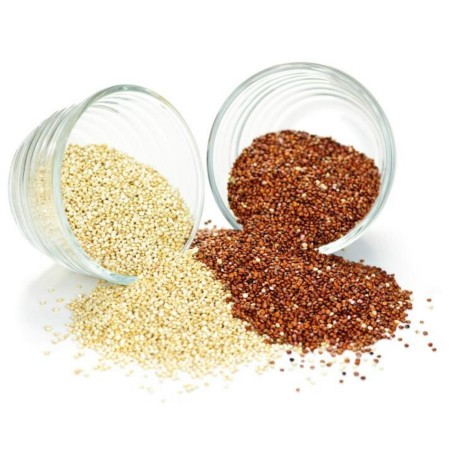
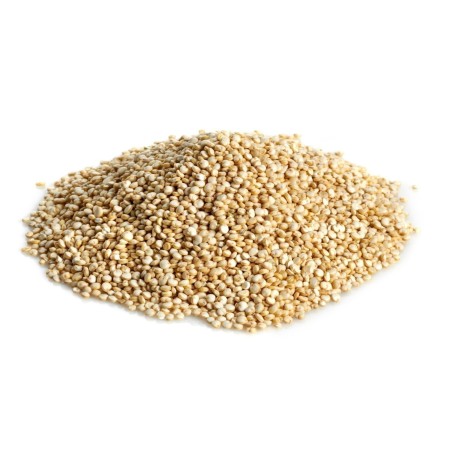
Chenopodium quinoa is a dicotyledonous annual plant usually about 1–2 metres (3.3–6.6 ft) high. It has broad, generally pubescent, powdery, smooth (rarely) to lobed leaves normally arranged alternately. The woody central stem is branched or unbranched depending on the variety and may be green, red or purple. The flowering panicles arise from the top of the plant or from leaf axils along the stem. Each panicle has a central axis from which a secondary axis emerges either with flowers (amaranthiform) or bearing a tertiary axis carrying the flowers (glomeruliform). The green hypogynous flowers have a simple perianth and are generally bisexual and self-fertilizing. The fruits are about 2 millimetres (0.079 in) in diameter and of various colours—from white to red or black, depending on the cultivar.
Natural distribution
Chenopodium quinoa is believed to have been domesticated in the Peruvian Andes from wild or weed populations of the same species. There are non-cultivated quinoa plants (Chenopodium quinoa var. melanospermum) that grow in the area it is cultivated; these may either be related to wild predecessors, or they could be descendants of cultivated plants.
Saponin content
In their natural state, the seeds have a coating of bitter-tasting saponins, making them unpalatable. Most of the grain sold commercially has been processed to remove this coating. This bitterness has beneficial effects during cultivation, as it is unpopular with birds and therefore requires minimal protection. The genetic control of bitterness involves quantitative inheritance; lowering the saponin content through selective breeding to produce sweeter, more palatable varieties is complicated by about 10% cross-pollination.
The toxicity category rating of quinoa saponins treats them as mild eye and respiratory irritants and as a low gastrointestinal irritant. The saponin is a toxic glycoside, a main contributor to its hemolytic effects when combined directly with blood cells. In South America, quinoa saponin has many uses, including as a detergent for clothing and washing and as an antiseptic for skin injuries. High levels of oxalic acid are in the leaves and stems of all species of the Chenopodium genus, and are also in the related genera of the Amaranthaceae family. The risks associated with quinoa are minimal, provided it is properly prepared and the leaves are not eaten to excess.
Nutritional value
Quinoa was important to the diet of pre-Columbian Andean civilizations. Quinoa grain has been called a superfood, a term which is not in common use by dietitians and nutrition scientists. Protein content is very high for a cereal/pseudo-cereal (14% by mass), but not as high as most beans and legumes. This includes a "low gluten content" that appears to be well tolerated when consumed at normal levels by people with celiac disease. The protein content per 100 calories is higher than brown rice, potatoes, barley and millet, but is less than wild rice and oats. Nutritional evaluations indicate that quinoa is a source of complete protein. Other sources claim its protein is not complete but relatively high in essential amino acids. Other pseudo grains derived from seeds are similar in complete protein levels; buckwheat is 18% protein compared to 14% for Quinoa; Amaranth, a related species to Quinoa, ranges from 12% to 17.5%.
Quinoa is a rich source (>20% of the Daily value, DV) of the B vitamins thiamine, riboflavin, vitamin B6, and folate and is a rich source of the dietary minerals iron, magnesium, phosphorus, and zinc. Quinoa is also a good source (10-19% of DV) of the B vitamins niacin and pantothenic acid, vitamin E, and the dietary mineral potassium. The pseudo cereal contains a modest amount of calcium, and thus is useful for vegans and those who are lactose intolerant. It is gluten-free and considered easy to digest. Because of these characteristics, it is being considered a possible crop in NASA's Controlled Ecological Life Support System for long-duration human occupied space flights.
The grain may be germinated in its raw form to boost its nutritional value, provided that the grains are rinsed thoroughly to remove any saponin.[26] It has a notably short germination period: only 2–4 hours in a glass of clean water is enough to make it sprout and release gases, as opposed to 12 hours with wheat. This process, besides its nutritional enhancements, softens the seeds, making them suitable to be added to salads and other cold foods.
Cultivation
The plant's growth is highly variable due to a high complexity of different subspecies, varieties and landraces (domesticated plants or animals adapted to the environment in which they originated). However, in general it is undemanding and altitude-hardy. It is grown from coastal regions to over 4,000 m (13,000 ft) in the Andes near the equator, with most of the cultivars being grown between 2,500 metres (8,200 ft) and 4,000 metres (13,000 ft). Depending on the variety, optimal growing conditions are in cool climates with temperatures that vary between −4 °C (25 °F) during the night to near 35 °C (95 °F) during the day. Some cultivars can withstand lower temperatures without damage. Light frosts normally do not affect the plants at any stage of development, except during flowering. Mid-summer frosts during flowering, often occurring in the Andes, lead to sterilization of the pollen. Rainfall conditions are highly variable between the different cultivars, ranging from 300 to 1,000 millimetres (12 to 39 in) during growing season. Growth is optimal with well-distributed rainfall during early growth and development and dry conditions during seed maturation and harvesting.
Quinoa has been cultivated in the United States, primarily in the high elevation San Luis Valley (SLV) of Colorado where it was introduced in 1982. In this high-altitude desert valley, maximum summer temperatures rarely exceed 30 °C (86 °F) and night temperatures are about 7 °C (45 °F). Due to the short growing season, North American cultivation requires short-maturity varieties, typically of Bolivian origin.
Sowing
Quinoa plants do best in sandy, well-drained soils with a low nutrient content, moderate salinity, and a soil pH of 6 to 8.5.
The seedbed must be well prepared and drained to avoid waterlogging. In the Andes, the seeds are normally broadcast over the land and raked into the soil. Sometimes it is sown in containers of soil and transplanted later.
Cultivation management
Yields are maximised when 170 to 200 kg (370 to 440 lb) N/hectare is available.[citation needed] The addition of phosphorus does not improve yield. In eastern North America, it is susceptible to a leaf miner that may reduce crop success and which also affects the common weed and close relative Chenopodium album, but C. album is much more resistant.
History and culture
Early history
Quinoa was first domesticated by Andean peoples around 3,000 to 4,000 years ago. It has been an important staple in the Andean cultures where the plant is indigenous but relatively obscure in the rest of the world. The Incas, who held the crop to be sacred, referred to it as chisaya mama or "mother of all grains", and it was the Inca emperor who would traditionally sow the first seeds of the season using "golden implements". During the Spanish conquest of South America, the colonists scorned it as "food for Indians", and suppressed its cultivation, due to its status within indigenous religious ceremonies. The conquistadors forbade quinoa cultivation for a time and the Incas were forced to grow wheat instead.
The grain has become increasingly popular in the United States, Canada, Europe, Australia, China and Japan where it is not typically grown, increasing crop value. Between 2006 and early 2013 quinoa crop prices tripled. In 2011, the average price was US$3,115 per ton with some varieties selling as high as $8,000 per ton. This compares with wheat prices of $9 per bushel (about $340 per ton). Since the 1970s, producers’ associations and cooperatives have worked toward greater producer control of the market. The higher prices make it harder for people to purchase, but also brings a livable income for farmers and enables many urban refugees to return to working the land.
The popularity of quinoa grain in non-indigenous regions has raised concerns over food security. Due to continued widespread poverty in regions where it is produced and because few other crops are compatible with the soil and climate in these regions, it has been suggested that the inflated price disrupts local access to food supplies. In 2013, The Guardian compared it to asparagus cultivated in Peru, a cash crop criticized for excessive water use, as "feeding our apparently insatiable 365-day-a-year hunger for this luxury vegetable" It has been suggested that, as people rise above subsistence-level income, they choose higher-status Western processed foods. However, anthropologist Pablo Laguna states that farmers are still saving a portion of the quinoa crop for their own use, and that the high prices affect nearby city dwellers more, but consumption in cities has traditionally been lower. According to Laguna, the net benefit of increased revenue for farmers outweighs the costs, saying that it is "very good news for small, indigenous farmers". The transformation from a healthy staple food for farming families and communities into a product that is held to be worth too much to keep for oneself and one's family is an ongoing process. It is seen as a valuable resource that can bring in far greater amounts[clarification needed] of cheap, low nutrient foods such as pasta and rice. It used to be seen as a peasant food that provided farming families with a very important source of nutrition, but now occupies a spectrum from an everyday food of urban Bolivia's middle class to a luxury food in the Peruvian capital of Lima where "it sells at a higher per pound price than chicken, and four times as much as rice". Efforts are being made in some areas to distribute it more widely and ensure that farming and poorer populations have access to it and have an understanding of its nutritional importance. These include incorporating it into free school breakfasts and in government provisions distributed to pregnant and nursing women in need.
Kosher controversy
Quinoa has become popular in the Jewish community as a substitute for the leavened grains that are forbidden during the Passover holiday. Several kosher certification organizations refuse to certify it as being kosher for Passover, citing reasons including its resemblance to prohibited grains or fear of cross-contamination of the product from nearby fields of prohibited grain or during packaging.
In December 2013, the Orthodox Union, the world's largest kosher certification agency, announced it would begin certifying quinoa as kosher for Passover.
International Year of Quinoa
The United Nations General Assembly declared 2013 as the "International Year of Quinoa" in recognition of ancestral practices of the Andean people, who have preserved it as food for present and future generations, through knowledge and practices of living in harmony with nature. The objective is to draw the world’s attention to the role that quinoa could play in providing food security, nutrition and poverty eradication, in support of achieving Millennium Development Goals.
The Food and Agriculture Organization of the United Nations is as the Secretariat of the international year. Bolivia has the presidency of the Coordination Committee and Ecuador, Peru and Chile share the vice presidency, with the rapporteurship in the hands of Argentina and France.
CategorieAcasaReferințăVE-232-CÎn stoc9922 Produse
Expediem in intreaga lume din Uniunea Europeana, folosind posta aeriana recomandata, cu confirmare prin semnatura la livrare.
📦Urmarirea comenzii tale Conectati-va la contul dvs. si navigati laIstoricul comenzilor > Detalii pentru a gasi numarul dvs. de urmarire.
Veti primi notificari prin e-mail pentru fiecare etapa a comenzii dumneavoastra. Daca nu vedeti aceste mesaje, verificati folderul Spam/mesaje nedorite sau contactati furnizorul dvs. de e-mail. Alternativ, cautati online cum sa deblocati e-mailurile expeditorilor.
SERVICIUL NOSTRU DE EMAIL FUNCTIONEAZA
Veti primi notificari prin e-mail pentru fiecare etapa a comenzii dvs. Daca nu vedeti aceste mesaje, verificati folderul Spam/mesaje nedorite sau contactati furnizorul dvs. de e-mail.
📧Cum sa te asiguri ca e-mailurile de la magazinul nostru online ajung intotdeauna in contul tau Gmailsau orice alt e-mailal furnizoruluiIn Inbox si nu sunt marcate ca spam sau blocate:
Adauga expeditorul in contactele Google sau ale oricarui alt furnizor de e-mail. Nu te putem ajuta daca setarile tale nu sunt astfel. Contacteaza furnizorul tau de e-mail pentru asistenta.
Pasul 1: Deschide Gmail si gaseste un e-mail de la noi xxxxxxxxxxxx@xxx.com Nu incercati sa ne trimiteti un e-mail direct la aceasta adresa; nu il vom primi. Orice contact se face exclusiv prin formularul de contact din magazinul nostru online! Daca nu gasiti e-mailul nostru, este posibil sa fi fost blocat. In acest caz, continuati cu Pasul 4 de mai jos.
Pasul 2: Puneti cursorul peste numele expeditorului sau adresa de e-mail din partea de sus a e-mailului.
Pasul 3: Faceti clic pe pictograma "Adauga la contacte" (mica pictograma cu o persoana).
Acest lucru va ajuta Gmail sa ne recunoasca ca expeditor de incredere, asigurandu-se ca e-mailurile noastre ajung direct in inboxul tau si nu in folderul de spam.
Creati un filtru pentru a preveni ca e-mailurile sa fie marcate ca spam sau blocate
Pasul 1: Deschide Gmail si da clic pe pictograma rotita din coltul din dreapta sus, apoi selecteaza "Vezi toate setarile".
Pasul 2: Accesati fila "Filtre si adrese blocate".
Pasul 3: Faceti clic pe "Creati un filtru nou".
Pasul 4: In campul "From", introduceti adresa de e-mail pe care doriti sa o adaugati pe lista alba (e.g., e-mailul magazinului nostru).
Pasul 5: Faceti clic pe "Creeaza filtru".
Pasul 6: In fereastra urmatoare, bifati caseta etichetata "Nu-l trimite niciodata in Spam".
Pasul 7: Faceti clic pe "Creeaza filtru" pentru a salva.
Acest lucru va asigura ca e-mailurile noastre ajung intotdeauna in inbox-ul tau si nu vor fi marcate ca spam sau blocate din greseala.
Urmareste-ti coletul prin:
Aftership
17Track
Posta.hr (pentru numere de urmarire precum RGxxxxxxHR)
⚠️Notificari importante
Plata la livrare esteNUDisponibil.
Furnizati intotdeauna un numar de telefon mobil valid cu codul tarii cand comandati (e.g., +365 456 7686 576).
Nu ordona sa P.O. Cutii, sau daca nu puteti fi acasa pentru a semna pentru colet, coletele nu pot fi lasate la vecini.
Daca un pachet trimis la P.O. Daca cutia este pierduta sau nedistribuita, nu se va emite nicio rambursare.
⚖️Responsabilitatea clientului privind conformitatea legala Clientul este responsabil sa se asigure ca produsul poate fi importat legal in tara sa, inclusiv prin respectarea tuturor reglementarilor de import, obtinerea permiselor necesare si plata taxelor vamale, impozitelor si a altor taxe aplicabile. Va rugam sa verificati legislatia locala inainte de a comanda pentru a evita orice probleme cu vama sau livrarea.
📦Pachete Pierdute, Returnate & Reexpediate
Clienti din Brazilia si Mexic:Nu putem rambursa coletele pierdute sau distruse de catre autoritatile vamale.
Daca coletul dumneavoastra este returnat, va vom rambursa doar costul produsului — costurile de livrare nu sunt rambursabile.
Costul expedierii de retur (2 €) si orice costuri de reexpediere trebuie acoperite de client.
Daca un pachet ne este returnat din orice motiv, sunteti responsabil pentru plata transportului de retur (€2) plus costul reexpedierii pachetului.
🚚Livrare colet Trimiterile inregistrate necesita o semnatura.
Daca urmarirea arata ca pachetul este inca la oficiul postal de expediere, acesta este in tranzit — contactati oficiul postal local pentru actualizari.
Din pacate, nici noi, nici serviciul postal prin care a fost expediata comanda dumneavoastra nu va putem ajuta sa aflati unde se afla aceasta. Cand vedeti ca pachetul este in tara dumneavoastra,TREBUIE sa contactati oficiul postal cu numarul de urmarire.si discutati problema cu ei. Trimitem toate comenzile prin posta oficiala de stat.
Nu suntem responsabili pentru termenele de livrare si nu putem urmari expedierile in numele dumneavoastra.
📅Optiuni de livrare & timpi estimati
Optiune de livrare
Timp de procesare
Notite
Livrare Prioritara
Se expediaza in 1–7 zile lucratoare
Acorda prioritate procesarii comenzilor (nu garanteaza o livrare mai rapida); pot aparea intarzieri in timpul sarbatorilor (3–10 zile)
Livrare securizata
Se expediaza in 1–7 zile lucratoare
Disponibil pentru comenzi de pana la 150 €; rambursare in caz de pierdere
Livrare standard
Se expediaza in 7–10 zile lucratoare
Mai economic; pot aparea intarzieri in perioada sarbatorilor (7–14 zile)
Timp estimat de livrare:
In UE:3–20 zile
La nivel mondial:5–30 zile
Exemple din SUA:Livrat in 13, 17, 19, 22, sau 27 de zile.
Nota:Timpul de livrare depinde de locatia dvs. si de sistemul postal local. COVID-19 sau perioadele de sarbatori pot provoca intarzieri suplimentare.
💰Costuri de livrare Taxele de expediere si manipulare sunt calculate automat la finalizarea comenzii, in functie de greutatea coletului si de destinatie.
⏰Ore de procesare a comenzilor Nu procesam si nu expediem comenzile in zilele de sambata si duminica.
💳Optiuni de plata
Transfer bancar (SEPA / IBAN / SWIFT-BIC) Includeti referinta comenzii dvs. in descrierea platii (e.g., "SGS-19811702"). Comenzile care nu sunt platite in termen de 7 zile vor fi anulate automat.
PayPal Platile sunt acceptate numai in euro. Va rugam sa selectati euro la finalizarea comenzii.
Plata cu cardul Acceptam Visa, MasterCard, American Express, CB, Diners Club, Discover, China UnionPay, JCB, si Discover.
⚠️Taxe de tranzactie Clientii sunt responsabili pentru orice comisioane de tranzactie bancare sau PayPal. Va rugam sa va asigurati ca detaliile de plata sunt corecte pentru o procesare mai rapida a comenzii.
📢Note finale Inainte de a plasa comanda, verificati intotdeauna site-ul nostru pentru anunturi speciale, programul din perioada sarbatorilor sau conditii specifice de livrare care ar putea afecta achizitia dumneavoastra.
Notificare importanta: Facturi digitale
Pentru a contribui la reducerea risipei de hartie, nu includem o factura tiparita impreuna cu comanda dvs. Puteti descarca si imprima cu usurinta factura dvs. in orice moment accesand contul dvs.Istoric comenzi in profilul contului tau