Quinoa (/ˈkiːnwɑː/, from Quechua kinwa or kinuwa ) is a species of the goosefoot genus (Chenopodium quinoa), a grain crop grown primarily for its edible seeds.
Quinoa (/ˈkiːnwɑː/, from Quechua kinwa or kinuwa ) is a species of the goosefoot genus (Chenopodium quinoa), a grain crop grown primarily for its edible seeds. It is a pseudocereal rather than a true cereal, as it is not a member of the true grass family. As a chenopod, quinoa is closely related to species such as beetroots, spinach and tumbleweeds. As a member of the Amaranthaceae family, it is related to and resembles amaranth, which is also a pseudocereal.
It is high in protein, and is tolerant of dry soil.
Quinoa (the name is derived from the Spanish spelling of the Quechua name kinwa) originated in the Andean region of Peru, Bolivia, Ecuador, Chile and Colombia, where it was domesticated 3,000 to 4,000 years ago for human consumption, though archaeological evidence shows a non-domesticated association with pastoral herding some 5,200 to 7,000 years ago.
Similar Chenopodium species, such as pitseed goosefoot (Chenopodium berlandieri) and fat hen (Chenopodium album), were grown and domesticated in North America as part of the Eastern Agricultural Complex before maize agriculture became popular. Fat hen, which has a widespread distribution in the Northern Hemisphere, produces edible seeds and greens much like quinoa, but in smaller quantities.
The nutrient composition is favourable compared with common cereals. Quinoa seeds contain essential amino acids like lysine and acceptable quantities of calcium, phosphorus, and iron.
After harvest, the seeds must be processed to remove the coating containing the bitter-tasting saponins. The seeds are in general cooked the same way as rice and can be used in a wide range of dishes. The leaves are eaten as a leaf vegetable, much like amaranth, but commercial availability of quinoa greens is limited.
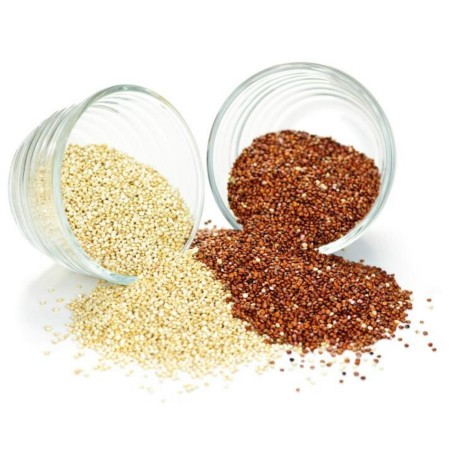
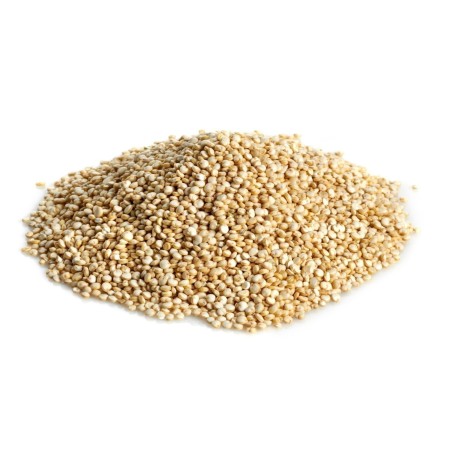
Chenopodium quinoa is a dicotyledonous annual plant usually about 1–2 metres (3.3–6.6 ft) high. It has broad, generally pubescent, powdery, smooth (rarely) to lobed leaves normally arranged alternately. The woody central stem is branched or unbranched depending on the variety and may be green, red or purple. The flowering panicles arise from the top of the plant or from leaf axils along the stem. Each panicle has a central axis from which a secondary axis emerges either with flowers (amaranthiform) or bearing a tertiary axis carrying the flowers (glomeruliform). The green hypogynous flowers have a simple perianth and are generally bisexual and self-fertilizing. The fruits are about 2 millimetres (0.079 in) in diameter and of various colours—from white to red or black, depending on the cultivar.
Natural distribution
Chenopodium quinoa is believed to have been domesticated in the Peruvian Andes from wild or weed populations of the same species. There are non-cultivated quinoa plants (Chenopodium quinoa var. melanospermum) that grow in the area it is cultivated; these may either be related to wild predecessors, or they could be descendants of cultivated plants.
Saponin content
In their natural state, the seeds have a coating of bitter-tasting saponins, making them unpalatable. Most of the grain sold commercially has been processed to remove this coating. This bitterness has beneficial effects during cultivation, as it is unpopular with birds and therefore requires minimal protection. The genetic control of bitterness involves quantitative inheritance; lowering the saponin content through selective breeding to produce sweeter, more palatable varieties is complicated by about 10% cross-pollination.
The toxicity category rating of quinoa saponins treats them as mild eye and respiratory irritants and as a low gastrointestinal irritant. The saponin is a toxic glycoside, a main contributor to its hemolytic effects when combined directly with blood cells. In South America, quinoa saponin has many uses, including as a detergent for clothing and washing and as an antiseptic for skin injuries. High levels of oxalic acid are in the leaves and stems of all species of the Chenopodium genus, and are also in the related genera of the Amaranthaceae family. The risks associated with quinoa are minimal, provided it is properly prepared and the leaves are not eaten to excess.
Nutritional value
Quinoa was important to the diet of pre-Columbian Andean civilizations. Quinoa grain has been called a superfood, a term which is not in common use by dietitians and nutrition scientists. Protein content is very high for a cereal/pseudo-cereal (14% by mass), but not as high as most beans and legumes. This includes a "low gluten content" that appears to be well tolerated when consumed at normal levels by people with celiac disease. The protein content per 100 calories is higher than brown rice, potatoes, barley and millet, but is less than wild rice and oats. Nutritional evaluations indicate that quinoa is a source of complete protein. Other sources claim its protein is not complete but relatively high in essential amino acids. Other pseudo grains derived from seeds are similar in complete protein levels; buckwheat is 18% protein compared to 14% for Quinoa; Amaranth, a related species to Quinoa, ranges from 12% to 17.5%.
Quinoa is a rich source (>20% of the Daily value, DV) of the B vitamins thiamine, riboflavin, vitamin B6, and folate and is a rich source of the dietary minerals iron, magnesium, phosphorus, and zinc. Quinoa is also a good source (10-19% of DV) of the B vitamins niacin and pantothenic acid, vitamin E, and the dietary mineral potassium. The pseudo cereal contains a modest amount of calcium, and thus is useful for vegans and those who are lactose intolerant. It is gluten-free and considered easy to digest. Because of these characteristics, it is being considered a possible crop in NASA's Controlled Ecological Life Support System for long-duration human occupied space flights.
The grain may be germinated in its raw form to boost its nutritional value, provided that the grains are rinsed thoroughly to remove any saponin.[26] It has a notably short germination period: only 2–4 hours in a glass of clean water is enough to make it sprout and release gases, as opposed to 12 hours with wheat. This process, besides its nutritional enhancements, softens the seeds, making them suitable to be added to salads and other cold foods.
Cultivation
The plant's growth is highly variable due to a high complexity of different subspecies, varieties and landraces (domesticated plants or animals adapted to the environment in which they originated). However, in general it is undemanding and altitude-hardy. It is grown from coastal regions to over 4,000 m (13,000 ft) in the Andes near the equator, with most of the cultivars being grown between 2,500 metres (8,200 ft) and 4,000 metres (13,000 ft). Depending on the variety, optimal growing conditions are in cool climates with temperatures that vary between −4 °C (25 °F) during the night to near 35 °C (95 °F) during the day. Some cultivars can withstand lower temperatures without damage. Light frosts normally do not affect the plants at any stage of development, except during flowering. Mid-summer frosts during flowering, often occurring in the Andes, lead to sterilization of the pollen. Rainfall conditions are highly variable between the different cultivars, ranging from 300 to 1,000 millimetres (12 to 39 in) during growing season. Growth is optimal with well-distributed rainfall during early growth and development and dry conditions during seed maturation and harvesting.
Quinoa has been cultivated in the United States, primarily in the high elevation San Luis Valley (SLV) of Colorado where it was introduced in 1982. In this high-altitude desert valley, maximum summer temperatures rarely exceed 30 °C (86 °F) and night temperatures are about 7 °C (45 °F). Due to the short growing season, North American cultivation requires short-maturity varieties, typically of Bolivian origin.
Sowing
Quinoa plants do best in sandy, well-drained soils with a low nutrient content, moderate salinity, and a soil pH of 6 to 8.5.
The seedbed must be well prepared and drained to avoid waterlogging. In the Andes, the seeds are normally broadcast over the land and raked into the soil. Sometimes it is sown in containers of soil and transplanted later.
Cultivation management
Yields are maximised when 170 to 200 kg (370 to 440 lb) N/hectare is available.[citation needed] The addition of phosphorus does not improve yield. In eastern North America, it is susceptible to a leaf miner that may reduce crop success and which also affects the common weed and close relative Chenopodium album, but C. album is much more resistant.
History and culture
Early history
Quinoa was first domesticated by Andean peoples around 3,000 to 4,000 years ago. It has been an important staple in the Andean cultures where the plant is indigenous but relatively obscure in the rest of the world. The Incas, who held the crop to be sacred, referred to it as chisaya mama or "mother of all grains", and it was the Inca emperor who would traditionally sow the first seeds of the season using "golden implements". During the Spanish conquest of South America, the colonists scorned it as "food for Indians", and suppressed its cultivation, due to its status within indigenous religious ceremonies. The conquistadors forbade quinoa cultivation for a time and the Incas were forced to grow wheat instead.
The grain has become increasingly popular in the United States, Canada, Europe, Australia, China and Japan where it is not typically grown, increasing crop value. Between 2006 and early 2013 quinoa crop prices tripled. In 2011, the average price was US$3,115 per ton with some varieties selling as high as $8,000 per ton. This compares with wheat prices of $9 per bushel (about $340 per ton). Since the 1970s, producers’ associations and cooperatives have worked toward greater producer control of the market. The higher prices make it harder for people to purchase, but also brings a livable income for farmers and enables many urban refugees to return to working the land.
The popularity of quinoa grain in non-indigenous regions has raised concerns over food security. Due to continued widespread poverty in regions where it is produced and because few other crops are compatible with the soil and climate in these regions, it has been suggested that the inflated price disrupts local access to food supplies. In 2013, The Guardian compared it to asparagus cultivated in Peru, a cash crop criticized for excessive water use, as "feeding our apparently insatiable 365-day-a-year hunger for this luxury vegetable" It has been suggested that, as people rise above subsistence-level income, they choose higher-status Western processed foods. However, anthropologist Pablo Laguna states that farmers are still saving a portion of the quinoa crop for their own use, and that the high prices affect nearby city dwellers more, but consumption in cities has traditionally been lower. According to Laguna, the net benefit of increased revenue for farmers outweighs the costs, saying that it is "very good news for small, indigenous farmers". The transformation from a healthy staple food for farming families and communities into a product that is held to be worth too much to keep for oneself and one's family is an ongoing process. It is seen as a valuable resource that can bring in far greater amounts[clarification needed] of cheap, low nutrient foods such as pasta and rice. It used to be seen as a peasant food that provided farming families with a very important source of nutrition, but now occupies a spectrum from an everyday food of urban Bolivia's middle class to a luxury food in the Peruvian capital of Lima where "it sells at a higher per pound price than chicken, and four times as much as rice". Efforts are being made in some areas to distribute it more widely and ensure that farming and poorer populations have access to it and have an understanding of its nutritional importance. These include incorporating it into free school breakfasts and in government provisions distributed to pregnant and nursing women in need.
Kosher controversy
Quinoa has become popular in the Jewish community as a substitute for the leavened grains that are forbidden during the Passover holiday. Several kosher certification organizations refuse to certify it as being kosher for Passover, citing reasons including its resemblance to prohibited grains or fear of cross-contamination of the product from nearby fields of prohibited grain or during packaging.
In December 2013, the Orthodox Union, the world's largest kosher certification agency, announced it would begin certifying quinoa as kosher for Passover.
International Year of Quinoa
The United Nations General Assembly declared 2013 as the "International Year of Quinoa" in recognition of ancestral practices of the Andean people, who have preserved it as food for present and future generations, through knowledge and practices of living in harmony with nature. The objective is to draw the world’s attention to the role that quinoa could play in providing food security, nutrition and poverty eradication, in support of achieving Millennium Development Goals.
The Food and Agriculture Organization of the United Nations is as the Secretariat of the international year. Bolivia has the presidency of the Coordination Committee and Ecuador, Peru and Chile share the vice presidency, with the rapporteurship in the hands of Argentina and France.
We verzenden wereldwijd vanuit de Europese Unie per aangetekende luchtpost met handtekeningbevestiging bij bezorging.
📦Uw bestelling volgen Log in op je account en navigeer naarBestelgeschiedenis > Details om uw trackingnummer te vinden.
Je ontvangt e-mailmeldingen voor elke fase van je bestelling. Als je deze berichten niet ziet, controleer dan je map Spam/Ongewenste e-mail of neem contact op met je e-mailprovider. Als alternatief kun je online zoeken naar hoe je e-mails van een afzender kunt deblokkeren.
ONZE E-MAILDIENST WERKT
U ontvangt e-mailmeldingen voor elke fase van uw bestelling. Als u deze berichten niet ziet, controleer dan uw map Spam/Ongewenste e-mail of neem contact op met uw e-mailprovider.
📧Hoe u ervoor zorgt dat e-mails van onze webshop altijd in uw Gmail terechtkomenof een andere e-mailvan de providerIn de inbox en niet als spam gemarkeerd of geblokkeerd:
Voeg de Afzender toe aan de contacten van uw Google-account of van een andere e-mailprovider. We kunnen u niet helpen als uw instellingen er niet zo uitzien. Neem contact op met uw e-mailprovider voor hulp.
Stap 1: Open Gmail en zoek een e-mail van ons xxxxxxxxxxxx@xxx.com Probeer ons niet rechtstreeks een e-mail naar dit adres te sturen; we zullen die niet ontvangen. Elk contact verloopt uitsluitend via het contactformulier in onze online shop! Als je onze e-mail niet kunt vinden, is deze mogelijk geblokkeerd. Ga in dat geval verder met Stap 4 hieronder.
Stap 2: Beweeg de muisaanwijzer over de naam van de afzender of het e-mailadres bovenaan de e-mail.
Stap 3Klik op het pictogram "Toevoegen aan contacten" (het pictogram van een klein persoonnetje).
Dit helpt Gmail ons te herkennen als een vertrouwde afzender, zodat onze e-mails rechtstreeks in je inbox terechtkomen en niet in de spam.
Maak een filter om te voorkomen dat e-mails als spam worden gemarkeerd of geblokkeerd
Stap 1: Open Gmail en klik op het tandwielpictogram rechtsboven, selecteer vervolgens "Alle instellingen bekijken".
Stap 2: Ga naar het tabblad "Filters en geblokkeerde adressen".
Stap 3: Klik op "Maak een nieuw filter aan".
Stap 4: Voer in het veld "From" het e-mailadres in dat u op de witte lijst wilt zetten (e.g., het e-mailadres van onze winkel).
Stap 5: Klik op "Filter maken".
Stap 6: Vink in het volgende venster het vakje met het label "Nooit naar Spam sturen" aan.
Stap 7: Klik op "Filter maken" om op te slaan.
Dit zorgt ervoor dat onze e-mails altijd in uw inbox terechtkomen en niet per ongeluk als spam worden gemarkeerd of geblokkeerd.
Volg uw pakket via:
Aftership
17Track
Posta.hr (voor trackingnummers zoals RGxxxxxxHR)
⚠️Belangrijke mededelingen
Contant bij aflevering isNIETBeschikbaar.
Geef bij het bestellen altijd een geldig mobiel nummer met landcode op (e.g., +365 456 7686 576).
Beveel niet om P.O. Dozen, of als u niet thuis kunt zijn om voor het pakket te tekenen, mogen pakketten niet bij buren worden achtergelaten.
Als een pakket gestuurd naar een P.O. Als de doos verloren is gegaan of niet is afgeleverd, wordt er geen terugbetaling verleend.
⚖️Verantwoordelijkheid van de klant voor naleving van wet- en regelgeving De klant is verantwoordelijk ervoor te zorgen dat het product legaal in hun land kan worden geïmporteerd, inclusief het naleven van alle importvoorschriften, het verkrijgen van de benodigde vergunningen en het betalen van toepasselijke douaneheffingen, belastingen en andere kosten. Controleer alstublieft uw lokale wetgeving voordat u bestelt om eventuele problemen met de douane of levering te voorkomen.
📦Verloren, Geretourneerde & Opnieuw Verzonden Pakketten
Brazilië & Mexico Klanten:We kunnen geen restitutie geven voor pakketten die door de douane verloren zijn gegaan of vernietigd zijn.
Als uw pakket wordt geretourneerd, zullen wij alleen de productkosten terugbetalen — verzendkosten zijn niet restitueerbaar.
Retourporto (€2) en eventuele kosten voor herverzending moeten door de klant worden betaald.
Als een pakket om welke reden dan ook naar ons wordt teruggestuurd, bent u verantwoordelijk voor het betalen van de retourverzendkosten (€2) plus de kosten om het pakket opnieuw te verzenden.
🚚Levering van zending Aangetekende zendingen vereisen een handtekening.
Als uw tracking aangeeft dat het pakket nog bij het postkantoor van vertrek is, is het onderweg — neem contact op met uw plaatselijke postkantoor voor updates.
Helaas kunnen noch wij, noch het postkantoor waarmee je bestelling is verzonden, je helpen met de vraag waar je bestelling is. Wanneer je ziet dat je pakket in je land is,je MOET contact opnemen met je postkantoor met het track & trace-nummerEn bespreek de zaak met hen. Wij verzenden alle bestellingen per officiële staatspost.
Wij zijn niet verantwoordelijk voor levertijden en kunnen zendingen niet voor u volgen.
📅Bezorgopties & Geschatte Tijden
Bezorgoptie
Verwerkingstijd
Notities
Prioritaire levering
Wordt verzonden binnen 1–7 werkdagen
Prioriteert orderverwerking (geen gegarandeerd snellere levering); vertragingen mogelijk tijdens feestdagen (3–10 dagen)
Beveiligde Levering
Wordt verzonden binnen 1–7 werkdagen
Beschikbaar voor bestellingen tot €150; terugbetaling bij verlies
Standaard levering
Verzending binnen 7–10 werkdagen
Goedkoper; tijdens feestdagen kunnen vertragingen optreden (7–14 dagen)
Geschatte levertijd:
Binnen de EU: 3–20 dagen
Wereldwijd: 5–30 dagen
Voorbeelden uit de VS:Geleverd in 13, 17, 19, 22, of 27 dagen.
Opmerking:De levertijden zijn afhankelijk van uw locatie en de lokale postdienst. COVID-19 of de feestdagen kunnen extra vertragingen veroorzaken.
💰Verzendkosten Verzend- en afhandelingskosten worden automatisch berekend bij het afrekenen op basis van het gewicht van het pakket en de bestemming.
⏰Verwerkingstijden voor bestellingen We verwerken of verzenden geen bestellingen op zaterdag of zondag.
💳 Betaalopties
Bankoverschrijving (SEPA / IBAN / SWIFT-BIC) Vermeld uw bestelreferentie in de betalingsomschrijving (e.g., "SGS-19811702"). Bestellingen zonder betaling binnen 7 dagen worden automatisch geannuleerd.
PayPal Betalingen worden alleen in euro's geaccepteerd. Selecteer alstublieft euro's tijdens het afrekenen.
Kaartbetaling We accepteren Visa, MasterCard, American Express, CB, Diners Club, Discover, China UnionPay, JCB, en Discover.
⚠️Transactiekosten Klanten zijn verantwoordelijk voor eventuele bank- of PayPal-transactiekosten. Zorg alstublieft dat de betalingsgegevens correct zijn voor een snellere verwerking van uw bestelling.
📢Slotopmerkingen Controleer voor het plaatsen van uw bestelling altijd onze website op speciale mededelingen, bezorgschema's tijdens feestdagen of specifieke verzendvoorwaarden die uw aankoop kunnen beïnvloeden.
Belangrijke mededeling: Digitale facturen
Om papierafval te verminderen voegen we geen papieren factuur bij je bestelling. Je kunt je factuur op elk gewenst moment eenvoudig downloaden en afdrukken door je Bestelgeschiedenis in je accountprofiel