Magnolia grandiflora este o specie de plante din genul Magnolia, familia Magnoliaceae, descrisă de Carl von Linné. Conform Catalogue of Life specia Magnolia grandiflora nu are subspecii cunoscute.
Magnolia grandiflora este o specie de plante din genul Magnolia, familia Magnoliaceae, descrisă de Carl von Linné. Conform Catalogue of Life specia Magnolia grandiflora nu are subspecii cunoscute. Magnolia grandiflora, commonly known as the southern magnolia or bull bay, is a tree of the family Magnoliaceae native to the southeastern United States, from coastal North Carolina to central Florida, and west to East Texas and Oklahoma. Reaching 27.5 m (90 ft) in height, it is a large, striking evergreen tree, with large dark green leaves up to 20 cm (7.9 in) long and 12 cm (4.7 in) wide, and large, white, fragrant flowers up to 30 cm (12 in) in diameter. Although endemic to the lowland subtropical forests on the Gulf and south Atlantic coastal plain, magnolia grandiflora is widely cultivated in warmer areas around the world. The timber is hard and heavy, and has been used commercially to make furniture, pallets, and veneer.
Description
Magnolia grandiflora is a medium to large evergreen tree which may grow 120 ft (37 m) tall. It typically has a single stem (or trunk) and a pyramidal shape.
The leaves are simple and broadly ovate, 12–20 cm (4.7–7.9 in) long and 6–12 cm (2.4–4.7 in) broad, with smooth margins. They are dark green, stiff and leathery, and often scurfy underneath with yellow-brown pubescence.
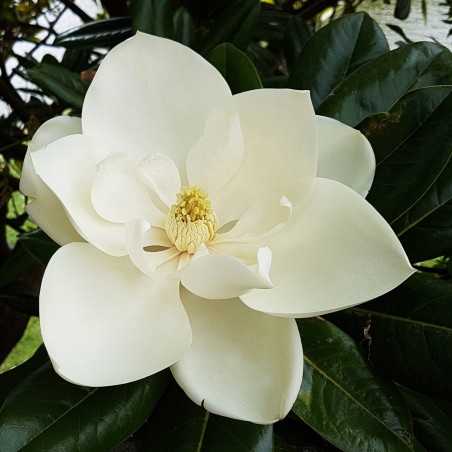
The large, showy, lemon citronella-scented flowers are white, up to 30 cm (12 in) across and fragrant, with six to 12 petals with a waxy texture, emerging from the tips of twigs on mature trees in late spring.
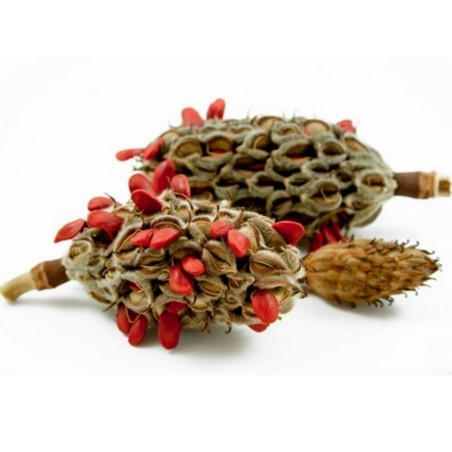
Flowering is followed by the rose-coloured fruit, ovoid polyfollicle, 7.5–10 cm (3.0–3.9 in) long, and 3–5 cm (1.2–2.0 in) wide.
Exceptionally large trees have been reported in the far southern United States. The national champion is a specimen in Smith County, Mississippi, that stands an incredible 37 m (121 ft). Another record includes a 35-m-high specimen from the Chickasawhay District, De Soto National Forest, in Mississippi, which measured 17.75 ft in circumference at breast height, from 1961, and a 30-m-tall tree from Baton Rouge, which reached 18 ft in circumference at breast height.
Taxonomy
Magnolia grandiflora was one of the many species first described by Linnaeus in the 10th edition of his Systema Naturae in 1759, basing his description on the earlier notes of Miller. He did not select a type specimen. Its specific epithet is derived from the Latin words grandis "big", and flor- "flower".
M. grandiflora is most commonly known as southern magnolia, a name derived from its range in the Southern United States. Many broadleaved evergreen trees are known as bays for their resemblance to the leaves of the red bay (Persea borbonia), with this species known as the bull bay for its huge size or alternatively because cattle have been reported eating its leaves. Laurel magnolia, evergreen magnolia, large-flower magnolia or big laurel are alternative names. The timber is known simply as magnolia.
Distribution and habitat
Southern magnolias are native to the Southeastern United States, from coastal North Carolina south to central Florida, and then west to East Texas and Oklahoma. It is found on the edges of bodies of water and swamps, in association with sweetgum (Liquidambar styraciflua), water oak (Quercus nigra), and black tupelo (Nyssa sylvatica). In more sheltered habitats, it grows as a large tree, but can be a low shrub when found on coastal dunes. It is killed by summer fires, and is missing from habitats that undergo regular burning.
In Florida, it is found in a number of different ecological areas that are typically shady and have well-draining soils; it is also found in hummocks, along ravines, on slopes, and in wooded floodplains. Despite preferring sites with increased moisture, it does not tolerate inundation. It grows on sand-hills in maritime forests, where it is found growing with live oaks and saw palmetto. In the eastern United States, it has become an escape, and has become naturalized in the tidewater area of Virginia, the Washington, D.C. metropolitan area and locally in other areas outside of its historically natural range.
Ecology
Magnolia grandiflora can produce seed by 10 years of age, although peak seed production is achieved closer to 25 years of age. Around 50% of seeds can germinate, and they are spread by birds and mammals. Squirrels, opossums, quail, and turkey are known to eat the seeds.
Cultivation and uses
The plant collector Mark Catesby, the first in North America, brought M. grandiflora to Britain in 1726, where it entered cultivation and overshadowed M. virginiana, which had been collected a few years earlier. It had also come to France, the French having collected it in the vicinity of the Mississippi River in Louisiana. It was glowingly described by Philip Miller in his 1731 work The Gardeners' Dictionary. One of the earliest people to cultivate it in Europe was Sir John Colliton of Exeter in Devon; scaffolding and tubs surrounded his tree, where gardeners propagated its branches by layering, the daughter plants initially selling for five guineas each (but later falling to half a guinea).
It is often planted in university campuses and allowed to grow into a large tree, either with dependent branches, or with the lower branches removed to display the bare trunks. It is also espaliered against walls, which improves its frost-hardiness.
United States cultivation
Magnolia grandiflora is a very popular ornamental tree throughout its native range in the coastal plain of the Gulf/South Atlantic states. Grown for its attractive, shiny green leaves and fragrant flowers, it has a long history in the southern United States. Many large and very old specimens can be found in the subtropical port cities such as New Orleans, Mobile, Savannah, Charleston, and Wilmington, NC. M. grandiflora is the state tree of Mississippi and the state flower of Louisiana.
The species is also cultivated in the warmer parts of the United States; on the East Coast, a small number of specimens can be found growing as far north as coastal areas of New Jersey, Connecticut, and Long Island, NY. Farther south, it is grown more widely in Delaware, much of the Chesapeake Bay region in Maryland, and much of eastern Virginia. On the West Coast, it can be grown as far north as the British Columbia/Seattle area, though cooler summers on the West Coast slow growth compared to the East Coast.
In the interior of the US, some of the cold-hardy cultivars have survived north to the southern Ohio Valley (Ohio, Kentucky, southern Indiana). Farther north, few known long term specimens are found due to the severe winters, very cold temperatures, and/or lack of sufficient summer heat.
Magnolia grandiflora is also grown in parts of Mexico, Central America, and South America as well as parts of Asia.
It is recommended for seashore plantings in areas that are windy but have little salt spray. The foliage will bronze, blotch, and burn in severe winters at the northern limits of cultivation, especially when grown in full winter sun, but most leaves remain until they are replaced by new foliage in the spring. In climates where the ground freezes, winter sun appears to do more damage than the cold. In the Northern Hemisphere, the south side of the tree will experience more leaf damage than the north side. Two extremes are known, with leaves white underneath and with leaves brown underneath. The brown varieties are claimed to be more cold-hardy than the white varieties, but this does not appear to be proven as yet. Once established, the plants are drought tolerant, and the most drought tolerant of all the Magnolia species.
The leaves are heavy and tend to fall year round from the interior of the crown and form a dense cover over the soil surface, and they have been used in decorative floral arrangements. The leaves have a waxy coating that makes them resistant to damage from salt and air pollution.
In the United States, southern magnolia, along with sweetbay (Magnolia virginiana) and cucumbertree (Magnolia acuminata), is commercially harvested. Lumber from all three species is simply called magnolia, which is used in the construction of furniture, boxes, pallets, venetian blinds, sashes, and doors and used as veneers. Southern magnolia has yellowish-white sapwood and light to dark brown heartwood tinted yellow or green. The usually straight-grained wood has uniform texture with closely spaced rings. The wood is ranked moderate in heaviness, hardness, and stiffness, and moderately low in shrinkage, bending, and compression strength; it is ranked moderately high in shock resistance.[18] Its use in the Southeastern United States has been supplanted by the availability of harder woods.
Expediem in intreaga lume din Uniunea Europeana, folosind posta aeriana recomandata, cu confirmare prin semnatura la livrare.
📦Urmarirea comenzii tale Conectati-va la contul dvs. si navigati laIstoricul comenzilor > Detalii pentru a gasi numarul dvs. de urmarire.
Veti primi notificari prin e-mail pentru fiecare etapa a comenzii dumneavoastra. Daca nu vedeti aceste mesaje, verificati folderul Spam/mesaje nedorite sau contactati furnizorul dvs. de e-mail. Alternativ, cautati online cum sa deblocati e-mailurile expeditorilor.
SERVICIUL NOSTRU DE EMAIL FUNCTIONEAZA
Veti primi notificari prin e-mail pentru fiecare etapa a comenzii dvs. Daca nu vedeti aceste mesaje, verificati folderul Spam/mesaje nedorite sau contactati furnizorul dvs. de e-mail.
📧Cum sa te asiguri ca e-mailurile de la magazinul nostru online ajung intotdeauna in contul tau Gmailsau orice alt e-mailal furnizoruluiIn Inbox si nu sunt marcate ca spam sau blocate:
Adauga expeditorul in contactele Google sau ale oricarui alt furnizor de e-mail. Nu te putem ajuta daca setarile tale nu sunt astfel. Contacteaza furnizorul tau de e-mail pentru asistenta.
Pasul 1: Deschide Gmail si gaseste un e-mail de la noi xxxxxxxxxxxx@xxx.com Nu incercati sa ne trimiteti un e-mail direct la aceasta adresa; nu il vom primi. Orice contact se face exclusiv prin formularul de contact din magazinul nostru online! Daca nu gasiti e-mailul nostru, este posibil sa fi fost blocat. In acest caz, continuati cu Pasul 4 de mai jos.
Pasul 2: Puneti cursorul peste numele expeditorului sau adresa de e-mail din partea de sus a e-mailului.
Pasul 3: Faceti clic pe pictograma "Adauga la contacte" (mica pictograma cu o persoana).
Acest lucru va ajuta Gmail sa ne recunoasca ca expeditor de incredere, asigurandu-se ca e-mailurile noastre ajung direct in inboxul tau si nu in folderul de spam.
Creati un filtru pentru a preveni ca e-mailurile sa fie marcate ca spam sau blocate
Pasul 1: Deschide Gmail si da clic pe pictograma rotita din coltul din dreapta sus, apoi selecteaza "Vezi toate setarile".
Pasul 2: Accesati fila "Filtre si adrese blocate".
Pasul 3: Faceti clic pe "Creati un filtru nou".
Pasul 4: In campul "From", introduceti adresa de e-mail pe care doriti sa o adaugati pe lista alba (e.g., e-mailul magazinului nostru).
Pasul 5: Faceti clic pe "Creeaza filtru".
Pasul 6: In fereastra urmatoare, bifati caseta etichetata "Nu-l trimite niciodata in Spam".
Pasul 7: Faceti clic pe "Creeaza filtru" pentru a salva.
Acest lucru va asigura ca e-mailurile noastre ajung intotdeauna in inbox-ul tau si nu vor fi marcate ca spam sau blocate din greseala.
Urmareste-ti coletul prin:
Aftership
17Track
Posta.hr (pentru numere de urmarire precum RGxxxxxxHR)
⚠️Notificari importante
Plata la livrare esteNUDisponibil.
Furnizati intotdeauna un numar de telefon mobil valid cu codul tarii cand comandati (e.g., +365 456 7686 576).
Nu ordona sa P.O. Cutii, sau daca nu puteti fi acasa pentru a semna pentru colet, coletele nu pot fi lasate la vecini.
Daca un pachet trimis la P.O. Daca cutia este pierduta sau nedistribuita, nu se va emite nicio rambursare.
⚖️Responsabilitatea clientului privind conformitatea legala Clientul este responsabil sa se asigure ca produsul poate fi importat legal in tara sa, inclusiv prin respectarea tuturor reglementarilor de import, obtinerea permiselor necesare si plata taxelor vamale, impozitelor si a altor taxe aplicabile. Va rugam sa verificati legislatia locala inainte de a comanda pentru a evita orice probleme cu vama sau livrarea.
📦Pachete Pierdute, Returnate & Reexpediate
Clienti din Brazilia si Mexic:Nu putem rambursa coletele pierdute sau distruse de catre autoritatile vamale.
Daca coletul dumneavoastra este returnat, va vom rambursa doar costul produsului — costurile de livrare nu sunt rambursabile.
Costul expedierii de retur (2 €) si orice costuri de reexpediere trebuie acoperite de client.
Daca un pachet ne este returnat din orice motiv, sunteti responsabil pentru plata transportului de retur (€2) plus costul reexpedierii pachetului.
🚚Livrare colet Trimiterile inregistrate necesita o semnatura.
Daca urmarirea arata ca pachetul este inca la oficiul postal de expediere, acesta este in tranzit — contactati oficiul postal local pentru actualizari.
Din pacate, nici noi, nici serviciul postal prin care a fost expediata comanda dumneavoastra nu va putem ajuta sa aflati unde se afla aceasta. Cand vedeti ca pachetul este in tara dumneavoastra,TREBUIE sa contactati oficiul postal cu numarul de urmarire.si discutati problema cu ei. Trimitem toate comenzile prin posta oficiala de stat.
Nu suntem responsabili pentru termenele de livrare si nu putem urmari expedierile in numele dumneavoastra.
📅Optiuni de livrare & timpi estimati
Optiune de livrare
Timp de procesare
Notite
Livrare Prioritara
Se expediaza in 1–7 zile lucratoare
Acorda prioritate procesarii comenzilor (nu garanteaza o livrare mai rapida); pot aparea intarzieri in timpul sarbatorilor (3–10 zile)
Livrare securizata
Se expediaza in 1–7 zile lucratoare
Disponibil pentru comenzi de pana la 150 €; rambursare in caz de pierdere
Livrare standard
Se expediaza in 7–10 zile lucratoare
Mai economic; pot aparea intarzieri in perioada sarbatorilor (7–14 zile)
Timp estimat de livrare:
In UE:3–20 zile
La nivel mondial:5–30 zile
Exemple din SUA:Livrat in 13, 17, 19, 22, sau 27 de zile.
Nota:Timpul de livrare depinde de locatia dvs. si de sistemul postal local. COVID-19 sau perioadele de sarbatori pot provoca intarzieri suplimentare.
💰Costuri de livrare Taxele de expediere si manipulare sunt calculate automat la finalizarea comenzii, in functie de greutatea coletului si de destinatie.
⏰Ore de procesare a comenzilor Nu procesam si nu expediem comenzile in zilele de sambata si duminica.
💳Optiuni de plata
Transfer bancar (SEPA / IBAN / SWIFT-BIC) Includeti referinta comenzii dvs. in descrierea platii (e.g., "SGS-19811702"). Comenzile care nu sunt platite in termen de 7 zile vor fi anulate automat.
PayPal Platile sunt acceptate numai in euro. Va rugam sa selectati euro la finalizarea comenzii.
Plata cu cardul Acceptam Visa, MasterCard, American Express, CB, Diners Club, Discover, China UnionPay, JCB, si Discover.
⚠️Taxe de tranzactie Clientii sunt responsabili pentru orice comisioane de tranzactie bancare sau PayPal. Va rugam sa va asigurati ca detaliile de plata sunt corecte pentru o procesare mai rapida a comenzii.
📢Note finale Inainte de a plasa comanda, verificati intotdeauna site-ul nostru pentru anunturi speciale, programul din perioada sarbatorilor sau conditii specifice de livrare care ar putea afecta achizitia dumneavoastra.
Notificare importanta: Facturi digitale
Pentru a contribui la reducerea risipei de hartie, nu includem o factura tiparita impreuna cu comanda dvs. Puteti descarca si imprima cu usurinta factura dvs. in orice moment accesand contul dvs.Istoric comenzi in profilul contului tau