Peppermint (Mentha × piperita, also known as M. balsamea Willd.) is a hybrid mint, a cross between watermint and spearmint. The plant, indigenous to Europe and the Middle East, is now widespread
Peppermint (Mentha × piperita, also known as M. balsamea Willd.) is a hybrid mint, a cross between watermint and spearmint. The plant, indigenous to Europe and the Middle East, is now widespread in cultivation in many regions of the world. It is found wild occasionally with its parent species.
Culinary and other uses
Pliny the elder, 79 AD, an ancient Roman author, natural philosopher and naval and military commander wrote Naturalis Historia, it tells us that the Greeks and Romans crowned themselves with peppermint at their feasts and adorned their tables with its sprays, and that their cooks flavoured both their sauces and their wines with its essence.
It is the oldest and most popular flavour of mint-flavoured confectionery and is often used in tea and for flavouring ice cream, confectionery, chewing gum, and toothpaste. Peppermint can also be found in some shampoos, soaps and skin care products.
Menthol activates cold-sensitive TRPM8 receptors in the skin and mucosal tissues, and is the primary source of the cooling sensation that follows the topical application of peppermint oil.
Peppermint flowers are large nectar producers and honey bees as well as other nectar harvesting organisms forage them heavily. A mild, pleasant varietal honey can be produced if there is a sufficient area of plants.
Peppermint oil
Peppermint oil has a high concentration of natural pesticides, mainly pulegone (Found mainly in Mentha arvensis var. piperascens Cornmint, Field Mint, Japanese Mint and to a lesser extent-6,530 ppm in Mentha x piperita subsp. nothosubsp. piperita) and menthone.
The chemical composition of the essential oil from peppermint (Mentha x piperita L.) was analyzed by GC/FID and GC-MS. The main constituents were menthol (40.7%) and menthone (23.4%). Further components were (+/-)-menthyl acetate, 1,8-cineole, limonene, beta-pinene and beta-caryophyllene.
Peppermint oil in Irritable Bowel Syndrome (IBS) with constipation
Peppermint oil has also been shown to be effective for IBS with constipation.
Possible medicinal uses
Peppermint has a long tradition of use in folk medicine and aromatherapy. Peppermint is commonly thought to soothe or treat symptoms such as nausea, vomiting, abdominal pain, indigestion, irritable bowel, and bloating, although most of these effects have not been adequately demonstrated in human research.
The aroma of peppermint has been studied for its possible effect to enhance memory and alertness, although other research contests this.
Peppermint oil ingestion by capsules for four weeks may relieve irritable bowel syndrome (IBS) symptoms via an effect on pain sensing fibers.
According to the German Commission E monographs, peppermint oil (as well as peppermint leaf) has been used internally as an antispasmodic (upper gastrointestinal tract and bile ducts) and to treat irritable bowel syndrome, catarrh of the respiratory tract, and inflammation of the oral mucosa. Externally, peppermint oil has been used for myalgia and neuralgia. According to Commission E, peppermint oil may also act as a carminative, cholagogue, antibacterial, and secretolytic, and it has a cooling action.
Enteric-coated peppermint oil capsules (Colpermin) have been used as an orally administered antispasmodic premedication in colonoscopy. The capsules were found beneficial in reducing total procedure time, reducing colonic spasm, increasing endoscopist satisfaction and decreasing pain in patients during colonoscopy.
When peppermint oil antacid products dissolve too quickly, they can sometimes cause heartburn and nausea.
Due to the menthol constituent, topical use of peppermint oil around the facial or chest areas of infants and young children, especially around the nose, can induce apnea, laryngeal and bronchial spasm, acute respiratory distress with cyanosis, or respiratory arrest.
Peppermint oil is also used in construction and plumbing to test for the tightness of pipes and disclose leaks by its odor.
Botany
Peppermint was first described in 1753 by Carl Linnaeus from specimens that had been collected in England; he treated it as a species, but it is now universally agreed to be a hybrid.
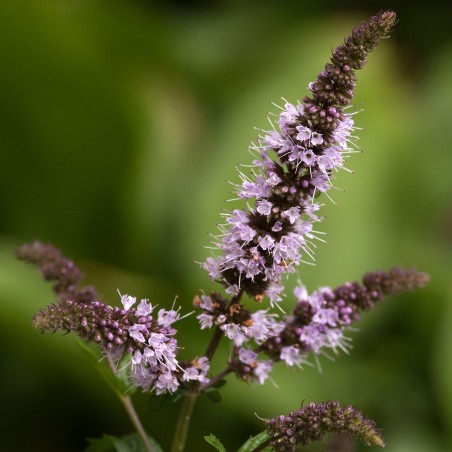
It is a herbaceous rhizomatous perennial plant growing to 30–90 cm (12–35 in) tall, with smooth stems, square in cross section. The rhizomes are wide-spreading, fleshy, and bare fibrous roots. The leaves are from 4–9 cm (1.6–3.5 in) long and 1.5–4 cm (0.59–1.57 in) broad, dark green with reddish veins, and with an acute apex and coarsely toothed margins. The leaves and stems are usually slightly fuzzy. The flowers are purple, 6–8 mm (0.24–0.31 in) long, with a four-lobed corolla about 5 mm (0.20 in) diameter; they are produced in whorls (verticillasters) around the stem, forming thick, blunt spikes. Flowering is from mid to late summer. The chromosome number is variable, with 2n counts of 66, 72, 84, and 120 recorded. Peppermint is a fast-growing plant; once it sprouts, it spreads very quickly.
Ecology
Peppermint typically occurs in moist habitats, including stream sides and drainage ditches. Being a hybrid, it is usually sterile, producing no seeds and reproducing only vegetatively, spreading by its rhizomes. If placed, it can grow anywhere, with a few exceptions.
Outside of its native range, areas where peppermint was formerly grown for oil often have an abundance of feral plants, and it is considered invasive in Australia, the Galápagos Islands, New Zealand, and in the United States in the Great Lakes region, noted since 1843.
Cultivation
Peppermint generally grows best in moist, shaded locations, and expands by underground rhizomes. Young shoots are taken from old stocks and dibbled into the ground about 1.5 feet apart. They grow quickly and cover the ground with runners if it is permanently moist. For the home gardener, it is often grown in containers to restrict rapid spreading. It grows best with a good supply of water, without being water-logged, and planted in areas with part-sun to shade.
The leaves and flowering tops are used; they are collected as soon as the flowers begin to open and can be dried. The wild form of the plant is less suitable for this purpose, with cultivated plants having been selected for more and better oil content. They may be allowed to lie and wilt a little before distillation, or they may be taken directly to the still.
Chemical constituents
Peppermint has a high menthol content. The oil also contains menthone and menthyl esters, particularly menthyl acetate. Dried peppermint typically has 0.3-0.4% of volatile oil containing menthol (7-48%), menthone (20-46%), menthyl acetate (3-10%), menthofuran (1-17%) and 1,8-cineol (3-6%). Peppermint oil also contains small amounts of many additional compounds including limonene, pulegone, caryophyllene and pinene.
Germination guide:
1Fill a seed tray with potting soil. Gently tap the seed tray on a hard surface to flatten and evenly distribute the soil.
2Moisten the potting soil lightly with a watering can.
3Sow the mint seeds 1/4 inch deep in the moist potting soil. Place one or two peppermint seeds in each section of the seed tray.
4Water the peppermint seeds lightly. The potting soil should be damp, but not too soggy.
5Cover the seed tray with plastic wrap or plastic film designed for seed trays, which is available at most gardening supply stores.
6Place the seed tray in a sunny and warm place indoors. Peppermint germinates in soil that maintains a temperature of at least 65 degrees Fahrenheit. Sprouts usually begin to emerge between seven and 14 days after planting.
7Water the seeds every few days to keep the soil damp.
8Peel back the plastic wrap once seedlings begin to emerge from the soil. Keep the seed tray in a sunny and warm spot until early spring. Transplant the seedlings outdoors.
Expediem in intreaga lume din Uniunea Europeana, folosind posta aeriana recomandata, cu confirmare prin semnatura la livrare.
📦Urmarirea comenzii tale Conectati-va la contul dvs. si navigati laIstoricul comenzilor > Detalii pentru a gasi numarul dvs. de urmarire.
Veti primi notificari prin e-mail pentru fiecare etapa a comenzii dumneavoastra. Daca nu vedeti aceste mesaje, verificati folderul Spam/mesaje nedorite sau contactati furnizorul dvs. de e-mail. Alternativ, cautati online cum sa deblocati e-mailurile expeditorilor.
SERVICIUL NOSTRU DE EMAIL FUNCTIONEAZA
Veti primi notificari prin e-mail pentru fiecare etapa a comenzii dvs. Daca nu vedeti aceste mesaje, verificati folderul Spam/mesaje nedorite sau contactati furnizorul dvs. de e-mail.
📧Cum sa te asiguri ca e-mailurile de la magazinul nostru online ajung intotdeauna in contul tau Gmailsau orice alt e-mailal furnizoruluiIn Inbox si nu sunt marcate ca spam sau blocate:
Adauga expeditorul in contactele Google sau ale oricarui alt furnizor de e-mail. Nu te putem ajuta daca setarile tale nu sunt astfel. Contacteaza furnizorul tau de e-mail pentru asistenta.
Pasul 1: Deschide Gmail si gaseste un e-mail de la noi xxxxxxxxxxxx@xxx.com Nu incercati sa ne trimiteti un e-mail direct la aceasta adresa; nu il vom primi. Orice contact se face exclusiv prin formularul de contact din magazinul nostru online! Daca nu gasiti e-mailul nostru, este posibil sa fi fost blocat. In acest caz, continuati cu Pasul 4 de mai jos.
Pasul 2: Puneti cursorul peste numele expeditorului sau adresa de e-mail din partea de sus a e-mailului.
Pasul 3: Faceti clic pe pictograma "Adauga la contacte" (mica pictograma cu o persoana).
Acest lucru va ajuta Gmail sa ne recunoasca ca expeditor de incredere, asigurandu-se ca e-mailurile noastre ajung direct in inboxul tau si nu in folderul de spam.
Creati un filtru pentru a preveni ca e-mailurile sa fie marcate ca spam sau blocate
Pasul 1: Deschide Gmail si da clic pe pictograma rotita din coltul din dreapta sus, apoi selecteaza "Vezi toate setarile".
Pasul 2: Accesati fila "Filtre si adrese blocate".
Pasul 3: Faceti clic pe "Creati un filtru nou".
Pasul 4: In campul "From", introduceti adresa de e-mail pe care doriti sa o adaugati pe lista alba (e.g., e-mailul magazinului nostru).
Pasul 5: Faceti clic pe "Creeaza filtru".
Pasul 6: In fereastra urmatoare, bifati caseta etichetata "Nu-l trimite niciodata in Spam".
Pasul 7: Faceti clic pe "Creeaza filtru" pentru a salva.
Acest lucru va asigura ca e-mailurile noastre ajung intotdeauna in inbox-ul tau si nu vor fi marcate ca spam sau blocate din greseala.
Urmareste-ti coletul prin:
Aftership
17Track
Posta.hr (pentru numere de urmarire precum RGxxxxxxHR)
⚠️Notificari importante
Plata la livrare esteNUDisponibil.
Furnizati intotdeauna un numar de telefon mobil valid cu codul tarii cand comandati (e.g., +365 456 7686 576).
Nu ordona sa P.O. Cutii, sau daca nu puteti fi acasa pentru a semna pentru colet, coletele nu pot fi lasate la vecini.
Daca un pachet trimis la P.O. Daca cutia este pierduta sau nedistribuita, nu se va emite nicio rambursare.
⚖️Responsabilitatea clientului privind conformitatea legala Clientul este responsabil sa se asigure ca produsul poate fi importat legal in tara sa, inclusiv prin respectarea tuturor reglementarilor de import, obtinerea permiselor necesare si plata taxelor vamale, impozitelor si a altor taxe aplicabile. Va rugam sa verificati legislatia locala inainte de a comanda pentru a evita orice probleme cu vama sau livrarea.
📦Pachete Pierdute, Returnate & Reexpediate
Clienti din Brazilia si Mexic:Nu putem rambursa coletele pierdute sau distruse de catre autoritatile vamale.
Daca coletul dumneavoastra este returnat, va vom rambursa doar costul produsului — costurile de livrare nu sunt rambursabile.
Costul expedierii de retur (2 €) si orice costuri de reexpediere trebuie acoperite de client.
Daca un pachet ne este returnat din orice motiv, sunteti responsabil pentru plata transportului de retur (€2) plus costul reexpedierii pachetului.
🚚Livrare colet Trimiterile inregistrate necesita o semnatura.
Daca urmarirea arata ca pachetul este inca la oficiul postal de expediere, acesta este in tranzit — contactati oficiul postal local pentru actualizari.
Din pacate, nici noi, nici serviciul postal prin care a fost expediata comanda dumneavoastra nu va putem ajuta sa aflati unde se afla aceasta. Cand vedeti ca pachetul este in tara dumneavoastra,TREBUIE sa contactati oficiul postal cu numarul de urmarire.si discutati problema cu ei. Trimitem toate comenzile prin posta oficiala de stat.
Nu suntem responsabili pentru termenele de livrare si nu putem urmari expedierile in numele dumneavoastra.
📅Optiuni de livrare & timpi estimati
Optiune de livrare
Timp de procesare
Notite
Livrare Prioritara
Se expediaza in 1–7 zile lucratoare
Acorda prioritate procesarii comenzilor (nu garanteaza o livrare mai rapida); pot aparea intarzieri in timpul sarbatorilor (3–10 zile)
Livrare securizata
Se expediaza in 1–7 zile lucratoare
Disponibil pentru comenzi de pana la 150 €; rambursare in caz de pierdere
Livrare standard
Se expediaza in 7–10 zile lucratoare
Mai economic; pot aparea intarzieri in perioada sarbatorilor (7–14 zile)
Timp estimat de livrare:
In UE:3–20 zile
La nivel mondial:5–30 zile
Exemple din SUA:Livrat in 13, 17, 19, 22, sau 27 de zile.
Nota:Timpul de livrare depinde de locatia dvs. si de sistemul postal local. COVID-19 sau perioadele de sarbatori pot provoca intarzieri suplimentare.
💰Costuri de livrare Taxele de expediere si manipulare sunt calculate automat la finalizarea comenzii, in functie de greutatea coletului si de destinatie.
⏰Ore de procesare a comenzilor Nu procesam si nu expediem comenzile in zilele de sambata si duminica.
💳Optiuni de plata
Transfer bancar (SEPA / IBAN / SWIFT-BIC) Includeti referinta comenzii dvs. in descrierea platii (e.g., "SGS-19811702"). Comenzile care nu sunt platite in termen de 7 zile vor fi anulate automat.
PayPal Platile sunt acceptate numai in euro. Va rugam sa selectati euro la finalizarea comenzii.
Plata cu cardul Acceptam Visa, MasterCard, American Express, CB, Diners Club, Discover, China UnionPay, JCB, si Discover.
⚠️Taxe de tranzactie Clientii sunt responsabili pentru orice comisioane de tranzactie bancare sau PayPal. Va rugam sa va asigurati ca detaliile de plata sunt corecte pentru o procesare mai rapida a comenzii.
📢Note finale Inainte de a plasa comanda, verificati intotdeauna site-ul nostru pentru anunturi speciale, programul din perioada sarbatorilor sau conditii specifice de livrare care ar putea afecta achizitia dumneavoastra.
Notificare importanta: Facturi digitale
Pentru a contribui la reducerea risipei de hartie, nu includem o factura tiparita impreuna cu comanda dvs. Puteti descarca si imprima cu usurinta factura dvs. in orice moment accesand contul dvs.Istoric comenzi in profilul contului tau