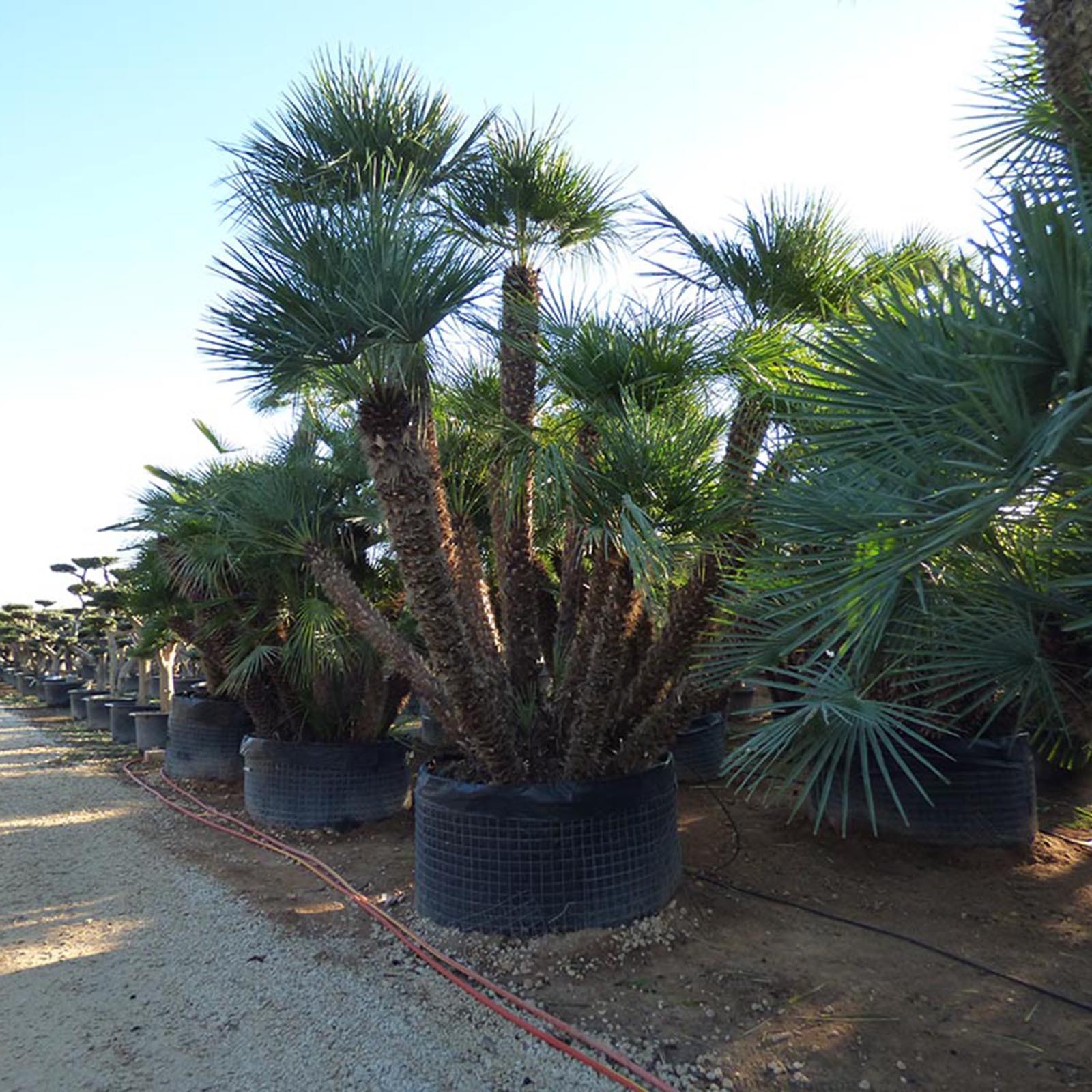
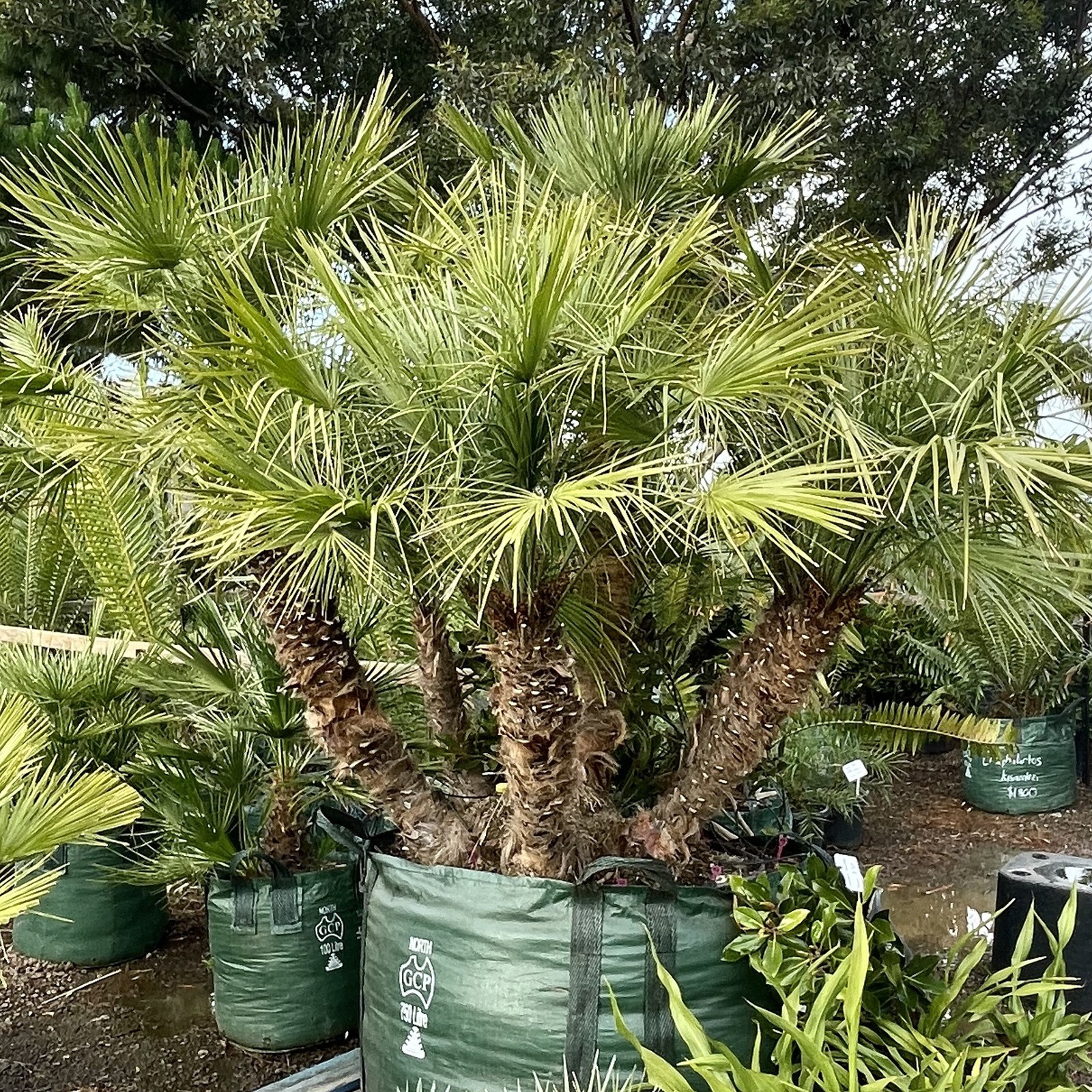
European fan palm, Mediterranean dwarf palm Seeds (Chamaerops humilis)
Price for Package of 3 seeds.
Chamaerops is a genus of flowering plants in the palm family Arecaceae. The only currently fully accepted species is Chamaerops humilis, variously called European fan palm, or the Mediterranean dwarf
European fan palm, Mediterranean dwarf palm Seeds (Chamaerops humilis)
Price for Package of 3 seeds.
Chamaerops is a genus of flowering plants in the palm family Arecaceae. The only currently fully accepted species is Chamaerops humilis, variously called European fan palm, or the Mediterranean dwarf palm. It is one of the more cold-hardy palms used in landscaping in temperate climates.
Chamaerops humilis is a shrub-like clumping palm, with several stems growing from a single base. It has an underground rhizome which produces shoots with palmate, sclerophyllous leaves.
The stems grow slowly and often tightly together, eventually reaching 2–5 m (10–20 ft) tall with a trunk diameter of 20–25 cm (8–10 in). It is a fan palm (Arecaceae tribe Corypheae), and as such, has leaves with petioles terminating in rounded fans of 10–20 leaflets. Each leaf is up to 1.5 m (5 ft) long, with leaflets 50–80 cm (20–30 in) long. The petioles are armed with numerous sharp, needle-like spines; these may protect the stem growing point from browsing animals.
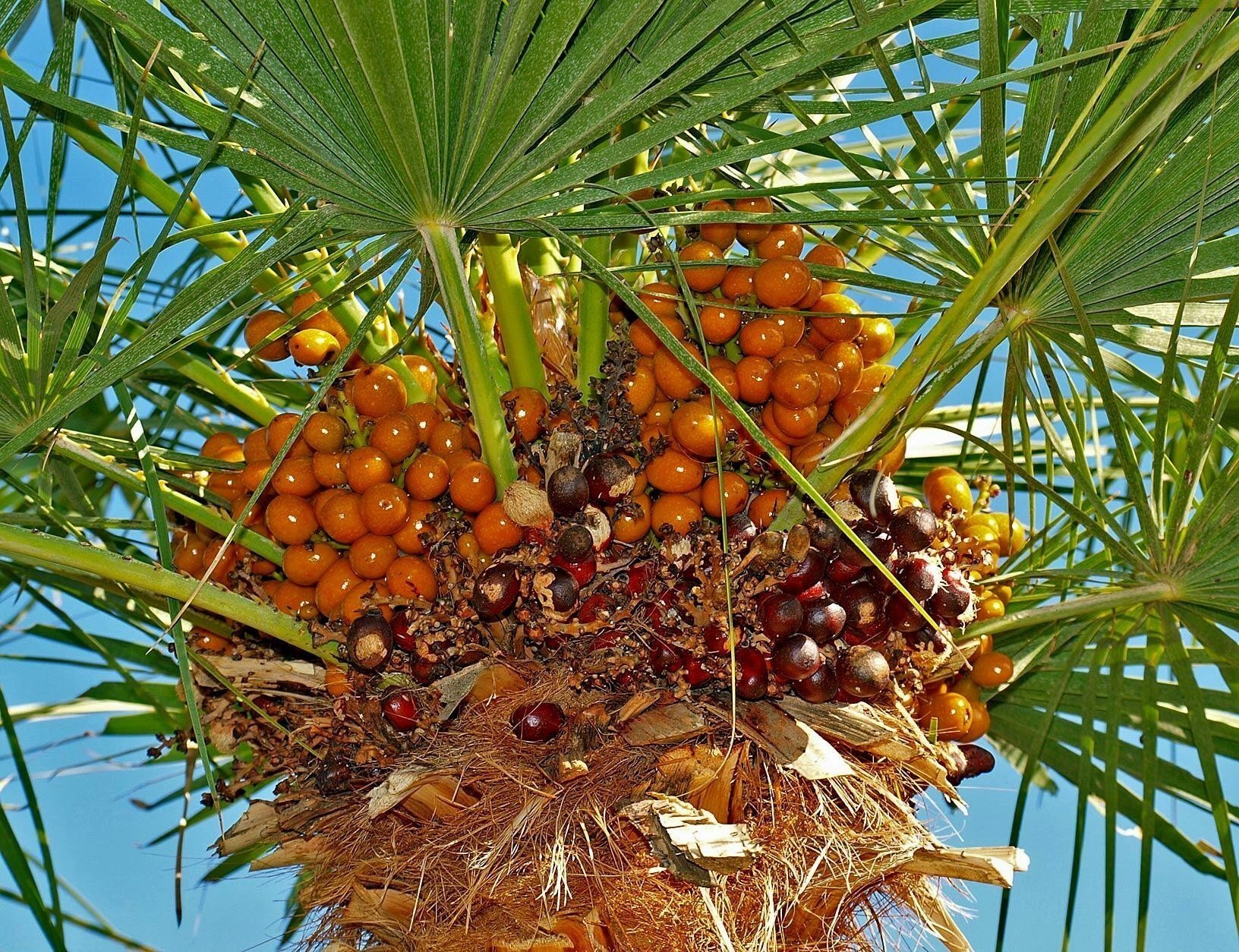
The flowers are borne in dense, short inflorescences at the tops of the stems. The plants usually, but not invariably, are dioecious with male and female flowers on separate plants. The prophyll covers the flowers on the inflorescence until the sexual phase (anthesis) and then splits open apically into two triangular lobes. The number of flowers per inflorescence is highly variable for both male and female plants, depending on the size of the inflorescence. Female flowers are tri-ovulate.[6] Unripe fruits are bright green, turning to dull yellow to brown as they ripen during autumn (September–November). The seed (usually 0.6–0.8 g or 1⁄50–3⁄100 oz) contains a small cylindrical embryo, which is surrounded by several layers, from inner to outer as follows:
a nutritious endosperm,
a wide woody layer or endocarp,
a fleshy and fibrous mesocarp (the pulp), and
the thin outer layer or exocarp.
Taxonomy
Apart from the fully accepted Chamaerops humilis there currently are a few species of unresolved status plus tens of species synonymised with Chamaerops humilis.
The species Chamaerops humilis itself has three accepted varieties as follows:
Chamaerops humilis var. argentea André (syn. C. h. var. cerifera) – "Atlas mountain palm" of Northwest Africa. Leaves glaucous.
Chamaerops humilis var. epondraes – Northwest Africa. Leaves glaucous.
Chamaerops humilis var. humilis – Southwest Europe. Leaves green.
There also are at least three cultivars (C. humilis var. humilis 'Nana', C. humilis 'Vulcano', C. humilis 'Stella'). C. humilis 'Vulcano' is a compact, thornless cultivar. May be silvery, but less so than argentea. The leaves tend to be thicker, and the appearance of the plant is bushier than var. humilis or var. argentea.
The genus Chamaerops is closely related to the genus Trachycarpus. The genera differ in that Trachycarpus lacks the clumping habit only forms single stems without basal suckers), the spiny leaf stems (spineless in Trachycarpus), and in small details of the flower anatomy.
Distribution
Chamaerops humilis is one of only two palm species native to southern Europe, the other being Phoenix theophrasti. It is mainly found in southwestern Europe (Malta, Sicily, over all the Mediterranean coast of Spain and Portugal, central and southern Italy, some parts of the southern Mediterranean coast of France and Monaco, as well as northwest Africa (Morocco, Algeria, Tunisia). It is the northernmost naturally occurring palm in the world, with the northernmost standing at Hyères-les-Palmiers, at 43° 07′ N.
Cultivation
Chamaerops humilis is valued in gardening and landscaping in many parts of the world. It is very drought-tolerant once established.
It is hardy to −12 °C (10 °F), but does prefer hot summers.
It is a very slow-growing plant. The blue form of the species, native to high elevations of the Atlas Mountains, has recently been introduced into the trade and early reports indicate that it may be −12 °C (−22 °F) or more degrees hardier than the green form.
It has gained the Royal Horticultural Society's Award of Garden Merit.
Ecology and interactions with animals
Chamaerops humilis flowers in spring, typically from April to May. The plant also may be partly anemophilous, that is to say, wind-pollinated, but it is at least partly entomophilous, that is to say dependent on pollination by insects. Only one insect species is known to pollinate it, namely a specific weevil, Derelomus chamaeropsis in the family Curculionidae.[13] The nature of the relationship with the weevil is a version of nursery pollination mutualism with the weevil; the form this takes is that once pollinating weevils have found a satisfactory plant, whether male or female, they usually stay on the same plant until the end of its anthesis, finding shelter, egg-laying sites, and food in the inflorescences.
At anthesis, as is common in Angiosperms, both male and female Chamaerops humilis plants attract their pollinators with chemical compounds, but an unusual feature is that their scents are released by the leaves, and not by the flowers.[15] Towards the end of anthesis, weevils leave the plant and seek a new host plant, again either male or female.
Larval development of the weevil Derelomus chamaeropsis occurs within rachises of inflorescences of male plants during autumn and winter. At the beginning of the next flowering period, adult weevils emerge from the dry and brittle stems of old inflorescences of the previous year of male plants only. Those that hatch in female plants die without concluding their development. This is because the palmettos are adapted to prevent the pollinating weevils from destroying the female inflorescences with their burden of seed. Weevils have been shown to lay eggs within female inflorescences, but as soon as seeds start to develop, eggs or larvae fail to continue their life cycle. On the other hand, male inflorescences have completed their function after pollination, so it is advantageous to the plant's reproduction for the weevils to complete their life cycles and shelter in the male inflorescences, thereby remaining available for pollination when they emerge in the following season.
The ripe pulp of C. humilis has several important functions.
When ripened, the pulp smells strongly of rancid butter[18] and thus acts as a foraging cue for nocturnal frugivores that commonly are fundamentally carnivorous mammals such as badgers and foxes.
The pulp inhibits germination, ensuring that the seed does not germinate until has been dispersed.
The pulp also acts as a chemical or physical barrier against invertebrate seed predators, typically beetles, and in particular weevils.
Because of the combination of such functions in the pulp, the palm both benefits and suffers adverse consequences when carnivores feed on the fruit and thereby remove the pulp. On the one hand, the seeds that carnivores swallow, germinate more frequently than seeds in entire fruit. On the other hand, ingested seeds are more frequently destroyed by invertebrate pests than non-ingested seeds. However, because of the mobility of carnivores, their dispersal service is important to the palmetto, given the severe fragmentation and isolation of most populations across the increasingly densely populated Mediterranean basin.
Uses and threats
Chamaerops humilis has a wide distribution in uncultivated land, and it is adapted to regimes of frequent burning, which it survives largely by re-sprouting from underground rhizomes and from fire-damaged stems. Such factors make the species ecologically important in preventing erosion and desertification and in providing shelter and food to many species of animals.
Apart from its material benefits, this palmetto is of emotional value as a charismatic component of the "garrigues" and "macchias" of the Mediterranean coastline.
The leaves of the adult plants have been used to make brooms and for weaving mats, carrier baskets, and similar articles. For finer work the young, unopened leaves are treated with sulphur to soften them softer and provide supple fibre.
The husk, known in southern Spain as "higa", is edible before it becomes too tough to eat as it matures. Because of their bitterness and high tannin content, the fruit are not used for human food, but in traditional medicine they have been used as an astringent.[19]
Urbanization and other human activities are making such rapid inroads into the natural habitat of palmetto that they are raising concerns about its future and that of its environment. Accordingly there is an increase in regulations to protect both its stands and those of associated Mediterranean endemics.
Another conservation problem is that particularly in the northernmost parts of its natural range, Chamaerops humilis is seriously threatened by an introduced South American moth Paysandisia archon.[9][20] Also, this Mediterranean native palm is affected by the introduction of related ornamental species because of the concurrent introduction of seed predators (such as Coccotrypes dactyliperda and Dactylotrypes longicollis) that feed on both the introduced and native palms.
CategorieAcasaReferințăPS-9-(3-S)În stoc294 Produse
Expediem in intreaga lume din Uniunea Europeana, folosind posta aeriana recomandata, cu confirmare prin semnatura la livrare.
📦Urmarirea comenzii tale Conectati-va la contul dvs. si navigati laIstoricul comenzilor > Detalii pentru a gasi numarul dvs. de urmarire.
Veti primi notificari prin e-mail pentru fiecare etapa a comenzii dumneavoastra. Daca nu vedeti aceste mesaje, verificati folderul Spam/mesaje nedorite sau contactati furnizorul dvs. de e-mail. Alternativ, cautati online cum sa deblocati e-mailurile expeditorilor.
SERVICIUL NOSTRU DE EMAIL FUNCTIONEAZA
Veti primi notificari prin e-mail pentru fiecare etapa a comenzii dvs. Daca nu vedeti aceste mesaje, verificati folderul Spam/mesaje nedorite sau contactati furnizorul dvs. de e-mail.
📧Cum sa te asiguri ca e-mailurile de la magazinul nostru online ajung intotdeauna in contul tau Gmailsau orice alt e-mailal furnizoruluiIn Inbox si nu sunt marcate ca spam sau blocate:
Adauga expeditorul in contactele Google sau ale oricarui alt furnizor de e-mail. Nu te putem ajuta daca setarile tale nu sunt astfel. Contacteaza furnizorul tau de e-mail pentru asistenta.
Pasul 1: Deschide Gmail si gaseste un e-mail de la noi xxxxxxxxxxxx@xxx.com Nu incercati sa ne trimiteti un e-mail direct la aceasta adresa; nu il vom primi. Orice contact se face exclusiv prin formularul de contact din magazinul nostru online! Daca nu gasiti e-mailul nostru, este posibil sa fi fost blocat. In acest caz, continuati cu Pasul 4 de mai jos.
Pasul 2: Puneti cursorul peste numele expeditorului sau adresa de e-mail din partea de sus a e-mailului.
Pasul 3: Faceti clic pe pictograma "Adauga la contacte" (mica pictograma cu o persoana).
Acest lucru va ajuta Gmail sa ne recunoasca ca expeditor de incredere, asigurandu-se ca e-mailurile noastre ajung direct in inboxul tau si nu in folderul de spam.
Creati un filtru pentru a preveni ca e-mailurile sa fie marcate ca spam sau blocate
Pasul 1: Deschide Gmail si da clic pe pictograma rotita din coltul din dreapta sus, apoi selecteaza "Vezi toate setarile".
Pasul 2: Accesati fila "Filtre si adrese blocate".
Pasul 3: Faceti clic pe "Creati un filtru nou".
Pasul 4: In campul "From", introduceti adresa de e-mail pe care doriti sa o adaugati pe lista alba (e.g., e-mailul magazinului nostru).
Pasul 5: Faceti clic pe "Creeaza filtru".
Pasul 6: In fereastra urmatoare, bifati caseta etichetata "Nu-l trimite niciodata in Spam".
Pasul 7: Faceti clic pe "Creeaza filtru" pentru a salva.
Acest lucru va asigura ca e-mailurile noastre ajung intotdeauna in inbox-ul tau si nu vor fi marcate ca spam sau blocate din greseala.
Urmareste-ti coletul prin:
Aftership
17Track
Posta.hr (pentru numere de urmarire precum RGxxxxxxHR)
⚠️Notificari importante
Plata la livrare esteNUDisponibil.
Furnizati intotdeauna un numar de telefon mobil valid cu codul tarii cand comandati (e.g., +365 456 7686 576).
Nu ordona sa P.O. Cutii, sau daca nu puteti fi acasa pentru a semna pentru colet, coletele nu pot fi lasate la vecini.
Daca un pachet trimis la P.O. Daca cutia este pierduta sau nedistribuita, nu se va emite nicio rambursare.
⚖️Responsabilitatea clientului privind conformitatea legala Clientul este responsabil sa se asigure ca produsul poate fi importat legal in tara sa, inclusiv prin respectarea tuturor reglementarilor de import, obtinerea permiselor necesare si plata taxelor vamale, impozitelor si a altor taxe aplicabile. Va rugam sa verificati legislatia locala inainte de a comanda pentru a evita orice probleme cu vama sau livrarea.
📦Pachete Pierdute, Returnate & Reexpediate
Clienti din Brazilia si Mexic:Nu putem rambursa coletele pierdute sau distruse de catre autoritatile vamale.
Daca coletul dumneavoastra este returnat, va vom rambursa doar costul produsului — costurile de livrare nu sunt rambursabile.
Costul expedierii de retur (2 €) si orice costuri de reexpediere trebuie acoperite de client.
Daca un pachet ne este returnat din orice motiv, sunteti responsabil pentru plata transportului de retur (€2) plus costul reexpedierii pachetului.
🚚Livrare colet Trimiterile inregistrate necesita o semnatura.
Daca urmarirea arata ca pachetul este inca la oficiul postal de expediere, acesta este in tranzit — contactati oficiul postal local pentru actualizari.
Din pacate, nici noi, nici serviciul postal prin care a fost expediata comanda dumneavoastra nu va putem ajuta sa aflati unde se afla aceasta. Cand vedeti ca pachetul este in tara dumneavoastra,TREBUIE sa contactati oficiul postal cu numarul de urmarire.si discutati problema cu ei. Trimitem toate comenzile prin posta oficiala de stat.
Nu suntem responsabili pentru termenele de livrare si nu putem urmari expedierile in numele dumneavoastra.
📅Optiuni de livrare & timpi estimati
Optiune de livrare
Timp de procesare
Notite
Livrare Prioritara
Se expediaza in 1–7 zile lucratoare
Acorda prioritate procesarii comenzilor (nu garanteaza o livrare mai rapida); pot aparea intarzieri in timpul sarbatorilor (3–10 zile)
Livrare securizata
Se expediaza in 1–7 zile lucratoare
Disponibil pentru comenzi de pana la 150 €; rambursare in caz de pierdere
Livrare standard
Se expediaza in 7–10 zile lucratoare
Mai economic; pot aparea intarzieri in perioada sarbatorilor (7–14 zile)
Timp estimat de livrare:
In UE:3–20 zile
La nivel mondial:5–30 zile
Exemple din SUA:Livrat in 13, 17, 19, 22, sau 27 de zile.
Nota:Timpul de livrare depinde de locatia dvs. si de sistemul postal local. COVID-19 sau perioadele de sarbatori pot provoca intarzieri suplimentare.
💰Costuri de livrare Taxele de expediere si manipulare sunt calculate automat la finalizarea comenzii, in functie de greutatea coletului si de destinatie.
⏰Ore de procesare a comenzilor Nu procesam si nu expediem comenzile in zilele de sambata si duminica.
💳Optiuni de plata
Transfer bancar (SEPA / IBAN / SWIFT-BIC) Includeti referinta comenzii dvs. in descrierea platii (e.g., "SGS-19811702"). Comenzile care nu sunt platite in termen de 7 zile vor fi anulate automat.
PayPal Platile sunt acceptate numai in euro. Va rugam sa selectati euro la finalizarea comenzii.
Plata cu cardul Acceptam Visa, MasterCard, American Express, CB, Diners Club, Discover, China UnionPay, JCB, si Discover.
⚠️Taxe de tranzactie Clientii sunt responsabili pentru orice comisioane de tranzactie bancare sau PayPal. Va rugam sa va asigurati ca detaliile de plata sunt corecte pentru o procesare mai rapida a comenzii.
📢Note finale Inainte de a plasa comanda, verificati intotdeauna site-ul nostru pentru anunturi speciale, programul din perioada sarbatorilor sau conditii specifice de livrare care ar putea afecta achizitia dumneavoastra.
Notificare importanta: Facturi digitale
Pentru a contribui la reducerea risipei de hartie, nu includem o factura tiparita impreuna cu comanda dvs. Puteti descarca si imprima cu usurinta factura dvs. in orice moment accesand contul dvs.Istoric comenzi in profilul contului tau