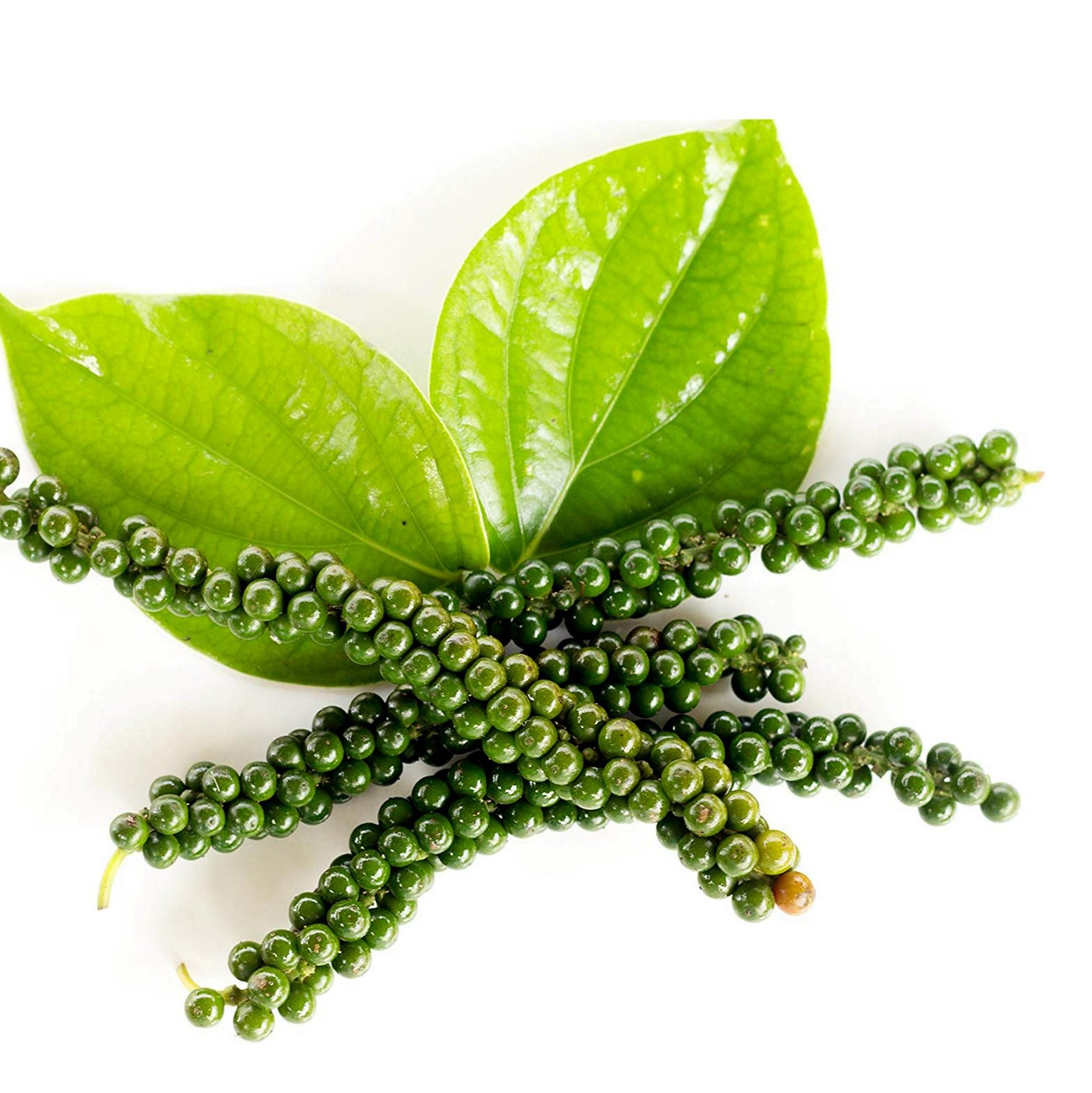
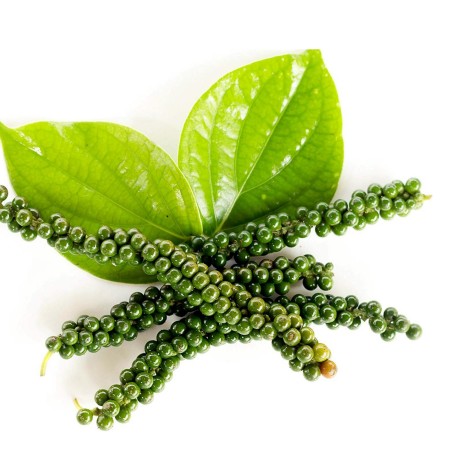
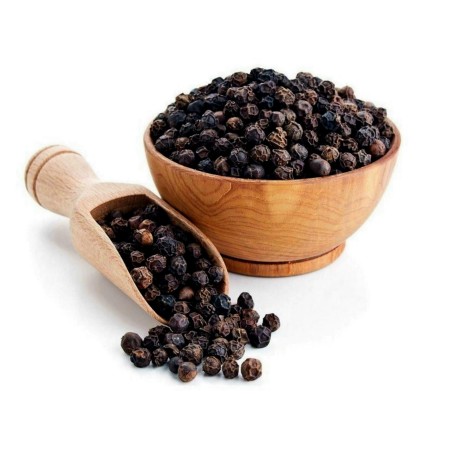
Black pepper (Piper nigrum) is a flowering vine in the family Piperaceae, cultivated for its fruit, which is usually dried and used as a spice and seasoning. When dried, the fruit is known as a peppercorn. When
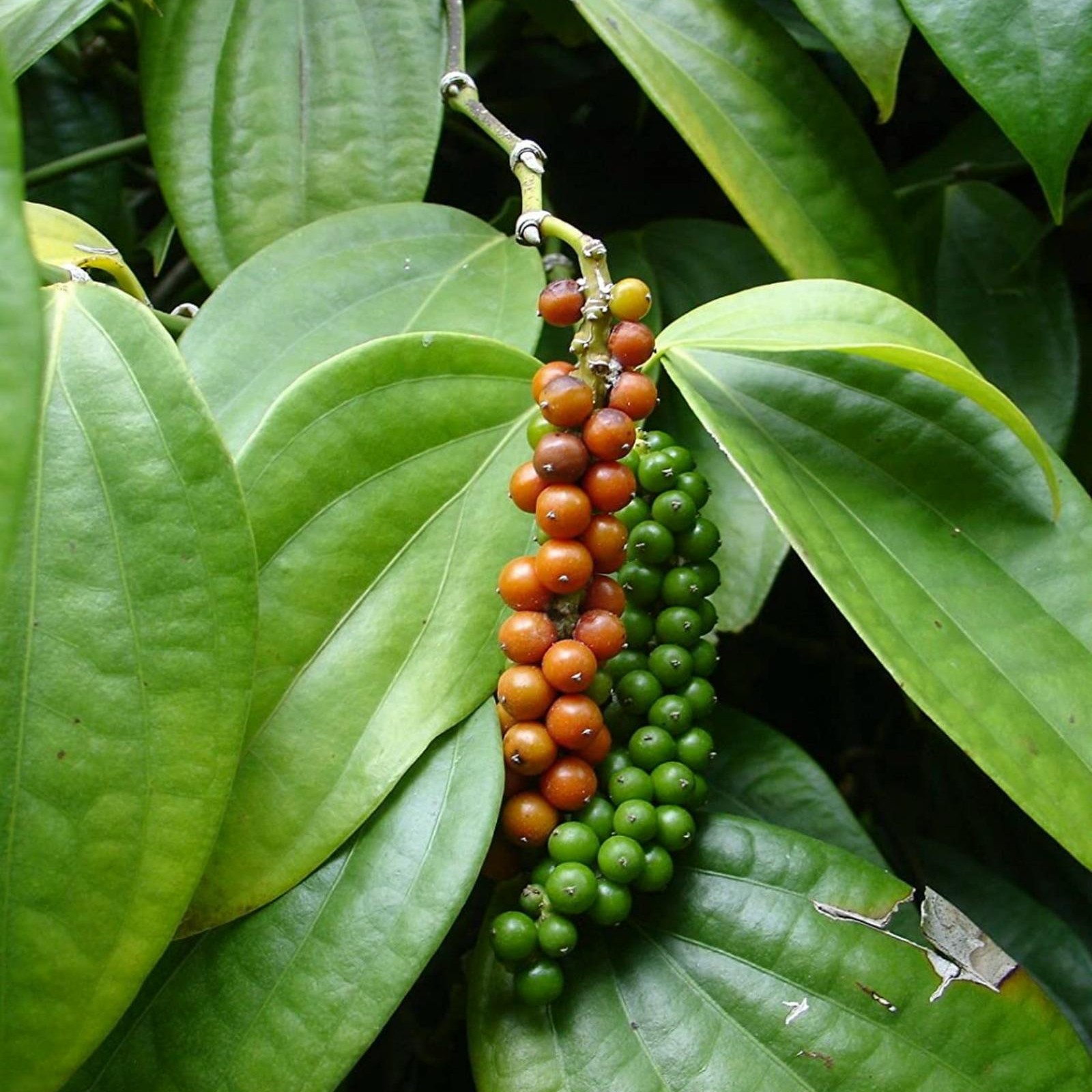
Black pepper (Piper nigrum) is a flowering vine in the family Piperaceae, cultivated for its fruit, which is usually dried and used as a spice and seasoning. When dried, the fruit is known as a peppercorn. When fresh and fully mature, it is approximately 5 millimeters (0.20 in) in diameter, dark red, and, like all drupes, contains a single seed. Peppercorns, and the ground pepper derived from them, maybe described simply as pepper, or more precisely as black pepper (cooked and dried unripe fruit), green pepper (dried unripe fruit) and white pepper (ripe fruit seeds).
Black pepper is native to south India and is extensively cultivated there and elsewhere in tropical regions. Currently, Vietnam is the world's largest producer and exporter of pepper, producing 34% of the world's Piper nigrum crop as of 2013.
Dried ground pepper has been used since antiquity for both its flavor and as traditional medicine. Black pepper is the world's most traded spice. It is one of the most common spices added to cuisines around the world. The spiciness of black pepper is due to the chemical piperine, not to be confused with the capsaicin characteristic of fresh hot peppers. Black pepper is ubiquitous in the modern world as a seasoning and is often paired with salt.
Etymology
The word "pepper" has its roots in the Dravidian word for long pepper, pippali.[2][3][4] Ancient Greek and Latin turned pippali into the Greek πέπερι peperi and then into the Latin piper, which was used by the Romans to refer both to black pepper and long pepper, as the Romans erroneously believed that both of these spices were derived from the same plant.[5] Today's "pepper" derives from the Old English pipor. The Latin word is also the source of Romanian piper, Italian pepe, Dutch peper, German Pfeffer, French poivre, and other similar forms.
In the 16th century, pepper started referring to the unrelated New World chili pepper as well. "Pepper" was used in a figurative sense to mean "spirit" or "energy" at least as far back as the 1840s; in the early 20th century, this was shortened to pep.
Black pepper
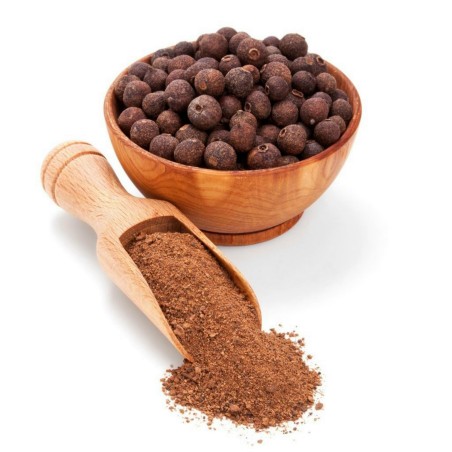
Black pepper is produced from the still-green, unripe drupes of the pepper plant. The drupes are cooked briefly in hot water, both to clean them and to prepare them for drying. The heat ruptures cell walls in the pepper, speeding the work of browning enzymes during drying. The drupes are dried in the sun or by machine for several days, during which the pepper around the seed shrinks and darkens into a thin, wrinkled black layer. Once dried, the spice is called black peppercorn. On some estates, the berries are separated from the stem by hand and then sun-dried without the boiling process.
Once the peppercorns are dried, pepper spirit and oil can be extracted from the berries by crushing them. Pepper spirit is used in many medicinal and beauty products. Pepper oil is also used as an ayurvedic massage oil and used in certain beauty and herbal treatments.
Plant
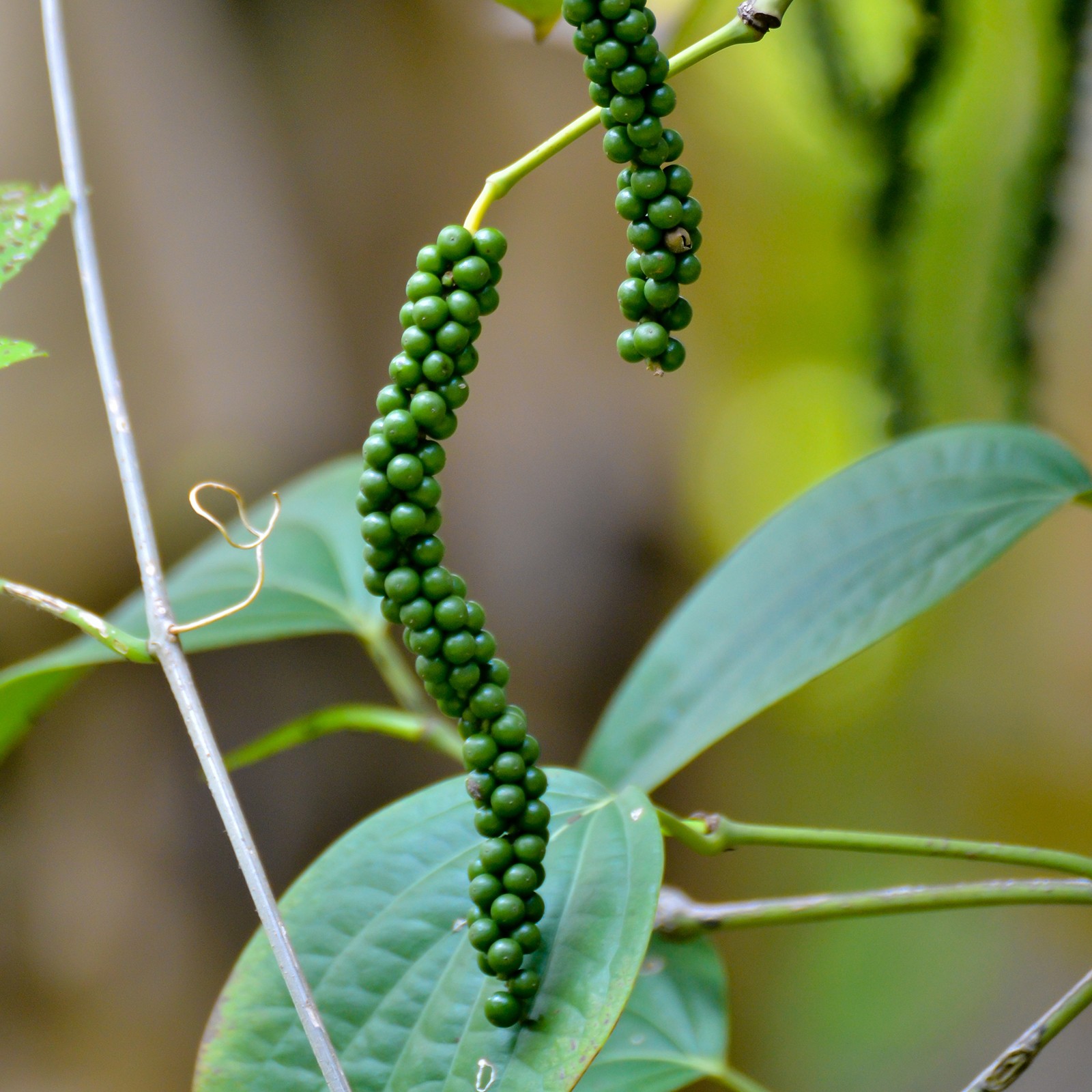
The pepper plant is a perennial woody vine growing up to 4 meters (13 ft) in height on supporting trees, poles, or trellises. It is a spreading vine, rooting readily where trailing stems touch the ground. The leaves are alternate, entire, 5 to 10 centimetres (2.0 to 3.9 in) long and 3 to 6 centimetres (1.2 to 2.4 in) across. The flowers are small, produced on pendulous spikes 4 to 8 centimetres (1.6 to 3.1 in) long at the leaf nodes, the spikes lengthening up to 7 to 15 centimetres (2.8 to 5.9 in) as the fruit matures.[15] The fruit of the black pepper is called a drupe and when dried is known as a peppercorn.
Pepper can be grown in soil that is neither too dry nor susceptible to flooding, moist, well-drained and rich in organic matter (the vines do not do too well over an altitude of 900 m (3,000 ft) above sea level). The plants are propagated by cuttings about 40 to 50 centimetres (16 to 20 in) long, tied up to neighbouring trees or climbing frames at distances of about 2 metres (6 ft 7 in) apart; trees with rough bark are favoured over those with smooth bark, as the pepper plants climb rough bark more readily. Competing plants are cleared away, leaving only sufficient trees to provide shade and permit free ventilation. The roots are covered in leaf mulch and manure, and the shoots are trimmed twice a year. On dry soils the young plants require watering every other day during the dry season for the first three years. The plants bear fruit from the fourth or fifth year, and typically continue to bear fruit for seven years. The cuttings are usually cultivars, selected both for yield and quality of fruit.
A single stem will bear 20 to 30 fruiting spikes. The harvest begins as soon as one or two fruits at the base of the spikes begin to turn red, and before the fruit is fully mature, and still hard; if allowed to ripen completely, the fruit lose pungency, and ultimately fall off and are lost. The spikes are collected and spread out to dry in the sun, then the peppercorns are stripped off the spikes.[15]
Black pepper is either native to Southeast Asia[16] or South Asia.[17] Within the genus Piper, it is most closely related to other Asian species such as Piper caninum.
History
Pepper is native to South Asia and Southeast Asia and has been known to Indian cooking since at least 2000 BCE.[20] J. Innes Miller notes that while pepper was grown in southern Thailand and in Malaysia, its most important source was India, particularly the Malabar Coast, in what is now the state of Kerala[21] Peppercorns were a much-prized trade good, often referred to as "black gold" and used as a form of commodity money. The legacy of this trade remains in some Western legal systems which recognize the term "peppercorn rent" as a form of a token payment made for something that is in fact being given.
The ancient history of black pepper is often interlinked with (and confused with) that of long pepper, the dried fruit of closely related Piper longum. The Romans knew of both and often referred to either as just "piper". In fact, it was not until the discovery of the New World and of chili peppers that the popularity of long pepper entirely declined. Chili peppers, some of which when dried are similar in shape and taste to long pepper, were easier to grow in a variety of locations more convenient to Europe.
Before the 16th century, pepper was being grown in Java, Sunda, Sumatra, Madagascar, Malaysia, and everywhere in Southeast Asia. These areas traded mainly with China, or used the pepper locally.[22] Ports in the Malabar area also served as a stop-off point for much of the trade in other spices from farther east in the Indian Ocean. Following the British hegemony in India, virtually all of the black pepper found in Europe, the Middle East, and North Africa was traded from Malabar region.
Ancient times
Black peppercorns were found stuffed in the nostrils of Ramesses II, placed there as part of the mummification rituals shortly after his death in 1213 BCE.[23] Little else is known about the use of pepper in ancient Egypt and how it reached the Nile from South Asia.
Pepper (both long and black) was known in Greece at least as early as the 4th century BCE, though it was probably an uncommon and expensive item that only the very rich could afford. Trade routes of the time were by land, or in ships which hugged the coastlines of the Arabian Sea. Long pepper, growing in the north-western part of India, was more accessible than the black pepper from further south; this trade advantage, plus long pepper's greater spiciness, probably made black pepper less popular at the time.
By the time of the early Roman Empire, especially after Rome's conquest of Egypt in 30 BCE, open-ocean crossing of the Arabian Sea direct to southern India's Malabar Coast was near routine. Details of this trading across the Indian Ocean have been passed down in the Periplus of the Erythraean Sea. According to the Roman geographer Strabo, the early Empire sent a fleet of around 120 ships on an annual one-year trip to China, Southeast Asia, India and back. The fleet timed its travel across the Arabian Sea to take advantage of the predictable monsoon winds. Returning from India, the ships travelled up the Red Sea, from where the cargo was carried overland or via the Nile-Red Sea canal to the Nile River, barged to Alexandria, and shipped from there to Italy and Rome. The rough geographical outlines of this same trade route would dominate the pepper trade into Europe for a millennium and a half to come.
With ships sailing directly to the Malabar coast, black pepper was now travelling a shorter trade route than long pepper, and the prices reflected it. Pliny the Elder's Natural History tells us the prices in Rome around 77 CE: "Long pepper ... is fifteen denarii per pound, while that of white pepper is seven, and of black, four." Pliny also complains "there is no year in which India does not drain the Roman Empire of fifty million sesterces," and further moralizes on pepper:
It is quite surprising that the use of pepper has come so much into fashion, seeing that in other substances which we use, it is sometimes their sweetness, and sometimes their appearance that has attracted our notice; whereas, pepper has nothing in it that can plead as a recommendation to either fruit or berry, its only desirable quality being a certain pungency; and yet it is for this that we import it all the way from India! Who was the first to make trial of it as an article of food? and who, I wonder, was the man that was not content to prepare himself by hunger only for the satisfying of a greedy appetite?
Black pepper was a well-known and widespread, if expensive, seasoning in the Roman Empire. Apicius' De re coquinaria, a 3rd-century cookbook probably based at least partly on one from the 1st century CE, includes pepper in a majority of its recipes. Edward Gibbon wrote, in The History of the Decline and Fall of the Roman Empire, that pepper was "a favorite ingredient of the most expensive Roman cookery".
Phytochemicals, folk medicine, and research
Like many eastern spices, pepper was historically both a seasoning and a folk medicine. Long pepper, being stronger, was often the preferred medication, but both were used. Black pepper (or perhaps long pepper) was believed to cure several illnesses, such as constipation, insomnia, oral abscesses, sunburn and toothaches, among others.[35] Various sources from the 5th century onward recommended pepper to treat eye problems, often by applying salves or poultices made with pepper directly to the eye. There is no current medical evidence that any of these treatments has any benefit.
Pepper is known to cause sneezing. Some sources say that piperine, a substance present in black pepper, irritates the nostrils, causing the sneezing.[37] Few, if any, controlled studies have been carried out to answer the question.
Piperine is under study for its potential to increase absorption of selenium, vitamin B, beta-carotene and curcumin, as well as other compounds.[38] As a folk medicine, pepper appears in the Buddhist Samaññaphala Sutta, chapter five, as one of the few medicines allowed to be carried by a monk.[39] Pepper contains phytochemicals,[40] including amides, piperidines, pyrrolidines and trace amounts of safrole which may be carcinogenic in laboratory rodents.
Piperine is under study for a variety of possible physiological effects,[42] although this work is preliminary and mechanisms of activity for piperine in the human body remain unknown.
Nutrition
One tablespoon (6 grams) of ground black pepper contains moderate amounts of vitamin K (13% of the daily value or DV), iron (10% DV) and manganese (18% DV), with trace amounts of other essential nutrients, protein and dietary fibre.
Flavor
Pepper gets its spicy heat mostly from piperine derived both from the outer fruit and the seed. Black pepper contains between 4.6% and 9.7% piperine by mass, and white pepper slightly more than that.[44] Refined piperine, by weight, is about one percent as hot as the capsaicin found in chili peppers.[45] The outer fruit layer, left on black pepper, also contains important odour-contributing terpenes including pinene, sabinene, limonene, caryophyllene, and linalool, which give citrusy, woody, and floral notes. These scents are mostly missing in white pepper, which is stripped of the fruit layer. White pepper can gain some different odours (including musty notes) from its longer fermentation stage.[46] The aroma of pepper is attributed to rotundone (3,4,5,6,7,8-Hexahydro-3α,8α-dimethyl-5α-(1-methylethenyl)azulene-1(2H)-one), a sesquiterpene originally discovered in the tubers of cyperus rotundus, which can be detected in concentrations of 0.4 nanograms/L in water and in wine: rotundone is also present in marjoram, oregano, rosemary, basil, thyme, and geranium, as well as in some Shiraz wines.
Pepper loses flavour and aroma through evaporation, so airtight storage helps preserve its spiciness longer. Pepper can also lose flavour when exposed to light, which can transform piperine into nearly tasteless isochavicine. Once ground, pepper's aromatics can evaporate quickly; most culinary sources recommend grinding whole peppercorns immediately before use for this reason. Handheld pepper mills or grinders, which mechanically grind or crush whole peppercorns, are used for this, sometimes instead of pepper shakers that dispense pre-ground pepper. Spice mills such as pepper mills were found in European kitchens as early as the 14th century, but the mortar and pestle used earlier for crushing pepper have remained a popular method for centuries as well.
KategóriaKezdőlapCikkszámMHS-56-PNKészleten37 Elemek
A jelentésed beküldve, és egy moderátor megvizsgálja.
Jelentésed beküldése nem lehetséges
Vélemény elküldve
A hozzászólásodat elküldtük és elérhető lesz, amint egy moderátor jóváhagyja.
Véleményed nem lehet elküldeni
🌍Szállítás világszerte az EU-ból
A világ minden tájára szállítunk az Európai Unióból, ajánlott légipostával, kézbesítéskor aláírásos visszaigazolással.
📦Rendelés követése Jelentkezz be a fiókodba, és navigálj aRendelési előzmények > Részletek hogy megtalálja a nyomonkövetési számát.
A rendelésed minden szakaszáról e-mail értesítést kapsz. Ha nem látod ezeket az üzeneteket, kérjük, ellenőrizd a Spam/Kéretlen levelek mappádat, vagy lépj kapcsolatba az e-mail szolgáltatóddal. Alternatívaként keress az interneten útmutatót arról, hogyan szüntetheted meg egy feladó e-mailjeinek blokkolását.
AZ E-MAIL SZOLGÁLTATÁSUNK MŰKÖDIK
Rendelésed minden egyes szakaszáról e-mail értesítést fogsz kapni. Ha nem látod ezeket az üzeneteket, kérjük, ellenőrizd a Spam/Junk mappádat, vagy lépj kapcsolatba az e-mail szolgáltatóddal.
📧Hogyan biztosítsuk, hogy a webshopunkból érkező e-mailek mindig a Gmail-fiókodba érkezzenekvagy bármely más e-mailszolgáltatóéMegérkeznek a Beérkező mappába, és nincsenek spamként megjelölve vagy blokkolva:
Adja hozzá a Feladót a Google- vagy bármely más e-mail szolgáltató névjegyeihez. Nem tudunk segíteni, ha a beállításai nem ilyenek. Forduljon segítségért az e-mail szolgáltatójához.
1. lépés: Nyisd meg a Gmailt, és keresd meg tőlünk érkező e-mailt xxxxxxxxxxxx@xxx.com Ne próbáljon nekünk közvetlenül erre a címre e-mailt küldeni; azt nem fogjuk megkapni. Minden kapcsolatfelvétel kizárólag webáruházunk kapcsolati űrlapján keresztül történik! Ha nem találod az e-mailünket, előfordulhat, hogy blokkolták. Ebben az esetben folytasd az alábbi 4. lépéssel.
2. lépés: Az e-mail tetején vidd az egérmutatót a feladó nevére vagy e-mail-címére.
3. lépés: Kattintson az "Add to Contacts" ikonra (a kis ember-ikonra).
Ez segít a Gmailnek, hogy megbízható küldőként ismerjen el minket, így az e-mailjeink közvetlenül a postaládádba kerülnek, és nem a spam mappába.
Hozzon létre egy szűrőt, hogy az e-mailek ne legyenek spamnek jelölve vagy letiltva
1. lépés: Nyisd meg a Gmailt, és kattints a jobb felső sarokban található fogaskerék ikonra, majd válaszd a "See all settings" lehetőséget.
2. lépés: Lépj a "Szűrők és letiltott címek" fülre.
3. lépés: Kattintson a "Hozzon létre egy új szűrőt".
4. lépés: A "From" mezőbe írja be azt az e-mail címet, amelyet fel szeretne venni a fehérlistára (e.g., boltunk e-mail címe).
5. lépés: Kattintson a "Szűrő létrehozása" gombra.
6. lépés: A következő ablakban jelölje be a "Soha ne küldje a Spam mappába" feliratú négyzetet.
7. lépés: Kattintson a "Szűrő létrehozása" gombra a mentéshez.
Ez biztosítja, hogy e-mailjeink mindig a beérkező levelek közé kerüljenek, és véletlenül se legyenek spamként megjelölve vagy letiltva.
Kövesse nyomon csomagját ezen keresztül:
Aftership
17Track
Posta.hr (olyan nyomkövetési számokhoz, mint RGxxxxxxHR)
⚠️Fontos értesítések
Utánvételes fizetésNEMElérhető.
Rendeléskor mindig adjon meg érvényes mobiltelefonszámot országkóddal (e.g., +365 456 7686 576).
Ne utasíts arra, hogy P.O. Dobozokat, illetve — ha nem tud otthon lenni, hogy aláírja a csomagot — csomagokat nem lehet a szomszédoknál hagyni.
Ha egy csomagot küldenek egy P.O. A doboz elvesztése vagy kézbesítetlensége esetén nem jár visszatérítés.
⚖️Ügyfél felelőssége a jogi megfelelésért A vevő felel azért, hogy a termék behozatala az ő országába jogszerű legyen, ideértve az összes vonatkozó importszabály betartását, a szükséges engedélyek beszerzését, valamint a vonatkozó vámok, adók és egyéb díjak megfizetését. Kérjük, ellenőrizze a helyi jogszabályokat megrendelés előtt, hogy elkerülje az esetleges problémákat a vámkezeléssel vagy a kézbesítéssel.
📦Elveszett, Visszaküldött & Újraküldött Csomagok
Brazília & Mexikó ügyfelei:Nem tudunk visszatérítést nyújtani a vám által elveszett vagy megsemmisített csomagokért.
Ha a csomagodat visszaküldik, csak a termék árát térítjük vissza — a szállítási költségeket nem térítjük vissza.
A visszaküldés postaköltségét (€2) és az esetleges újraküldési költségeket a vásárlónak kell fedeznie.
Ha egy csomag bármilyen okból visszaérkezik hozzánk, Ön köteles megfizetni a visszaküldés szállítási költségét (€2), valamint az újraküldés díját.
🚚Szállítmány kézbesítése Az ajánlott küldeményekhez aláírás szükséges.
Ha a nyomkövetés szerint a csomag még az induló postánál van, az úton van — lépjen kapcsolatba a helyi postával a frissítésekért.
Sajnos sem mi, sem az a posta, amelyen keresztül a rendelésed feladásra került, nem tud segíteni a rendelésed hollétével kapcsolatban. Amikor látod, hogy a csomagod az országodban van,KÖTELEZŐ felvenned a kapcsolatot a postával a nyomkövetési számmalés beszélje meg velük az ügyet. Minden megrendelést hivatalos állami postán küldünk.
Nem vagyunk felelősek a kézbesítési időkért, és nem tudjuk az Ön helyett nyomon követni a küldeményeket.
📅 Szállítási Lehetőségek & Várható Kézbesítési Idők
Szállítási lehetőség
Feldolgozási idő
Jegyzetek
Elsőbbségi kézbesítés
Szállítjuk 1–7 munkanapon belül
A rendelés feldolgozását részesíti előnyben (a gyorsabb kézbesítés nem garantált); ünnepek alatt késések lehetségesek (3–10 nap).
Biztonságos Kézbesítés
Szállítjuk 1–7 munkanapon belül
Legfeljebb 150 € értékű rendelésekre érvényes; elvesztés esetén visszatérítjük.
Normál Kiszállítás
Feladás 7–10 munkanapon belül
Gazdaságosabb; ünnepek alatt késések előfordulhatnak (7–14 nap)
Becsült kézbesítési idő:
Az EU-n belül: 3–20 nap
Világszerte: 5–30 nap
USA példák:Kiszállítás 13, 17, 19, 22 vagy 27 napon belül.
Megjegyzés:A kézbesítési idők az Ön tartózkodási helyétől és a helyi postai rendszer működésétől függenek. A COVID-19 vagy az ünnepi időszakok további késéseket okozhatnak.
💰Szállítási költségek A szállítási és kezelési díjakat a pénztárnál automatikusan számítjuk ki a csomag súlya és a rendeltetési hely alapján.
⏰Rendelések feldolgozási ideje Szombaton és vasárnap nem dolgozzuk fel és nem küldjük ki a megrendeléseket.
💳Fizetési lehetőségek
Banki átutalás (SEPA / IBAN / SWIFT-BIC) A fizetési közleményben tüntesse fel a rendelés azonosítóját (e.g., "SGS-19811702"). A 7 napon belül be nem fizetett rendelések automatikusan törlésre kerülnek.
PayPal A fizetés csak euróban fogadható el. Kérjük, a fizetés során válassza az eurót.
Kártyás fizetés Elfogadjuk a Visa, MasterCard, American Express, CB, Diners Club, Discover, China UnionPay, JCB és Discover kártyákat.
⚠️Tranzakciós díjak A vásárlók felelősek bármilyen banki vagy PayPal tranzakciós díjért. Kérjük, adja meg a pontos fizetési adatokat a gyorsabb rendelésfeldolgozás érdekében.
📢Záró megjegyzések Mielőtt leadná a rendelését, mindig ellenőrizze weboldalunkat az esetleges különleges közlemények, ünnepi nyitvatartások vagy olyan szállítási feltételek miatt, amelyek befolyásolhatják a vásárlását.
Fontos értesítés: Digitális számlák
A papírhulladék csökkentése érdekében a rendeléséhez nem mellékelünk nyomtatott számlát. Számláját bármikor egyszerűen letöltheti és kinyomtathatja, ha ellátogat a fiókjábaRendelési Előzmények a fiókod profiljában