Undoubtedly a candidate for most poisonous plant in the garden but also a contender for most beautiful. This species is considered to be native to Spain, the Balearic Islands and Morocco east through
Undoubtedly a candidate for most poisonous plant in the garden but also a contender for most beautiful.
This species is considered to be native to Spain, the Balearic Islands and Morocco east through Mediterranean coastal countries to the Arabian Peninsula, Ethiopia, Niger, Afghanistan, Iran and Iraq to India and central China. It occurs as a non-native in parts of Africa, the Azores, Japan, Indonesia, Australia, New Zealand, the United States, central and eastern Mexico, Central and South America.
This species is very widely cultivated as an ornamental. All parts of the plant are poisonous and so it is not grazed or eaten. Steam from boiled leaves is inhaled to relieve sinusitis, pounded leaves are applied to the skin to relieve itching, ulcers and tumours (Jongbloed 2003); the leaves are used as an insecticide.
Nerium
Believed to come from the Greek ‘nerion’ which is, itself, believed to be based on ‘neros’, ‘wet’ or ‘fresh’.
oleander
Possibly a combination of the Latin ‘olea’, ‘olive’ and ‘rodandrum’, ‘rhododendron’ meaning the plant looks somewhat similar to a cross between these two.
Common Names and Synonyms
oleander, rose bay, common oleander, rose laurel
WIKIPEDIA:
Nerium oleander /ˈnɪəriəm ˈoʊliː.ændər/[3] is an evergreen shrub or small tree in the dogbane family Apocynaceae, toxic in all its parts. It is the only species currently classified in the genus Nerium. It is most commonly known as oleander, from its superficial resemblance to the unrelated olive Olea.[Note 1] It is so widely cultivated that no precise region of origin has been identified, though southwest Asia has been suggested. The ancient city of Volubilis in Morocco may have taken its name from the Berber name oualilt for the flower.[4] Oleander is one of the most poisonous commonly grown garden plants.
Description
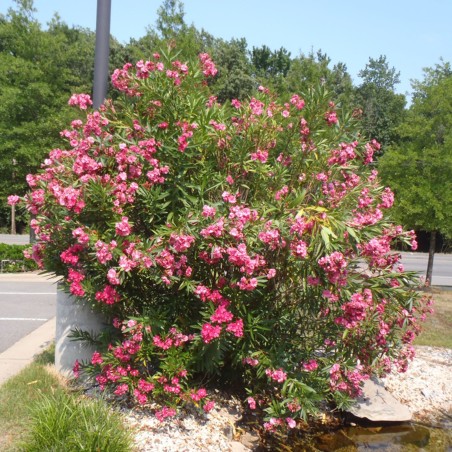
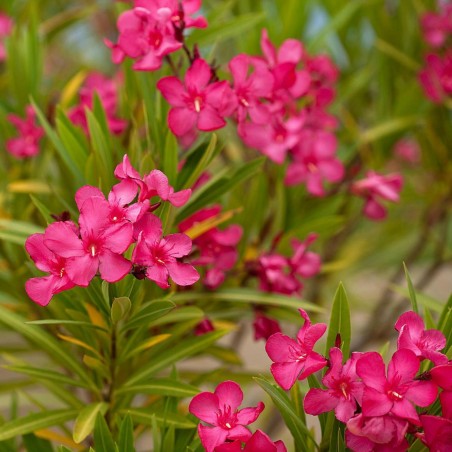
Oleander grows to 2–6 m (6.6–19.7 ft) tall, with erect stems that splay outward as they mature; first-year stems have a glaucous bloom, while mature stems have a grayish bark. The leaves are in pairs or whorls of three, thick and leathery, dark-green, narrow lanceolate, 5–21 cm (2.0–8.3 in) long and 1–3.5 cm (0.39–1.38 in) broad, and with an entire margin. The flowers grow in clusters at the end of each branch; they are white, pink to red,[Note 2] 2.5–5 cm (0.98–1.97 in) diameter, with a deeply 5-lobed fringed corolla round the central corolla tube. They are often, but not always, sweet-scented.[Note 3] The fruit is a long narrow capsule 5–23 cm (2.0–9.1 in) long, which splits open at maturity to release numerous downy seeds.
Habitat and range
N. oleander is either native or naturalized to a broad area from Mauritania, Morocco, and Portugal eastward through the Mediterranean region and the Sahara (where it is only found sporadically), to the Arabian peninsula, southern Asia, and as far East as Yunnan in southern parts of China.[5][6][7][8] It typically occurs around dry stream beds. Nerium oleander is planted in many subtropical and tropical areas of the world. On the East Coast of the US, it grows as far north as Virginia Beach, Virginia, while in California and Texas it is naturalized as a median strip planting.[citation needed] Because of its durability, Oleander was planted prolifically on Galveston Island in Texas after the disastrous Hurricane of 1900. They are so prolific that Galveston is known as the 'Oleander City'; an annual Oleander festival is hosted every spring.[9] Oleander can be grown successfully outdoors in southern England, particularly in London and mild coastal regions of Dorset and Cornwall.
Ecology
Some invertebrates are known to be unaffected by oleander toxins, and feed on the plants. Caterpillars of the polka-dot wasp moth (Syntomeida epilais) feed specifically on oleanders and survive by eating only the pulp surrounding the leaf-veins, avoiding the fibers. Larvae of the common crow butterfly (Euploea core) also feed on oleanders, and they retain or modify toxins, making them unpalatable to would-be predators such as birds, but not to other invertebrates such as spiders and wasps.
The flowers require insect visits to set seed, and seem to be pollinated through a deception mechanism. The showy corolla acts as a potent advertisement to attract pollinators from a distance, but the flowers are nectarless and offer no reward to their visitors. They therefore receive very few visits, as typical of many rewardless flower species.[11][12] Fears of honey contamination with toxic oleander nectar are therefore unsubstantiated.
Ornamental gardening
Oleander is a vigorous grower in warm subtropical regions, where it is extensively used as an ornamental plant in parks, along roadsides, and as a windbreak. It will tolerate occasional light frost down to −10 °C (14 °F).,[8] though the leaves may be damaged. The toxicity of Oleander renders it deer-resistant. The plant is tolerant of poor soils, salt spray, and sustained drought, although it will flower and grow more vigorously with regular water. Nerium Oleander also responds well to heavy pruning, which should be done in the autumn or early spring to keep plants from becoming unruly.
In cold-winter climates Oleander can be grown in greenhouses and conservatories, or as potted indoor plants that can be kept outside in the summer. Oleander flowers are showy, profuse, and often fragrant, which makes them very attractive in many contexts. Over 400 cultivars have been named, with several additional flower colors not found in wild plants having been selected, including red, pink, yellow, and salmon; white and a variety of pinks are the most common. Double flowered cultivars like 'Mrs Isadore Dyer' or 'Mont Blanc' are enjoyed for their large, rose-like blooms and strong fragrance. Many dwarf cultivars have also been developed, which grow only to about 10' at maturity. In most Mediterranean climates they can be expected to bloom from April through October, with their heaviest bloom usually in May or June.
Toxicity
Oleander has historically been considered a poisonous plant because some of its compounds may exhibit toxicity, especially to animals, when consumed in large amounts. Among these compounds are oleandrin and oleandrigenin, known as cardiac glycosides, which are known to have a narrow therapeutic index and can be toxic when ingested.
Toxicity studies of animals administered oleander extract concluded that rodents and birds were observed to be relatively insensitive to oleander cardiac glycosides.[16] Other mammals, however, such as dogs and humans, are relatively sensitive to the effects of cardiac glycosides and the clinical manifestations of "glycoside intoxication".
However, despite the common "poisonous" designation of this plant, very few toxic events in humans have been reported. According to the Toxic Exposure Surveillance System, in 2002, 847 human exposures to oleander were reported to poison centers in the United States.[19] Despite this exposure level, from 1985 through 2005, only three deaths were reported. One cited death was apparently due to the ingestion of oleander leaves by a diabetic man.[20] His blood indicated a total blood concentration of cardiac glycosides of about 20 μg/l, which is well above the reported fatal level. Another study reported on the death of a woman who self-administered "an undefined oleander extract" both orally and rectally and her oleandrin tissue levels were 10 to 39 μg/g, which were in the high range of reported levels at autopsy.[21] And finally, one study reported the death of a woman who ingested oleander 'tea'.[22] Few other details were provided.
In contrast to consumption of these undefined oleander-derived materials, no toxicity or deaths were reported from topical administration or contact with N. oleander or specific products derived from them. In reviewing oleander toxicity, Lanford and Boor[23] concluded that, except for children who might be at greater risk, "the human mortality associated with oleander ingestion is generally very low, even in cases of moderate intentional consumption (suicide attempts)".
Toxicity studies conducted in dogs and rodents administered oleander extracts by intramuscular injection indicated that, on an equivalent weight basis, doses of an oleander extract with glycosides 10 times those likely to be administered therapeutically to humans are still safe and without any "severe toxicity observed".
In South Indian states such as Tamil Nadu and in Sri Lanka the seeds of related plant with similar local name (Kaneru(S) කණේරු) Cascabela thevetia produce a poisonous plum with big seeds. As these seeds contain cardenolides, swallowing them is one of the preferred methods for suicides in villages.
Effects of poisoning
Ingestion of this plant can affect the gastrointestinal system, the heart, and the central nervous system. The gastrointestinal effects can consist of nausea and vomiting, excess salivation, abdominal pain, diarrhea that may contain blood, and especially in horses, colic.[7] Cardiac reactions consist of irregular heart rate, sometimes characterized by a racing heart at first that then slows to below normal further along in the reaction. Extremities may become pale and cold due to poor or irregular circulation. The effect on the central nervous system may show itself in symptoms such as drowsiness, tremors or shaking of the muscles, seizures, collapse, and even coma that can lead to death.
Oleander sap can cause skin irritations, severe eye inflammation and irritation, and allergic reactions characterized by dermatitis.
Treatment
Poisoning and reactions to oleander plants are evident quickly, requiring immediate medical care in suspected or known poisonings of both humans and animals.[25] Induced vomiting and gastric lavage are protective measures to reduce absorption of the toxic compounds. Charcoal may also be administered to help absorb any remaining toxins.[7] Further medical attention may be required depending on the severity of the poisoning and symptoms. Temporary cardiac pacing will be required in many cases (usually for a few days) until the toxin is excreted.
Digoxin immune fab is the best way to cure an oleander poisoning if inducing vomiting has no or minimal success, although it is usually used only for life-threatening conditions due to side effects.
Drying of plant materials does not eliminate the toxins. It is also hazardous for animals such as sheep, horses, cattle, and other grazing animals, with as little as 100 g being enough to kill an adult horse.[26] Plant clippings are especially dangerous to horses, as they are sweet. In July 2009, several horses were poisoned in this manner from the leaves of the plant.[27] Symptoms of a poisoned horse include severe diarrhea and abnormal heartbeat. There is a wide range of toxins and secondary compounds within oleander, and care should be taken around this plant due to its toxic nature. Different names for oleander are used around the world in different locations, so, when encountering a plant with this appearance, regardless of the name used for it, one should exercise great care and caution to avoid ingestion of any part of the plant, including its sap and dried leaves or twigs. The dried or fresh branches should not be used for spearing food, for preparing a cooking fire, or as a food skewer. Many of the oleander relatives, such as the desert rose (Adenium obesum) found in East Africa, have similar leaves and flowers and are equally toxic.
Folklore
The alleged toxicity of the plant makes it the center of an urban legend documented on several continents and over more than a century. Often told as a true and local event, typically an entire family, or in other tellings a group of scouts, succumbs after consuming hot dogs or other food roasted over a campfire using oleander sticks.
Garden history
In his book Enquiries into Plants of circa 300 BC, Theophrastus described (among plants that affect the mind) a shrub he called onotheras, which modern editors render oleander; "the root of onotheras [oleander] administered in wine", he alleges, "makes the temper gentler and more cheerful".
The plant has a leaf like that of the almond, but smaller, and the flower is red like a rose. The plant itself (which loves hilly country) forms a large bush; the root is red and large, and, if this is dried, it gives off a fragrance like wine.
In another mention, of "wild bay" (Daphne agria), Theophrastus appears to intend the same shrub.
Oleander was a very popular ornamental shrub in Roman peristyle gardens; it is one of the flora most frequently depicted on murals in Pompeii and elsewhere in Italy. These murals include the famous garden scene from the House of Livia at Prima Porta outside Rome, and those from the House of the Wedding of Alexander and the Marine Venus in Pompeii.
Willa Cather, in her book The Song of the Lark, mentions oleander in this passage:
This morning Thea saw to her delight that the two oleander trees, one white and one red, had been brought up from their winter quarters in the cellar. There is hardly a German family in the most arid parts of Utah, New Mexico, Arizona, but has its oleander trees. However loutish the American-born sons of the family may be, there was never one who refused to give his muscle to the back-breaking task of getting those tubbed trees down into the cellar in the fall and up into the sunlight in the spring. They may strive to avert the day, but they grapple with the tub at last.
Oleander is the official flower of the city of Hiroshima, having been the first to bloom following the atomic bombing of the city in 1945.
Z Evropské unie odesíláme do celého světa registrovanou leteckou poštou s potvrzením podpisu při doručení.
📦Sledování vaší objednávky Přihlaste se do svého účtu a přejděte naHistorie objednávek > Podrobnosti najít vaše sledovací číslo.
Obdržíte e-mailová oznámení o každé fázi vaší objednávky. Pokud tyto zprávy nevidíte, zkontrolujte prosím složku Spam/Nežádaná pošta nebo kontaktujte svého poskytovatele e-mailu. Případně vyhledejte na internetu, jak odblokovat e-mailovou adresu odesílatele.
NAŠE E-MAILOVÁ SLUŽBA FUNGUJE
Obdržíte e-mailová upozornění v každé fázi vaší objednávky. Pokud tyto zprávy nevidíte, zkontrolujte prosím složku Spam/Nevyžádaná pošta nebo kontaktujte svého poskytovatele e-mailu.
📧Jak zajistit, aby e-maily z našeho online obchodu vždy dorazily do vašeho Gmailunebo jakýkoli jiný e-mailposkytovateleJsou v doručené poště a nejsou označeny jako nevyžádaná pošta nebo zablokovány:
Přidejte Odesílatele do kontaktů ve svém účtu Google nebo u jakéhokoli jiného poskytovatele e-mailu. Nemůžeme vám pomoci, pokud vaše nastavení není takové. Obraťte se na svého poskytovatele e-mailu pro pomoc.
Krok 1: Otevřete Gmail a najděte e-mail od nás xxxxxxxxxxxx@xxx.com Nezkoušejte nám posílat e-mail přímo na tuto adresu; nedostaneme ho. Veškerý kontakt probíhá výhradně přes kontaktní formulář v našem online obchodě! Pokud nemůžete najít náš e-mail, mohl být zablokován. V tom případě postupujte podle kroku 4 níže.
Krok 2: Umístěte kurzor myši nad jméno odesílatele nebo e-mailovou adresu v horní části e-mailu.
Krok 3: Klikněte na ikonu „Přidat do kontaktů“ (malá ikona osoby).
To pomůže Gmailu rozpoznat nás jako důvěryhodného odesílatele, takže naše e-maily půjdou přímo do vaší doručené pošty a ne do spamu.
Vytvořte filtr, který zabrání tomu, aby byly e-maily označeny jako spam nebo zablokovány.
Krok 1: Otevřete Gmail a klikněte na ikonu ozubeného kola v pravém horním rohu, poté vyberte "Zobrazit všechna nastavení".
Krok 2: Přejděte na kartu "Filtry a zablokované adresy".
Krok 3: Klikněte na "Vytvořit nový filtr".
Krok 4: Do pole "From" zadejte e-mailovou adresu, kterou chcete přidat na bílou listinu (e.g., e-mail našeho obchodu).
Krok 5: Klikněte na "Vytvořit filtr".
Krok 6: V dalším okně zaškrtněte políčko označené "Nikdy to neodesílat do spamu".
Krok 7: Klikněte na "Vytvořit filtr" pro uložení.
To zajistí, že naše e-maily vždy dorazí do vaší doručené pošty a nebudou omylem označeny jako spam ani zablokovány.
Sledujte svou zásilku pomocí:
Aftership
17Track
Posta.hr (pro sledovací čísla jako RGxxxxxxHR)
⚠️Důležitá oznámení
Platba na dobírku jeNE k dispozici.
Při objednávání vždy uveďte platné mobilní číslo s předvolbou země (e.g., +365 456 7686 576).
Nenařizujte, aby P.O. Krabice, nebo pokud nemůžete být doma, abyste podepsali převzetí balíku, zásilky nelze zanechat u sousedů.
Pokud je balíček zaslaný na P.O. Pokud je zásilka ztracena nebo nedoručena, nebude poskytnuto vrácení peněz.
⚖️Zodpovědnost zákazníka za dodržování právních předpisů Zákazník je odpovědný za zajištění, že je dovoz produktu do své země legální, včetně dodržení všech dovozních předpisů, získání nezbytných povolení a zaplacení příslušných celních poplatků, daní a dalších poplatků. Před objednáním si prosím ověřte místní právní předpisy, abyste se vyhnuli problémům s celním odbavením nebo doručením.
Pokud vaše sledování ukazuje, že je balíček stále na poště odesílatele, je na cestě — kontaktujte místní pobočku pošty pro aktuální informace.
Bohužel my ani pošta, přes kterou byla vaše objednávka odeslána, vám nemůžeme pomoci s tím, kde se vaše objednávka nachází. Jakmile uvidíte, že je vaše zásilka ve vaší zemi,MUSÍTE kontaktovat svou poštu s číslem zásilky a projednejte to s nimi. Všechny objednávky odesíláme oficiální státní poštou.
Neodpovídáme za dodací lhůty a nemůžeme za vás sledovat zásilky.
📅Možnosti doručení & odhadované časy
Možnost doručení
Doba zpracování
Poznámky
Přednostní doručení
Odesíláme během 1–7 pracovních dnů.
Upřednostňuje zpracování objednávek (není zaručeno rychlejší doručení); během svátků mohou nastat zpoždění (3–10 dní)
Zabezpečené doručení
Odesíláme během 1–7 pracovních dnů.
Dostupné pro objednávky do €150; vrácení peněz v případě ztráty
Standardní doručení
Odesíláme do 7–10 pracovních dnů.
Levnější; během svátků mohou nastat zpoždění (7–14 dní)
Odhadovaný čas doručení:
V rámci EU: 3–20 dní
Celosvětově:5–30 dní
Příklady USA:Doručeno za 13, 17, 19, 22 nebo 27 dní.
Poznámka:Doba doručení závisí na vaší poloze a na místním poštovním systému. COVID-19 nebo sváteční období mohou způsobit další zpoždění.
💰Náklady na dopravu Poplatky za dopravu a manipulaci se automaticky vypočítají při dokončení objednávky na základě hmotnosti zásilky a místa doručení.
⏰Provozní doba zpracování objednávek V sobotu a v neděli objednávky nevyřizujeme ani neodesíláme.
💳Možnosti platby
Bankovní převod (SEPA / IBAN / SWIFT-BIC) Do popisu platby uveďte referenci vaší objednávky (e.g., "SGS-19811702"). Objednávky bez platby do 7 dnů budou automaticky zrušeny.
PayPal Platby jsou přijímány pouze v eurech. Prosím vyberte eura při placení.
Platba kartou Akceptujeme Visa, MasterCard, American Express, CB, Diners Club, Discover, China UnionPay, JCB a Discover.
⚠️Transakční poplatky Zákazníci hradí veškeré bankovní nebo PayPal transakční poplatky. Prosím, zajistěte přesné platební údaje pro rychlejší zpracování objednávky.
📢Závěrečné poznámky Před zadáním objednávky si vždy zkontrolujte naše webové stránky kvůli zvláštním oznámením, informacím o provozu během svátků nebo konkrétním přepravním podmínkám, které by mohly ovlivnit váš nákup.
Důležité upozornění: Digitální faktury
Abychom snížili množství papírového odpadu, nepřikládáme k vaší objednávce tištěnou fakturu. Fakturu si můžete kdykoli snadno stáhnout a vytisknout návštěvou vašehoHistorie objednávek v profilu vašeho účtu