The almond (Prunus dulcis, syn. Prunus amygdalus) is a species of tree native to the Middle East, the Indian subcontinent and North Africa. "Almond" is also the name of the edible and widely cultivated
The almond (Prunus dulcis, syn. Prunus amygdalus) is a species of tree native to the Middle East, the Indian subcontinent and North Africa.
"Almond" is also the name of the edible and widely cultivated seed of this tree. Within the genus Prunus, it is classified with the peach in the subgenus Amygdalus, distinguished from the other subgenera by corrugations on the shell (endocarp) surrounding the seed.
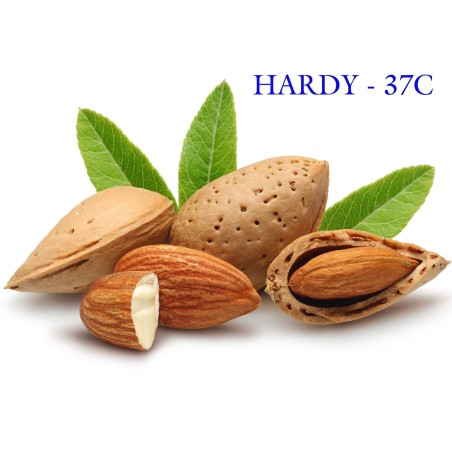
The fruit of the almond is a drupe, consisting of an outer hull and a hard shell with the seed, which is not a true nut, inside. Shelling almonds refers to removing the shell to reveal the seed. Almonds are sold shelled or unshelled. Blanched almonds are shelled almonds that have been treated with hot water to soften the seedcoat, which is then removed to reveal the white embryo.
The almond is a deciduous tree, growing 4–10 m (13–33 ft) in height, with a trunk of up to 30 cm (12 in) in diameter. The young twigs are green at first, becoming purplish where exposed to sunlight, then grey in their second year. The leaves are 3–5 inches long,[3] with a serrated margin and a 2.5 cm (1 in) petiole. The flowers are white to pale pink, 3–5 cm (1–2 in) diameter with five petals, produced singly or in pairs and appearing before the leaves in early spring.[4][5] Almond grows best in Mediterranean climates with warm, dry summers and mild, wet winters. The optimal temperature for their growth is between 15 and 30 °C (59 and 86 °F) and the tree buds have a chilling requirement of 300 to 600 hours below 7.2 °C (45.0 °F) to break dormancy.
Almonds begin bearing an economic crop in the third year after planting. Trees reach full bearing five to six years after planting. The fruit matures in the autumn, 7–8 months after flowering.
Drupe
The almond fruit measures 3.5–6 cm (1–2 in) long. In botanical terms, it is not a nut but a drupe. The outer covering or exocarp, fleshy in other members of Prunus such as the plum and cherry, is instead a thick, leathery, grey-green coat (with a downy exterior), called the hull. Inside the hull is a reticulated, hard, woody shell (like the outside of a peach pit) called the endocarp. Inside the shell is the edible seed, commonly called a nut. Generally, one seed is present, but occasionally two occur.
Origin and history
The almond is native to the Mediterranean climate region of the Middle East, eastward as far as the Yamuna River in India. It was spread by humans in ancient times along the shores of the Mediterranean into northern Africa and southern Europe, and more recently transported to other parts of the world, notably California, United States.
The wild form of domesticated almond grows in parts of the Levant. The fruit of the wild forms contains the glycoside amygdalin, "which becomes transformed into deadly prussic acid (hydrogen cyanide) after crushing, chewing, or any other injury to the seed."
Selection of the sweet type from the many bitter types in the wild marked the beginning of almond domestication. It is unclear as to which wild ancestor of the almond created the domesticated species. Ladizinsky suggests the taxon Amygdalus fenzliana (Fritsch) Lipsky is the most likely wild ancestor of the almond in part because it is native of Armenia and western Azerbaijan where it was apparently domesticated.
While wild almond species are toxic, domesticated almonds are not; Jared Diamond argues that a common genetic mutation causes an absence of amygdalin, and this mutant was grown by early farmers, "at first unintentionally in the garbage heaps, and later intentionally in their orchards". Zohary and Hopf believe that almonds were one of the earliest domesticated fruit trees due to "the ability of the grower to raise attractive almonds from seed. Thus, in spite of the fact that this plant does not lend itself to propagation from suckers or from cuttings, it could have been domesticated even before the introduction of grafting". Domesticated almonds appear in the Early Bronze Age (3000–2000 BC) such as the archaeological sites of Numeria (Jordan), or possibly a little earlier. Another well-known archaeological example of the almond is the fruit found in Tutankhamun's tomb in Egypt (c. 1325 BC), probably imported from the Levant. Of the European countries that the Royal Botanic Garden Edinburgh reported as cultivating almonds, Germany is the northernmost, though the domesticated form can be found as far north as Iceland.
Etymology and names
The word "almond" comes from Old French almande or alemande, Late Latin *amandula, derived through a form amygdala from the Greek ἀμυγδαλή (amygdalē) (cf. amygdala), an almond.[15] The al- in English, for the a- used in other languages may be due a confusion with the Arabic article al, the word having first dropped the a- as in the Italian form mandorla; the British pronunciation ah-mond and the modern Catalan ametlla and modern French amande show a form of the word closer to the original. Other related names of almond include Mandel or Knackmandel (German), mandorlo (Italian for the tree), mandorla (Italian for the fruit), amêndoa (Portuguese), and almendra (Spanish).[16]
The adjective "amygdaloid" (literally "like an almond") is used to describe objects which are roughly almond-shaped, particularly a shape which is part way between a triangle and an ellipse. See, for example, the brain structure amygdala, which uses a direct borrowing of the Greek term amygdalē.
Production
World production of almonds was 2.9 million tonnes in 2013, with United States as the largest producer of 1.8 million tonnes.
In the United States, production is concentrated in California, with almonds being California's third-leading agricultural product, its top agricultural export in 2008,[19] and 100% of the U.S. commercial supply. The United States is the dominant supplier of almonds. Almonds are mostly exported as shelled almonds (70%), with the remainder being either unshelled or processed.[20] In 2015, environmental problems in California affected the almond supply, contributing to higher almond prices worldwide. Rising demand for almonds has also contributed to higher prices worldwide and increased production in California.
Australia is the largest almond production region in the Southern Hemisphere, and second largest producing country. In 2013, Australia produced 9% of the world almond supply (table). Most of the almond orchards are located along the Murray River corridor in New South Wales, Victoria, and South Australia.
Spain has one of the most diverse commercial cultivars of almonds.[25] It is grown in Spain's Catalonia, Valencia, Murcia, Andalusia, and Aragón regions and the Balearic Islands.[26] In Greece, most of the production comes from the region of Magnesia at the area of Almyros. The most cultivated types of almonds in Greece are 'Ferragnes' and 'Texas' ('Mission'), which are known for their sweet taste and premium quality. Because of its quality, it is used as a luxury nut. In Turkey, most of the production comes from the Aegean, Marmara, and Mediterranean regions.
Pollination
The pollination of California's almonds is the largest annual managed pollination event in the world, with close to one million hives (nearly half of all beehives in the USA) being trucked in February to the almond groves. Much of the pollination is managed by pollination brokers, who contract with migratory beekeepers from at least 49 states for the event. This business has been heavily affected by colony collapse disorder, causing nationwide shortages of honey bees and increasing the price of insect pollination. To partially protect almond growers from the rising cost of insect pollination, researchers at the Agricultural Research Service (ARS) have developed a new line of self-pollinating almond trees.[28] Self-pollinating almond trees, such as the 'Tuono', have been around for a while, but their harvest is not as desirable as the insect-pollinated California 'Nonpareil' almond tree. The 'Nonpareil' tree produces large, smooth almonds and offers 60–65% edible kernel per nut. The 'Tuono' has thicker, hairier shells and offers only 32% of edible kernel per nut, but having a thick shell has advantages. The 'Tuono's' shell protects the nut from threatening pests such as the navel orangeworm. ARS researchers have managed to crossbreed the pest-resistant 'Tuono' tree with the 'Nonpareil', resulting in hybridized cultivars of almond trees that are self-pollinated and maintain a high nut quality.[29] The new, self-pollinating hybrids possess quality skin color, flavor, and oil content, and reduce almond growers' dependency on insect pollination.
Sweet and bitter almonds
The seeds of Prunus dulcis var. dulcis are predominantly sweet[31][32] but some individual trees produce seeds that are somewhat more bitter. The genetic basis for bitterness involves a single gene, the bitter flavour furthermore being recessive,[33][34] both aspects making this trait easier to domesticate. The fruits from Prunus dulcis var. amara are always bitter, as are the kernels from other Prunus species, such as peach and cherry (to a lesser extent).
The bitter almond is slightly broader and shorter than the sweet almond and contains about 50% of the fixed oil that occurs in sweet almonds. It also contains the enzyme emulsin which, in the presence of water, acts on soluble glucosides, amygdalin, and prunasin,[35] yielding glucose, cyanide and the essential oil of bitter almonds, which is nearly pure benzaldehyde, the chemical causing the bitter flavor. Bitter almonds may yield from 4–9 mg of hydrogen cyanide per almond[36] and contain 42 times higher amounts of cyanide than the trace levels found in sweet almonds.[37] The origin of cyanide content in bitter almonds is via the enzymatic hydrolysis of amygdalin.
Extract of bitter almond was once used medicinally but even in small doses, effects are severe or lethal, especially in children; the cyanide must be removed before consumption.[37] The acute oral lethal dose of cyanide for adult humans is reported to be 0.5–3.5 mg/kg of body weight (approximately 50 bitter almonds), whereas for children, consuming 5–10 bitter almonds may be fatal.
All commercially grown almonds sold as food in the United States are "sweet" cultivars. The US Food and Drug Administration reported in 2010 that some fractions of imported sweet almonds were contaminated with bitter almonds. Eating such almonds could result in vertigo and other typical bitter almond (cyanide) poisoning effects.
Certain natural food stores sell "bitter almonds" or "apricot kernels" labeled as such, requiring significant caution by consumers for how to prepare and eat these products.
Culinary uses
While the almond is often eaten on its own, raw or toasted, it is also a component of various dishes. Almonds are available in many forms, such as whole, sliced (flaked, slivered), and as flour. Almonds yield almond oil and can also be made into almond butter or almond milk. These products can be used in both sweet and savoury dishes.
Along with other nuts, almonds can be sprinkled over breakfasts and desserts, particularly muesli or ice cream-based dishes. Almonds are used in marzipan, nougat, many pastries (including jesuites), cookies (including French macarons, macaroons), and cakes (including financiers), noghl, and other sweets and desserts. They are also used to make almond butter, a spread similar to peanut butter, popular with peanut allergy sufferers and for its naturally sweeter taste. The young, developing fruit of the almond tree can be eaten whole ("green almonds") when they are still green and fleshy on the outside and the inner shell has not yet hardened. The fruit is somewhat sour, but is a popular snack in parts of the Middle East, eaten dipped in salt to balance the sour taste. Also in the Middle East they are often eaten with dates. They are available only from mid-April to mid-June in the Northern Hemisphere; pickling or brining extends the fruit's shelf life.
Almond cookies, Chinese almond biscuits, and Italian ricciarelli are made with almonds.
In Greece, ground blanched almonds are used as the base material in a great variety of desserts, usually called amygdalota (αμυγδαλωτά). Because of their white colour, most are traditionally considered "wedding sweets" and are served at wedding banquets. In addition, a soft drink known as soumada is made from almonds in various regions.
In Iran, green almonds are dipped in sea salt and eaten as snacks on street markets; they are called chaqale bâdam. Also sweet almonds are used to prepare a special food for babies, named harire badam. Almonds are added to some foods, cookies, and desserts, or are used to decorate foods. People in Iran consume roasted nuts for special events, for example, during New Year (Nowruz) parties.
In Italy, the bitter almonds from apricots are the base for amaretti[40][41] (almond macaroons), a common dessert. Traditionally, a low percentage of bitter almonds (10–20%) is added to the ingredients, which gives the cookies their bitter taste (commercially, apricot kernels are used as a substitute for bitter almonds). Almonds are also a common choice as the nuts to include in torrone. In Apulia and Sicily, pasta di mandorle (almond paste) is used to make small soft cakes, often decorated with jam, pistachio, or chocolate. In Sicily, almond milk is a popular refreshing beverage in summer.
In Morocco, almonds in the form of sweet almond paste are the main ingredient in pastry fillings, and several other desserts. Fried blanched whole almonds are also used to decorate sweet tajines such as lamb with prunes. A drink made from almonds mixed with milk is served in important ceremonies such as weddings and can also be ordered in some cafes. Southwestern Berber regions of Essaouira and Souss are also known for amlou, a spread made of almond paste, argan oil, and honey. Almond paste is also mixed with toasted flour and among others, honey, olive oil or butter, anise, fennel, sesame seeds, and cinnamon to make sellou (also called zamita in Meknes or slilou in Marrakech), a sweet snack known for its long shelf life and high nutritive value.
In Indian cuisine, almonds are the base ingredients of pasanda-style and Mughlai curries. Badam halva is a sweet made from almonds with added coloring. Almond flakes are added to many sweets (such as sohan barfi), and are usually visible sticking to the outer surface. Almonds form the base of various drinks which are supposed to have cooling properties. Almond sherbet or sherbet-e-badaam, is a popular summer drink. Almonds are also sold as a snack with added salt.
In Israel almonds are topping tahini cookie or eaten as a snack.
The 'Marcona' almond cultivar is recognizably different from other almonds, and is marketed by name.[42] The kernel is short, round, relatively sweet, and delicate in texture. It has been grown in Spain for a long time and its origin is unknown; the tree is very productive, and the shell of the nut is very hard.[42] 'Marcona' almonds are traditionally served after being lightly fried in oil, and are used by Spanish confectioners to prepare a sweet called turrón.
Almond milk
Almonds can be processed into a milk substitute called almond milk; the nut's soft texture, mild flavour, and light colouring (when skinned) make for an efficient analog to dairy, and a soy-free choice for lactose intolerant people and vegans. Raw, blanched, and lightly toasted almonds work well for different production techniques, some of which are similar to that of soymilk and some of which use no heat, resulting in "raw milk" (see raw foodism).
Almond flour and skins
Almond flour is often used as a gluten-free alternative to wheat flour in cooking and baking.
Almonds contain polyphenols in their skins consisting of flavonols, flavan-3-ols, hydroxybenzoic acids and flavanones analogous to those of certain fruits and vegetables. These phenolic compounds and almond skin prebiotic dietary fiber have commercial interest as food additives or dietary supplements.
Almond syrup
Historically, almond syrup was an emulsion of sweet and bitter almonds, usually made with barley syrup (orgeat syrup) or in a syrup of orange flower water and sugar, often flavored with a synthetic aroma of almonds.
Due to the cyanide found in bitter almonds, modern syrups generally are produced only from sweet almonds. Such syrup products do not contain significant levels of hydrocyanic acid, so are generally considered safe for human consumption
Nutrition
The almond is a nutritionally dense food (see chart pictured right) and a 100 gram serving is a rich source (>20% of the Daily value, DV) of the B vitamins riboflavin and niacin, vitamin E, and the essential minerals calcium, iron, magnesium, manganese, phosphorus, and zinc. The same serving size is also a good source (10–19% DV) of the B vitamins thiamine, vitamin B6, and folate; choline; and the essential mineral potassium. They are also rich in dietary fiber, monounsaturated fats, and polyunsaturated fats, fats which potentially may lower LDL cholesterol.[46] Typical of nuts and seeds, almonds also contain phytosterols such as beta-sitosterol, stigmasterol, campesterol, sitostanol, and campestanol, which have been associated with cholesterol-lowering properties.
Preliminary research associates consumption of almonds with elevated blood levels of high density lipoproteins and lower low density lipoproteins.
Almonds may cause allergy or intolerance. Cross-reactivity is common with peach allergens (lipid transfer proteins) and tree nut allergens. Symptoms range from local signs and symptoms (e.g., oral allergy syndrome, contact urticaria) to systemic signs and symptoms including anaphylaxis (e.g., urticaria, angioedema, gastrointestinal and respiratory symptoms).
During the digestion process in humans, almond flour may be fermented into short-chain fatty acids, most notably butyrate which is a substrate for cells lining the large intestine.
Oils
Almonds are a rich source of oil, with 50% of kernel dry mass as fat (table). Almond oil contains 32% monounsaturated oleic acid (an omega-9 fatty acid), 13% linoleic acid (a polyunsaturated omega-6 essential fatty acid), and 5% saturated fatty acid (USDA link in table). Linolenic acid, an polyunsaturated omega-3 fat, is not present (table). Almond oil is a rich source of vitamin E providing 261% of the Daily Value per 100 ml (table).
"Oleum amygdalae", the fixed oil, is prepared from either sweet or bitter almonds and is a glyceryl oleate, with a slight odour and a nutty taste. It is almost insoluble in alcohol but readily soluble in chloroform or ether. Sweet almond oil is obtained from the dried kernel of sweet almonds.
The oil is good for application to the skin as an emollient, and has been traditionally used by massage therapists to lubricate the skin during a massage session.
Almond oil can also be used as a wood conditioner of certain woodwind instruments, such as the oboe and clarinet.
Aflatoxins
Almonds are susceptible to aflatoxin-producing molds.[53] Aflatoxins are potent carcinogenic chemicals produced by molds such as Aspergillus flavus and Aspergillus parasiticus. The mold contamination may occur from soil, previously infested almonds, and almond pests such as navel-orange worm. High levels of mold growth typically appear as gray to black filament like growth. It is unsafe to eat mold infected tree nuts.
Some countries have strict limits on allowable levels of aflatoxin contamination of almonds and require adequate testing before the nuts can be marketed to their citizens. The European Union, for example, introduced a requirement since 2007 that all almond shipments to EU be tested for aflatoxin. If aflatoxin does not meet the strict safety regulations, the entire consignment may be reprocessed to eliminate the aflatoxin or it must be destroyed.
Expediem in intreaga lume din Uniunea Europeana, folosind posta aeriana recomandata, cu confirmare prin semnatura la livrare.
📦Urmarirea comenzii tale Conectati-va la contul dvs. si navigati laIstoricul comenzilor > Detalii pentru a gasi numarul dvs. de urmarire.
Veti primi notificari prin e-mail pentru fiecare etapa a comenzii dumneavoastra. Daca nu vedeti aceste mesaje, verificati folderul Spam/mesaje nedorite sau contactati furnizorul dvs. de e-mail. Alternativ, cautati online cum sa deblocati e-mailurile expeditorilor.
SERVICIUL NOSTRU DE EMAIL FUNCTIONEAZA
Veti primi notificari prin e-mail pentru fiecare etapa a comenzii dvs. Daca nu vedeti aceste mesaje, verificati folderul Spam/mesaje nedorite sau contactati furnizorul dvs. de e-mail.
📧Cum sa te asiguri ca e-mailurile de la magazinul nostru online ajung intotdeauna in contul tau Gmailsau orice alt e-mailal furnizoruluiIn Inbox si nu sunt marcate ca spam sau blocate:
Adauga expeditorul in contactele Google sau ale oricarui alt furnizor de e-mail. Nu te putem ajuta daca setarile tale nu sunt astfel. Contacteaza furnizorul tau de e-mail pentru asistenta.
Pasul 1: Deschide Gmail si gaseste un e-mail de la noi xxxxxxxxxxxx@xxx.com Nu incercati sa ne trimiteti un e-mail direct la aceasta adresa; nu il vom primi. Orice contact se face exclusiv prin formularul de contact din magazinul nostru online! Daca nu gasiti e-mailul nostru, este posibil sa fi fost blocat. In acest caz, continuati cu Pasul 4 de mai jos.
Pasul 2: Puneti cursorul peste numele expeditorului sau adresa de e-mail din partea de sus a e-mailului.
Pasul 3: Faceti clic pe pictograma "Adauga la contacte" (mica pictograma cu o persoana).
Acest lucru va ajuta Gmail sa ne recunoasca ca expeditor de incredere, asigurandu-se ca e-mailurile noastre ajung direct in inboxul tau si nu in folderul de spam.
Creati un filtru pentru a preveni ca e-mailurile sa fie marcate ca spam sau blocate
Pasul 1: Deschide Gmail si da clic pe pictograma rotita din coltul din dreapta sus, apoi selecteaza "Vezi toate setarile".
Pasul 2: Accesati fila "Filtre si adrese blocate".
Pasul 3: Faceti clic pe "Creati un filtru nou".
Pasul 4: In campul "From", introduceti adresa de e-mail pe care doriti sa o adaugati pe lista alba (e.g., e-mailul magazinului nostru).
Pasul 5: Faceti clic pe "Creeaza filtru".
Pasul 6: In fereastra urmatoare, bifati caseta etichetata "Nu-l trimite niciodata in Spam".
Pasul 7: Faceti clic pe "Creeaza filtru" pentru a salva.
Acest lucru va asigura ca e-mailurile noastre ajung intotdeauna in inbox-ul tau si nu vor fi marcate ca spam sau blocate din greseala.
Urmareste-ti coletul prin:
Aftership
17Track
Posta.hr (pentru numere de urmarire precum RGxxxxxxHR)
⚠️Notificari importante
Plata la livrare esteNUDisponibil.
Furnizati intotdeauna un numar de telefon mobil valid cu codul tarii cand comandati (e.g., +365 456 7686 576).
Nu ordona sa P.O. Cutii, sau daca nu puteti fi acasa pentru a semna pentru colet, coletele nu pot fi lasate la vecini.
Daca un pachet trimis la P.O. Daca cutia este pierduta sau nedistribuita, nu se va emite nicio rambursare.
⚖️Responsabilitatea clientului privind conformitatea legala Clientul este responsabil sa se asigure ca produsul poate fi importat legal in tara sa, inclusiv prin respectarea tuturor reglementarilor de import, obtinerea permiselor necesare si plata taxelor vamale, impozitelor si a altor taxe aplicabile. Va rugam sa verificati legislatia locala inainte de a comanda pentru a evita orice probleme cu vama sau livrarea.
📦Pachete Pierdute, Returnate & Reexpediate
Clienti din Brazilia si Mexic:Nu putem rambursa coletele pierdute sau distruse de catre autoritatile vamale.
Daca coletul dumneavoastra este returnat, va vom rambursa doar costul produsului — costurile de livrare nu sunt rambursabile.
Costul expedierii de retur (2 €) si orice costuri de reexpediere trebuie acoperite de client.
Daca un pachet ne este returnat din orice motiv, sunteti responsabil pentru plata transportului de retur (€2) plus costul reexpedierii pachetului.
🚚Livrare colet Trimiterile inregistrate necesita o semnatura.
Daca urmarirea arata ca pachetul este inca la oficiul postal de expediere, acesta este in tranzit — contactati oficiul postal local pentru actualizari.
Din pacate, nici noi, nici serviciul postal prin care a fost expediata comanda dumneavoastra nu va putem ajuta sa aflati unde se afla aceasta. Cand vedeti ca pachetul este in tara dumneavoastra,TREBUIE sa contactati oficiul postal cu numarul de urmarire.si discutati problema cu ei. Trimitem toate comenzile prin posta oficiala de stat.
Nu suntem responsabili pentru termenele de livrare si nu putem urmari expedierile in numele dumneavoastra.
📅Optiuni de livrare & timpi estimati
Optiune de livrare
Timp de procesare
Notite
Livrare Prioritara
Se expediaza in 1–7 zile lucratoare
Acorda prioritate procesarii comenzilor (nu garanteaza o livrare mai rapida); pot aparea intarzieri in timpul sarbatorilor (3–10 zile)
Livrare securizata
Se expediaza in 1–7 zile lucratoare
Disponibil pentru comenzi de pana la 150 €; rambursare in caz de pierdere
Livrare standard
Se expediaza in 7–10 zile lucratoare
Mai economic; pot aparea intarzieri in perioada sarbatorilor (7–14 zile)
Timp estimat de livrare:
In UE:3–20 zile
La nivel mondial:5–30 zile
Exemple din SUA:Livrat in 13, 17, 19, 22, sau 27 de zile.
Nota:Timpul de livrare depinde de locatia dvs. si de sistemul postal local. COVID-19 sau perioadele de sarbatori pot provoca intarzieri suplimentare.
💰Costuri de livrare Taxele de expediere si manipulare sunt calculate automat la finalizarea comenzii, in functie de greutatea coletului si de destinatie.
⏰Ore de procesare a comenzilor Nu procesam si nu expediem comenzile in zilele de sambata si duminica.
💳Optiuni de plata
Transfer bancar (SEPA / IBAN / SWIFT-BIC) Includeti referinta comenzii dvs. in descrierea platii (e.g., "SGS-19811702"). Comenzile care nu sunt platite in termen de 7 zile vor fi anulate automat.
PayPal Platile sunt acceptate numai in euro. Va rugam sa selectati euro la finalizarea comenzii.
Plata cu cardul Acceptam Visa, MasterCard, American Express, CB, Diners Club, Discover, China UnionPay, JCB, si Discover.
⚠️Taxe de tranzactie Clientii sunt responsabili pentru orice comisioane de tranzactie bancare sau PayPal. Va rugam sa va asigurati ca detaliile de plata sunt corecte pentru o procesare mai rapida a comenzii.
📢Note finale Inainte de a plasa comanda, verificati intotdeauna site-ul nostru pentru anunturi speciale, programul din perioada sarbatorilor sau conditii specifice de livrare care ar putea afecta achizitia dumneavoastra.
Notificare importanta: Facturi digitale
Pentru a contribui la reducerea risipei de hartie, nu includem o factura tiparita impreuna cu comanda dvs. Puteti descarca si imprima cu usurinta factura dvs. in orice moment accesand contul dvs.Istoric comenzi in profilul contului tau