Flax (also known as common flax or linseed), with the binomial name Linum usitatissimum, is a member of the genus Linum in the family Linaceae. It is a food and fiber crop that is grown
Flax (also known as common flax or linseed), with the binomial name Linum usitatissimum, is a member of the genus Linum in the family Linaceae. It is a food and fiber crop that is grown in cooler regions of the world. In addition to referring to the plant itself, the word "flax" may refer to the unspun fibers of the flax plant. The plant species is known only as a cultivated plant, and appears to have been domesticated just once from the wild species Linum bienne, called pale flax.
Description
Several other species in the genus Linum are similar in appearance to Linum usitatissimum, cultivated flax, including some that have similar blue flowers, and others with white, yellow, or red flowers. Some of these are perennial plants, unlike L. usitatissimum, which is an annual plant.
Cultivated flax plants grow to 1.2 m (3 ft 11 in) tall, with slender stems. The leaves are glaucous green, slender lanceolate, 20–40 mm long and 3 mm broad.
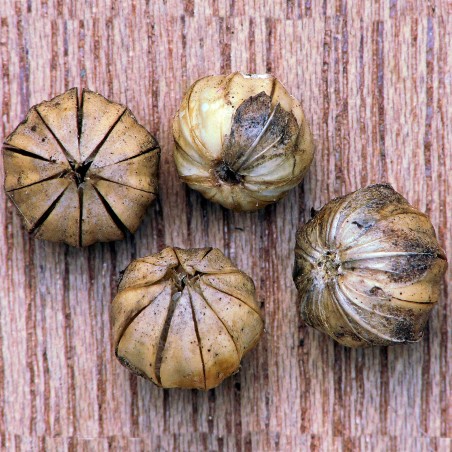
The flowers are pure pale blue, 15–25 mm diameter, with five petals. The fruit is a round, dry capsule 5–9 mm diameter, containing several glossy brown seeds shaped like an apple pip, 4–7 mm long.
Uses
Flax is grown for its oil, used as a nutritional supplement, and as an ingredient in many wood-finishing products. Flax is also grown as an ornamental plant in gardens. Flax fibers are used to make linen. The Latin species name usitatissimum means most useful.
Flax fibres are taken from the stem of the plant and are two to three times as strong as those of cotton. As well, flax fibers are naturally smooth and straight. Europe and North America depended on flax for vegetable-based cloth until the nineteenth century, when cotton overtook flax as the most common plant used for making rag-based paper. Flax is grown on the Canadian Prairies for linseed oil, which is used as a drying oil in paints and varnish and in products such as linoleum and printing inks.
History
The earliest evidence of humans using wild flax as a textile comes from the present day Republic of Georgia, where spun, dyed, and knotted wild flax fibers were found in Dzudzuana Cave and dated to the Upper Paleolithic, 30,000 years ago. Flax was first domesticated in the Fertile Crescent region. There is evidence of a domesticated oil-seed flax with increased seed size by 9,000 years ago from Tell Ramad in Syria. Use of the crop steadily spread, reaching places as far as Switzerland and Germany by 5,000 years ago (3,000 BCE). In China and India domesticated flax was cultivated by at least 5,000 years ago (3,000 BCE).
Flax was extensively cultivated in ancient Egypt, where temple walls had paintings of flowering flax and mummies were entombed in linen. Egyptian priests only wore linen, as flax was considered a symbol of purity. Phoenicians traded Egyptian linen throughout the Mediterranean, and the Romans used it for their sails. As the Roman Empire declined, so did flax production, but Charlemagne revived the crop in the 8th century CE with laws designed to publicize the hygiene of linen textiles and the health of linseed oil. Eventually, Flanders became the major center of the linen industry in the European Middle Ages. In North America, flax was introduced by the colonists and it flourished there. But by the early 20th century cheap cotton and rising farm wages had caused production of flax to become concentrated in northern Russia, which came to provide 90% of the world's output. Since then flax has lost its importance as a commercial crop, due to the easy availability of more durable fibers.
Flax seeds
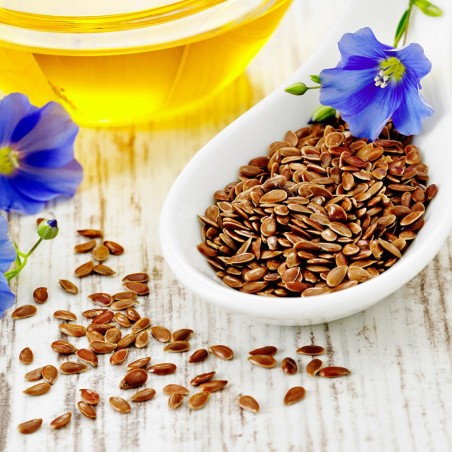
Flax seeds come in two basic varieties: 1. brown; and 2. yellow or golden (also known as golden linseeds). Most types have similar nutritional characteristics and equal numbers of short-chain omega-3 fatty acids. The exception is a type of yellow flax called solin (trade name Linola), which has a completely different oil profile and is very low in omega-3 FAs. Flax seeds produce a vegetable oil known as flaxseed oil or linseed oil, which is one of the oldest commercial oils. It is an edible oil obtained by expeller pressing, sometimes followed by solvent extraction. Solvent-processed flax seed oil has been used for many centuries as a drying oil in painting and varnishing.
Although brown flax can be consumed as readily as yellow, and has been for thousands of years, its better-known uses are in paints, for fiber, and for cattle feed.
Culinary
One hundred grams of ground flax seed supplies about 450 calories, 41 grams of fat, 28 grams of fiber, and 20 grams of protein.
Flax seed sprouts are edible, with a slightly spicy flavor. Excessive consumption of flax seeds with inadequate water can cause bowel obstruction. In northern India, flaxseed, called (tisi or alsi), is traditionally roasted, powdered, and eaten with boiled rice, a little water, and a little salt.
Whole flax seeds are chemically stable, but ground flaxseed can go rancid at room temperature in as little as one week, although there is contrary evidence. Refrigeration and storage in sealed containers will keep ground flax from becoming rancid for a longer period; under conditions similar to those found in commercial bakeries, trained sensory panelists could not detect differences between bread made with freshly ground flax and bread made with milled flax stored for four months at room temperature. Milled flax is stable to oxidation when stored for nine months at room temperature if packed immediately without exposure to air and light and for 20 months at ambient temperatures under warehouse conditions.
Three natural phenolic glucosides, secoisolariciresinol diglucoside, p-coumaric acid glucoside and ferulic acid glucoside, can be found in commercial breads containing flaxseed.
Medicinal
Linum usitatissimum seeds are mentioned in the Ayurveda and have been used in the traditional Austrian medicine internally (directly soaked or as tea) and externally (as compresses or oil extracts) for treatment of disorders of the respiratory tract, eyes, infections, cold, flu, fever, rheumatism and gout.
Nutrients and clinical research
Flax seeds contain high levels of dietary fiber as well as lignans, an abundance of micronutrients and omega-3 fatty acids (table). Studies have shown that flax seeds may lower cholesterol levels, although with differing results depending on the sex of the consumer. One study found results were better for women whereas a later study found benefits only for men. Initial studies suggest that flax seeds taken in the diet may benefit individuals with certain types of breast and prostate cancers.
A study done at Duke University suggests that flaxseed may stunt the growth of prostate tumors, although a meta-analysis found the evidence on this point to be inconclusive. Flax may also lessen the severity of diabetes by stabilizing blood-sugar levels. There is some support for the use of flax seed as a laxative due to its dietary fiber content though excessive consumption without liquid can result in intestinal blockage. Consuming large amounts of flax seed may impair the effectiveness of certain oral medications, due to its fiber content,. Flaxseed has shown to lower the concentration of pro-inflammatory oxylipins in humans as well as lower blood pressure in patients with peripheral arterial disease and high blood pressure.
One of the main components of flax is lignan, which has plant estrogen as well as antioxidants (flax contains up to 800 times more lignans than other plant foods contain).
Toxicity
Flaxseed oil has repeatedly been demonstrated to be non-toxic and is generally recognized as safe for human consumption. The cyanogenic glycoside linamarin occurs at low levels in the seed and cannot be detected in flaxseed oil. Cyanogenic glycosides are common food substances and are particularly toxic when consumed in larger quantities in staple foods like cassava. Flaxseed is not a staple food and the cyanogenic glycosides do not present a feasible risk in flaxseed product consumption.
Flax fibers
Flax fiber is extracted from the bast or skin of the stem of the flax plant. Flax fiber is soft, lustrous and flexible; bundles of fiber have the appearance of blonde hair, hence the description "flaxen". It is stronger than cotton fiber but less elastic. The best grades are used for linen fabrics such as damasks, lace and sheeting. Coarser grades are used for the manufacturing of twine and rope, and historically for canvas and webbing equipment. Flax fiber is a raw material used in the high-quality paper industry for the use of printed banknotes and rolling paper for cigarettes and tea bags. Flax mills for spinning flaxen yarn were invented by John Kendrew and Thomas Porthouse of Darlington in 1787. New methods of processing flax and the rising price of cotton have led to renewed interest in the use of flax as an industrial fiber.
Cultivation
The soils most suitable for flax, besides the alluvial kind, are deep loams, and containing a large proportion of organic matter. Flax is often found growing just above the waterline in cranberry bogs. Heavy clays are unsuitable, as are soils of a gravelly or dry sandy nature. Farming flax requires few fertilizers or pesticides. Within eight weeks of sowing, the plant will reach 10–15 cm in height and will grow several centimeters per day under its optimal growth conditions, reaching 70–80 cm within fifteen days.
Harvesting
Maturation
Flax is harvested for fiber production after approximately 100 days, or a month after the plant flowers and two weeks after the seed capsules form. The base of the plant will begin to turn yellow. If the plant is still green, the seed will not be useful, and the fiber will be underdeveloped. The fiber degrades once the plant is brown.
Methods
There are two ways to harvest flax, one involving mechanized equipment (combines), and a second method, more manual and targeted towards maximizing the fiber length.
Mechanical
The mature plant is cut with mowing equipment, similar to hay harvesting, and raked into windrows. When dried sufficiently, a combine then harvests the seeds similar to wheat or oat harvesting. The amount of weeds in the straw affects its marketability, and this coupled with market prices determined whether the farmer chose to harvest the flax straw. If the flax was not harvested, it was typically burned, since the straw stalk is quite tough and decomposes slowly (i.e., not in a single season), and still being somewhat in a windrow from the harvesting process, the straw would often clog up tillage and planting equipment. It was common, in the flax growing regions of western Minnesota, to see the harvested flax straw (square) bale stacks start appearing every July, the size of some stacks being estimated at 10-15 yards wide by 50 or more yards long, and as tall as a two-story house
Manual
The mature plant is pulled up with the roots (not cut), so as to maximize the fiber length. After this, the flax is allowed to dry, the seeds are removed, and is then retted. Dependent upon climatic conditions, characteristics of the sown flax and fields, the flax remains on the ground between two weeks and two months for retting. As a result of alternating rain and the sun, an enzymatic action degrades the pectins which bind fibers to the straw. The farmers turn over the straw during retting to evenly rett the stalks. When the straw is retted and sufficiently dry, it is rolled up. It will then be stored by farmers before scutching to extract fibers.
Flax grown for seed is allowed to mature until the seed capsules are yellow and just starting to split; it is then harvested by combine harvester and dried to extract the seed.
Threshing flax
Threshing is the process of removing the seeds from the rest of the plant. As noted above in the Mechanical section, the threshing could be done in the field by a machine, or in another process, a description of which follows:
The process is divided into two parts: the first part is intended for the farmer, or flax-grower, to bring the flax into a fit state for general or common purposes. This is performed by three machines: one for threshing out the seed, one for breaking and separating the straw (stem) from the fiber, and one for further separating the broken straw and matter from the fiber. In some cases the farmers thrash out the seed in their own mill and therefore, in such cases, the first machine will be unnecessary.
The second part of the process is intended for the manufacturer to bring the flax into a state for the very finest purposes, such as lace, cambric, damask, and very fine linen. This second part is performed by the refining machine only.
The threshing process would be conducted as follows:
Take the flax in small bundles, as it comes from the field or stack, and holding it in the left hand, put the seed end between the threshing machine and the bed or block against which the machine is to strike; then take the handle of the machine in the right hand, and move the machine backward and forward, to strike on the flax, until the seed is all threshed out.
Take the flax in small handfuls in the left hand, spread it flat between the third and little finger, with the seed end downwards, and the root-end above, as near the hand as possible.
Put the handful between the beater of the breaking machine, and beat it gently till the three or four inches, which have been under the operation of the machine, appear to be soft.
Remove the flax a little higher in the hand, so as to let the soft part of the flax rest upon the little finger, and continue to beat it till all is soft, and the wood is separated from the fiber, keeping the left hand close to the block and the flax as flat upon the block as possible.
The other end of the flax is then to be turned, and the end which has been beaten is to be wrapped round the little finger, the root end flat, and beaten in the machine till the wood is separated, exactly in the same way as the other end was beaten.
CategorieAcasaReferințăVE-215-(1g)În stoc1935 Produse
Expediem in intreaga lume din Uniunea Europeana, folosind posta aeriana recomandata, cu confirmare prin semnatura la livrare.
📦Urmarirea comenzii tale Conectati-va la contul dvs. si navigati laIstoricul comenzilor > Detalii pentru a gasi numarul dvs. de urmarire.
Veti primi notificari prin e-mail pentru fiecare etapa a comenzii dumneavoastra. Daca nu vedeti aceste mesaje, verificati folderul Spam/mesaje nedorite sau contactati furnizorul dvs. de e-mail. Alternativ, cautati online cum sa deblocati e-mailurile expeditorilor.
SERVICIUL NOSTRU DE EMAIL FUNCTIONEAZA
Veti primi notificari prin e-mail pentru fiecare etapa a comenzii dvs. Daca nu vedeti aceste mesaje, verificati folderul Spam/mesaje nedorite sau contactati furnizorul dvs. de e-mail.
📧Cum sa te asiguri ca e-mailurile de la magazinul nostru online ajung intotdeauna in contul tau Gmailsau orice alt e-mailal furnizoruluiIn Inbox si nu sunt marcate ca spam sau blocate:
Adauga expeditorul in contactele Google sau ale oricarui alt furnizor de e-mail. Nu te putem ajuta daca setarile tale nu sunt astfel. Contacteaza furnizorul tau de e-mail pentru asistenta.
Pasul 1: Deschide Gmail si gaseste un e-mail de la noi xxxxxxxxxxxx@xxx.com Nu incercati sa ne trimiteti un e-mail direct la aceasta adresa; nu il vom primi. Orice contact se face exclusiv prin formularul de contact din magazinul nostru online! Daca nu gasiti e-mailul nostru, este posibil sa fi fost blocat. In acest caz, continuati cu Pasul 4 de mai jos.
Pasul 2: Puneti cursorul peste numele expeditorului sau adresa de e-mail din partea de sus a e-mailului.
Pasul 3: Faceti clic pe pictograma "Adauga la contacte" (mica pictograma cu o persoana).
Acest lucru va ajuta Gmail sa ne recunoasca ca expeditor de incredere, asigurandu-se ca e-mailurile noastre ajung direct in inboxul tau si nu in folderul de spam.
Creati un filtru pentru a preveni ca e-mailurile sa fie marcate ca spam sau blocate
Pasul 1: Deschide Gmail si da clic pe pictograma rotita din coltul din dreapta sus, apoi selecteaza "Vezi toate setarile".
Pasul 2: Accesati fila "Filtre si adrese blocate".
Pasul 3: Faceti clic pe "Creati un filtru nou".
Pasul 4: In campul "From", introduceti adresa de e-mail pe care doriti sa o adaugati pe lista alba (e.g., e-mailul magazinului nostru).
Pasul 5: Faceti clic pe "Creeaza filtru".
Pasul 6: In fereastra urmatoare, bifati caseta etichetata "Nu-l trimite niciodata in Spam".
Pasul 7: Faceti clic pe "Creeaza filtru" pentru a salva.
Acest lucru va asigura ca e-mailurile noastre ajung intotdeauna in inbox-ul tau si nu vor fi marcate ca spam sau blocate din greseala.
Urmareste-ti coletul prin:
Aftership
17Track
Posta.hr (pentru numere de urmarire precum RGxxxxxxHR)
⚠️Notificari importante
Plata la livrare esteNUDisponibil.
Furnizati intotdeauna un numar de telefon mobil valid cu codul tarii cand comandati (e.g., +365 456 7686 576).
Nu ordona sa P.O. Cutii, sau daca nu puteti fi acasa pentru a semna pentru colet, coletele nu pot fi lasate la vecini.
Daca un pachet trimis la P.O. Daca cutia este pierduta sau nedistribuita, nu se va emite nicio rambursare.
⚖️Responsabilitatea clientului privind conformitatea legala Clientul este responsabil sa se asigure ca produsul poate fi importat legal in tara sa, inclusiv prin respectarea tuturor reglementarilor de import, obtinerea permiselor necesare si plata taxelor vamale, impozitelor si a altor taxe aplicabile. Va rugam sa verificati legislatia locala inainte de a comanda pentru a evita orice probleme cu vama sau livrarea.
📦Pachete Pierdute, Returnate & Reexpediate
Clienti din Brazilia si Mexic:Nu putem rambursa coletele pierdute sau distruse de catre autoritatile vamale.
Daca coletul dumneavoastra este returnat, va vom rambursa doar costul produsului — costurile de livrare nu sunt rambursabile.
Costul expedierii de retur (2 €) si orice costuri de reexpediere trebuie acoperite de client.
Daca un pachet ne este returnat din orice motiv, sunteti responsabil pentru plata transportului de retur (€2) plus costul reexpedierii pachetului.
🚚Livrare colet Trimiterile inregistrate necesita o semnatura.
Daca urmarirea arata ca pachetul este inca la oficiul postal de expediere, acesta este in tranzit — contactati oficiul postal local pentru actualizari.
Din pacate, nici noi, nici serviciul postal prin care a fost expediata comanda dumneavoastra nu va putem ajuta sa aflati unde se afla aceasta. Cand vedeti ca pachetul este in tara dumneavoastra,TREBUIE sa contactati oficiul postal cu numarul de urmarire.si discutati problema cu ei. Trimitem toate comenzile prin posta oficiala de stat.
Nu suntem responsabili pentru termenele de livrare si nu putem urmari expedierile in numele dumneavoastra.
📅Optiuni de livrare & timpi estimati
Optiune de livrare
Timp de procesare
Notite
Livrare Prioritara
Se expediaza in 1–7 zile lucratoare
Acorda prioritate procesarii comenzilor (nu garanteaza o livrare mai rapida); pot aparea intarzieri in timpul sarbatorilor (3–10 zile)
Livrare securizata
Se expediaza in 1–7 zile lucratoare
Disponibil pentru comenzi de pana la 150 €; rambursare in caz de pierdere
Livrare standard
Se expediaza in 7–10 zile lucratoare
Mai economic; pot aparea intarzieri in perioada sarbatorilor (7–14 zile)
Timp estimat de livrare:
In UE:3–20 zile
La nivel mondial:5–30 zile
Exemple din SUA:Livrat in 13, 17, 19, 22, sau 27 de zile.
Nota:Timpul de livrare depinde de locatia dvs. si de sistemul postal local. COVID-19 sau perioadele de sarbatori pot provoca intarzieri suplimentare.
💰Costuri de livrare Taxele de expediere si manipulare sunt calculate automat la finalizarea comenzii, in functie de greutatea coletului si de destinatie.
⏰Ore de procesare a comenzilor Nu procesam si nu expediem comenzile in zilele de sambata si duminica.
💳Optiuni de plata
Transfer bancar (SEPA / IBAN / SWIFT-BIC) Includeti referinta comenzii dvs. in descrierea platii (e.g., "SGS-19811702"). Comenzile care nu sunt platite in termen de 7 zile vor fi anulate automat.
PayPal Platile sunt acceptate numai in euro. Va rugam sa selectati euro la finalizarea comenzii.
Plata cu cardul Acceptam Visa, MasterCard, American Express, CB, Diners Club, Discover, China UnionPay, JCB, si Discover.
⚠️Taxe de tranzactie Clientii sunt responsabili pentru orice comisioane de tranzactie bancare sau PayPal. Va rugam sa va asigurati ca detaliile de plata sunt corecte pentru o procesare mai rapida a comenzii.
📢Note finale Inainte de a plasa comanda, verificati intotdeauna site-ul nostru pentru anunturi speciale, programul din perioada sarbatorilor sau conditii specifice de livrare care ar putea afecta achizitia dumneavoastra.
Notificare importanta: Facturi digitale
Pentru a contribui la reducerea risipei de hartie, nu includem o factura tiparita impreuna cu comanda dvs. Puteti descarca si imprima cu usurinta factura dvs. in orice moment accesand contul dvs.Istoric comenzi in profilul contului tau