True Lavender Seeds
€ 2,00


The avocado (Persea americana) is a tree, long thought to have originated in South Central Mexico, classified as a member of the flowering plant family Lauraceae. The fruit of the plant, also called an avocado (or avocado pear or alligator pear), is botanically a large berry containing a single large seed.
Avocados are commercially valuable and are cultivated in tropical and Mediterranean climates throughout the world.[4] They have a green-skinned, fleshy body that may be pear-shaped, egg-shaped, or spherical. Commercially, they ripen after harvesting. Avocado trees are partially self-pollinating and are often propagated through grafting to maintain a predictable quality and quantity of the fruit.

Persea americana is a tree that grows to 20 m (66 ft), with alternately arranged leaves 12–25 cm (4.7–9.8 in) long. Panicles of flowers with deciduous bracts arise from new growth or the axils of leaves.[6] The flowers are inconspicuous, greenish-yellow, 5–10 mm (0.2–0.4 in) wide.
The species is variable because of selection pressure by humans to produce larger flesher fruits with a thinner exocarp.[7] The avocado fruit is a climacteric,[8] single-seeded berry, due to the imperceptible endocarp covering the seed,[5][9] rather than a drupe.[10] The pear-shaped fruit is 7–20 cm (2.8–7.9 in) long, weighs between 100 and 1,000 g (3.5 and 35.3 oz), and has a large central seed, 5–6.4 cm (2.0–2.5 in) long.[4]
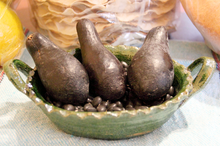
Persea americana, or the avocado, possibly originated in the Tehuacan Valley[11] in the state of Puebla, Mexico,[12] although fossil evidencesuggests similar species were much more widespread millions of years ago. However, there is evidence for three possible separate domestications of the avocado, resulting in the currently recognized Mexican (aoacatl), Guatemalan (quilaoacatl), and West Indian (tlacacolaocatl) landraces.[13][14] The Mexican and Guatemalan landraces originated in the highlands of those countries, while the West Indian landrace is a lowland variety that ranges from Guatemala, Costa Rica, Colombia, Ecuador to Peru,[13] achieving a wide range through human agency before the arrival of the Europeans.[14] The three separate landraces were most likely to have already intermingled[a] in pre-Columbian America and were described in the Florentine Codex.[14]
The earliest residents were living in temporary camps in an ancient wetland eating avocados, chilies, mollusks, sharks, birds, and sea lions.[15] The oldest discovery of an avocado pit comes from Coxcatlan Cave, dating from around 9,000 to 10,000 years ago.[11][14] Other caves in the Tehuacan Valley from around the same time period also show early evidence for the presence of avocado.[11] There is evidence for avocado use at Norte Chico civilization sites in Peru by at least 3,200 years ago and at Caballo Muerto in Peru from around 3,800 to 4,500 years ago.[11]
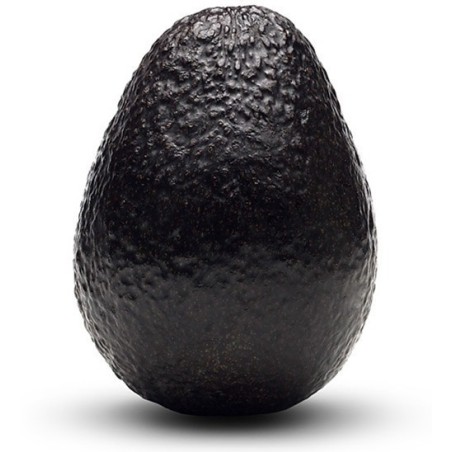
The native, undomesticated variety is known as a criollo, and is small, with dark black skin, and contains a large seed.[16] It probably coevolved with extinct megafauna.[17] The avocado tree also has a long history of cultivation in Central and South America, likely beginning as early as 5,000 BC.[12] A water jar shaped like an avocado, dating to AD 900, was discovered in the pre-Incan city of Chan Chan.[18]
The earliest known written account of the avocado in Europe is that of Martín Fernández de Enciso (circa 1470–1528) in 1519 in his book, Suma De Geographia Que Trata De Todas Las Partidas Y Provincias Del Mundo.[19][20] The first detailed account that unequivocally describes the avocado was given by Gonzalo Fernández de Oviedo y Valdés in his work Sumario de la natural historia de las Indias [es] in 1526.[13] The first written record in English of the use of the word 'avocado' was by Hans Sloane, who coined the term in 1669,[13] in a 1696 index of Jamaican plants. The plant was introduced to Spain in 1601, Indonesia around 1750, Mauritius in 1780, Brazil in 1809, the United States mainland in 1825, South Africa and Australia in the late 19th century, and Israel in 1908.[14] In the United States, the avocado was introduced to Florida and Hawaii in 1833 and in California in 1856.[14]
Before 1915, the avocado was commonly referred to in California as ahuacate and in Florida as alligator pear. In 1915, the California Avocado Association introduced the then-innovative term avocado to refer to the plant.[14]
The word "avocado" comes from the Spanish aguacate, which in turn comes from the Nahuatl word āhuacatl [aːˈwakat͡ɬ],[21] which goes back to the proto-Aztecan *pa:wa which also meant "avocado".[22] Sometimes the Nahuatl word was used with the meaning "testicle", probably because of the likeness between the fruit and the body part.[23]
The modern English name comes from an English rendering of the Spanish aguacate as avogato. The earliest known written use in English is attested from 1697 as "avogato pear", a term which was later corrupted as "alligator pear".[24] Because the word avogato sounded like "advocate", several languages reinterpreted it to have that meaning. French uses avocat, which also means lawyer, and "advocate" — forms of the word appear in several Germanic languages, such as the (now obsolete) German Advogato-Birne, the old Danish advokat-pære (today it is called avocado) and the Dutch advocaatpeer.[25]
In other Central American and Caribbean Spanish-speaking countries, it is known by the Mexican name, while South American Spanish-speaking countries use a Quechua-derived word, palta. In Portuguese, it is abacate. The fruit is sometimes called an avocado pear or alligator pear (due to its shape and the rough green skin of some cultivars).[4] The Nahuatl āhuacatl can be compounded with other words, as in ahuacamolli, meaning avocado soup or sauce, from which the Spanish word guacamole derives.[26]
In the United Kingdom, the term avocado pear is still sometimes misused as applied when avocados first became commonly available in the 1960s.[27]
Originating as a diminutive in Australian English, a clipped form, avo, has since become a common colloquialism in South Africa and the United Kingdom.
It is known as "butter fruit" in parts of India and goes by the name bơ [ɓɘː] in Vietnamese, which is the same word that is used for butter.[28] In eastern China, it is known as è lí (鳄梨; 鱷梨; "alligator pear") or niú yóu guǒ(牛油果; "butter fruit"). In Taiwan, it is known as luò lí (酪梨, "cheese pear").
The subtropical species needs a climate without frost and with little wind. High winds reduce the humidity, dehydrate the flowers, and affect pollination. When even a mild frost occurs, premature fruit drop may occur, although the 'Hass' cultivar can tolerate temperatures down to −1 °C. Several cold-hardy varieties are planted in the region of Gainesville, Florida, which survive temperatures as low as −6.5 °C (20 °F) with only minor leaf damage. The trees also need well-aerated soils, ideally more than 1 m deep. Yield is reduced when the irrigation water is highly saline. These soil and climate conditions are available in southern and eastern Spain, Morocco, the Levant, South Africa, Venezuela, Colombia, Peru, parts of central and northern Chile, Vietnam, Indonesia, parts of southern India, Sri Lanka, Australia, New Zealand, the Philippines, Malaysia, Central America, the Caribbean, Mexico, southern California, Arizona, Puerto Rico, Texas, Florida, Hawaii, Ecuador, and Rwanda. Each region has different cultivars.[citation needed]
Commercial orchards produce an average of seven tonnes per hectare each year, with some orchards achieving 20 tonnes per hectare.[29] Biennial bearing can be a problem, with heavy crops in one year being followed by poor yields the next.
Like the banana, the avocado is a climacteric fruit, which matures on the tree, but ripens off the tree. Avocados used in commerce are picked hard and green and kept in coolers at 3.3 to 5.6 °C (37.9 to 42.1 °F) until they reach their final destination. Avocados must be mature to ripen properly. Avocados that fall off the tree ripen on the ground. Generally, the fruit is picked once it reaches maturity; Mexican growers pick 'Hass' avocados when they have more than 23% dry matter, and other producing countries have similar standards. Once picked, avocados ripen in one to two weeks (depending on the cultivar) at room temperature (faster if stored with other fruits such as apples or bananas, because of the influence of ethylene gas). Some supermarkets sell ripened avocados which have been treated with synthetic ethylene to hasten ripening.[30] The use of an ethylene gas "ripening room", which is now an industry standard, was pioneered in the 1980s by farmer Gil Henry of Escondido, California, in response to footage from a hidden supermarket camera which showed shoppers repeatedly squeezing hard, unripe avocados, putting them "back in the bin," and moving on without making a purchase.[31] In some cases, avocados can be left on the tree for several months, which is an advantage to commercial growers who seek the greatest return for their crop, but if the fruit remains unpicked for too long, it falls to the ground.

The species is only partially able to self-pollinate because of dichogamy in its flowering. This limitation, added to the long juvenile period, makes the species difficult to breed. Most cultivars are propagated by grafting, having originated from random seedling plants or minor mutations derived from cultivars. Modern breeding programs tend to use isolation plots where the chances of cross-pollination are reduced. That is the case for programs at the University of California, Riverside, as well as the Volcani Centre and the Instituto de Investigaciones Agropecuarias in Chile.
The avocado is unusual in that the timing of the male and female flower phases differs among cultivars. The two flowering types are A and B. A-cultivar flowers open as female on the morning of the first day and close in late morning or early afternoon. Then they open as male in the afternoon of the second day. B varieties open as female on the afternoon of the first day, close in late afternoon and reopen as male the following morning.
Certain cultivars, such as the 'Hass', have a tendency to bear well only in alternate years. After a season with a low yield, due to factors such as cold (which the avocado does not tolerate well), the trees tend to produce abundantly the next season. In addition, due to environmental circumstances during some years, seedless avocados may appear on the trees.[34] Known in the avocado industry as "cukes", they are usually discarded commercially due to their small size.[35]

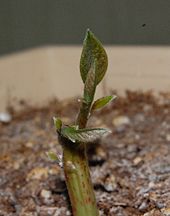
Avocados can be propagated by seed, taking roughly four to six years to bear fruit, although in some cases seedlings can take 10 years to come into bearing.[36] The offspring is unlikely to be identical to the parent cultivar in fruit quality. Prime quality varieties are therefore propagated by grafting to rootstocks that are propagated by seed (seedling rootstocks) or by layering (clonal rootstocks). After about a year of growing in a greenhouse, the young rootstocks are ready to be grafted. Terminal and lateral grafting is normally used. The scion cultivar grows for another 6–12 months before the tree is ready to be sold. Clonal rootstocks are selected for tolerance of specific soil and disease conditions, such as poor soil aeration or resistance to the soil-borne disease (root rot) caused by Phytophthora.
Commercial avocado production is limited to a small fraction of the vast genetic diversity in the species. Conservation of this genetic diversity has relied largely on field collection, as avocado seeds often do not survive storage in seed banks. This is problematic, as field preservation of living cultivars is expensive, and habitat loss threatens wild cultivars. More recently, an alternate method of conservation has been developed based on cryopreservation of avocado somatic embryos with reliable methods for somatic embryogenesis and reconstitution into living trees.[37]
Indoors, an avocado tree is usually grown from the pit of an avocado fruit. This is often done by removing the pit from a ripe, unrefrigerated avocado fruit. The pit is then stabbed with three or four toothpicks, about one-third of the way up from the flat end. The pit is placed in a jar or vase containing tepid water. It should split in four to six weeks and yield roots and a sprout. If there is no change by this time, the avocado pit is discarded. Once the stem has grown a few inches, it is placed in a pot with soil. It should be watered every few days. Avocados have been known to grow large, so owners must be ready to re-pot the plant several times.

Avocado trees are vulnerable to bacterial, viral, fungal, and nutritional diseases (excesses and deficiencies of key minerals). Disease can affect all parts of the plant, causing spotting, rotting, cankers, pitting, and discoloration.[38]
Mexico is by far the world's largest avocado growing country, producing several times more than the second largest producer.[39] In 2013, the total area dedicated to avocado production was 168,155 hectares (415,520 acres), and the harvest was 1.47 million tonnes.[40] The states that produce the most are México, Morelos, Nayarit, Puebla, and Michoacan, accounting for 86% of the total. In Michoacán, the cultivation is complicated by the existence of drug cartels that extort protection fees from cultivators. They are reported to exact 2000 Mexican pesos per hectare from avocado farmers and 1 to 3 pesos/kg of harvested fruit.[41]
The avocado was introduced from Mexico to California in the 19th century, and has become a successful cash crop. About 59,000 acres (240 km2) – some 95% of United States avocado production – is located in Southern California, with 60% in San Diego County.[42][43] Fallbrook, California, claims the title of "Avocado Capital of the World" (also claimed by the town of Uruapan in Mexico[44]), and both Fallbrook and Carpinteria, California, host annual avocado festivals. Avocado is the official fruit of the State of California.[45]
Hass avocado production in Peru encompasses thousands of hectares in central and western Peru.[46] Peru has now become the largest supplier of avocados imported to the European Union and, more recently, has begun to export avocados in significant quantities to North America.
Peru's location near the equator and along the Pacific Ocean creates consistently mild temperatures year round. The soil is rich and sandy and the towering Andes mountains provide a constant flow of pure water for irrigation. Naturally sheltered as it is from heavy rain or freezing temperatures, Peru is an almost perfect climate for the cultivation of avocados.
Hass avocados from Peru are seasonally available to consumers from May through September and are promoted under the auspices of the Peruvian Avocado Commission, headquartered in Washington, D.C.


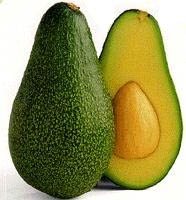
Other avocado cultivars include 'Spinks'. Historically attested varieties (which may or may not survive among horticulturists) include the 'Challenge', 'Dickinson', 'Kist', 'Queen', 'Rey', 'Royal', 'Sharpless', and 'Taft'.[49]
A stoneless avocado, marketed as a "cocktail avocado," which does not contain a pit, is available on a limited basis. They are five to eight centimetres long; the whole fruit may be eaten, including the skin. It is produced from an unpollinated blossom in which the seed does not develop.[50] Seedless avocados regularly appear on trees.[51] Known in the avocado industry as "cukes", they are usually discarded commercially due to their small size.[52]
| Avocado production – 2016 | |
|---|---|
| Country | Production (millions of tonnes) |
 Mexico Mexico |
|
 Dominican Republic Dominican Republic |
|
 Peru Peru |
|
 Colombia Colombia |
|
 Indonesia Indonesia |
|
In 2016, world production of avocados was 5.6 million tonnes, led by Mexico alone with 34% (1.89 million tonnes) of the total (table). Other major producers were Dominican Republic, Peru, Colombia, and Indonesia, together producing 30% of the world total (table).[40]

After the North American Free Trade Agreement (NAFTA) went into effect in 1994, Mexico tried exporting avocados to the US. The US government resisted, claiming the trade would introduce Tephritidae fruit flies that would destroy California's crops. The Mexican government responded by inviting USDA inspectors to Mexico, but the US government declined, claiming fruit fly inspection was not feasible. The Mexican government then proposed to sell avocados only to the northeastern US in the winter (fruit flies cannot withstand extreme cold). The US government balked, but gave in when the Mexican government started erecting barriers to US corn.

Imports from Mexico in the 2005–2006 season exceeded 130,000 metric tons (143,300 short tons; 127,900 long tons).[53][54]
In 2009, Peru joined Chile and Mexico as an exporter of avocados to the US.[55]
In the US, avocados are grown in California and Florida, where land, labor, and water are expensive. Avocado trees require frequent, deep watering to bear optimally, particularly in spring, summer, and fall. Due to increased Southern California water costs, they are now costly to grow. California produces 90% of the United States' avocados.[42]
As of 2013, Mexico leads international exports, with other significant production in California, New Zealand, Peru, and South Africa.

The fruit of horticultural cultivars has a markedly higher fat content than most other fruit, mostly monounsaturated fat, and as such serves as an important staple in the diet of consumers who have limited access to other fatty foods (high-fat meats and fish, dairy products). Having a high smoke point, avocado oil is expensive compared to common saladand cooking oils, and mostly used for salads or dips.
A ripe avocado yields to gentle pressure when held in the palm of the hand and squeezed. The flesh is prone to enzymatic browning, quickly turning brown after exposure to air.[56]To prevent this, lime or lemon juice can be added to avocados after peeling.

The fruit is not sweet, but distinctly and subtly flavored, with smooth texture.[4] It is used in both savory and sweet dishes, though in many countries not for both. The avocado is popular in vegetarian cuisine as a substitute for meats in sandwiches and salads because of its high fat content.
Generally, avocado is served raw, though some cultivars, including the common 'Hass', can be cooked for a short time without becoming bitter. The flesh of some avocados may be rendered inedible by heat. Prolonged cooking induces this chemical reaction in all cultivars.[57]

It is used as the base for the Mexican dip known as guacamole,[4] as well as a spread on corn tortillas or toast, served with spices.
In the Philippines, Brazil, Indonesia, Vietnam, and southern India (especially the coastal Kerala, Tamil Nadu and Karnataka region), avocados are frequently used for milkshakes and occasionally added to ice cream and other desserts. In Brazil, Vietnam, the Philippines[58] and Indonesia, a dessert drink is made with sugar, milk or water, and pureed avocado. Chocolate syrup is sometimes added. In Morocco, a similar chilled avocado and milk drink is sweetened with confectioner's sugar and flavored with a touch of orange flower water.
In Ethiopia, avocados are made into juice by mixing them with sugar and milk or water, usually served with Vimto and a slice of lemon. It is also common to serve layered multiple fruit juices in a glass (locally called Spris) made of avocados, mangoes, bananas, guavas, and papayas. Avocados are also used to make salads.
Avocados in savory dishes, often seen as exotic, are a relative novelty in Portuguese-speaking countries, such as Brazil, where the traditional preparation is mashed with sugar and lime, and eaten as a dessert or snack. This contrasts with Spanish-speaking countries such as Chile, Mexico, or Argentina, where the opposite is true and sweet preparations are rare.

In Australia and New Zealand, it is commonly served in sandwiches, sushi, on toast, or with chicken. In Ghana, it is often eaten alone in sliced bread as a sandwich. In Sri Lanka, well-ripened flesh, thoroughly mashed with sugar and milk, or treacle (a syrup made from the nectar of a particular palm flower) is a popular dessert. In Haiti, it is often consumed with cassava or regular bread for breakfast.
In Mexico and Central America, avocados are served mixed with white rice, in soups, salads, or on the side of chicken and meat. In Peru, they are consumed with tequeños as mayonnaise, served as a side dish with parrillas, used in salads and sandwiches, or as a whole dish when filled with tuna, shrimp, or chicken. In Chile, it is used as a puree-like sauce with chicken, hamburgers, and hot dogs; and in slices for celery or lettuce salads. The Chilean version of Caesar salad contains large slices of mature avocado. In Kenyaand Nigeria, the avocado is often eaten as a fruit eaten alone or mixed with other fruits in a fruit salad, or as part of a vegetable salad.
Avocado is a primary ingredient in avocado soup. Avocado slices are frequently added to hamburgers, tortas, hot dogs, and carne asada. Avocado can be combined with eggs (in scrambled eggs, tortillas, or omelettes), and is a key ingredient in California rolls and other makizushi ("maki", or rolled sushi).
In the United Kingdom, the avocado became available during the 1960s when introduced by Sainsbury's under the name 'avocado pear'.[27]

In addition to the fruit, the leaves of Mexican avocados (Persea americana var. drymifolia) are used in some cuisines as a spice, with a flavor somewhat reminiscent of anise.[citation needed] They are sold both dried and fresh, toasted before use, and either crumbled or used whole, commonly in bean dishes.[59] Leaves of P. americana, Guatemalanvariety, are toxic to goats, sheep, and horses.[60]
| Nutritional value per 100 g (3.5 oz) | |
|---|---|
| Energy | 670 kJ (160 kcal) |
|
Carbohydrates |
8.53 g |
| Sugars | 0.66 g |
| Dietary fiber | 6.7 g |
|
Fat |
14.66 g |
| Saturated | 2.13 g |
| Monounsaturated | 9.80 g |
| Polyunsaturated | 1.82 g |
|
Protein |
2 g |
| Vitamins | Quantity%DV† |
| Vitamin A equiv.
beta-Carotene lutein zeaxanthin |
1% 7 μg
1% 62 μg271 μg |
| Thiamine (B1) |
6% 0.067 mg |
| Riboflavin (B2) |
11% 0.13 mg |
| Niacin (B3) |
12% 1.738 mg |
| Pantothenic acid (B5) |
28% 1.389 mg |
| Vitamin B6 |
20% 0.257 mg |
| Folate (B9) |
20% 81 μg |
| Vitamin C |
12% 10 mg |
| Vitamin E |
14% 2.07 mg |
| Vitamin K |
20% 21 μg |
| Minerals | Quantity%DV† |
| Calcium |
1% 12 mg |
| Iron |
4% 0.55 mg |
| Magnesium |
8% 29 mg |
| Manganese |
7% 0.142 mg |
| Phosphorus |
7% 52 mg |
| Potassium |
10% 485 mg |
| Sodium |
0% 7 mg |
| Zinc |
7% 0.64 mg |
| Other constituents | Quantity |
| Water | 73.23 g |
| Fluoride | 7 µg |
| Beta-sitosterol | 76 mg |
Link to USDA Database entry
|
|
|
|
| †Percentages are roughly approximated using US recommendations for adults. Source: USDA Nutrient Database |
|
A typical serving of avocado (100 g) is moderate to rich in several B vitamins and vitamin K, with good content of vitamin C, vitamin E and potassium (right table, USDA nutrient data). Avocados also contain phytosterols and carotenoids, such as lutein and zeaxanthin.[61]
Avocados have diverse fats.[62] For a typical avocado:
Although costly to produce, nutrient-rich avocado oil has diverse uses for salads or cooking and in cosmetics and soap products.[4]

The avocado tree can be grown domestically and used as a (decorative) houseplant. The pit germinates in normal soil conditions or partially submerged in a small glass (or container) of water. In the latter method, the pit sprouts in four to six weeks, at which time it is planted in standard houseplant potting soil. The plant normally grows large enough to be prunable; it does not bear fruit unless it has ample sunlight. Home gardeners can graft a branch from a fruit-bearing plant to speed maturity, which typically takes four to six years to bear fruit.[citation needed]
Some people have allergic reactions to avocado. There are two main forms of allergy: those with a tree-pollen allergy develop local symptoms in the mouth and throat shortly after eating avocado; the second, known as latex-fruit syndrome,[63] is related to latex allergy[64] and symptoms include generalised urticaria, abdominal pain, and vomiting and can sometimes be life-threatening.[65]
Avocado leaves, bark, skin, or pit are documented to be harmful to animals; cats, dogs, cattle, goats, rabbits,[66] rats, guinea pigs, birds, fish, and horses[43][67] can be severely harmed or even killed when they consume them. The avocado fruit is poisonous to some birds, and the American Society for the Prevention of Cruelty to Animals(ASPCA) lists it as toxic to horses.[68]
Avocado leaves contain a toxic fatty acid derivative, persin, which in sufficient quantity can cause colic in horses and without veterinary treatment, death.[69] The symptoms include gastrointestinal irritation, vomiting, diarrhea, respiratory distress, congestion, fluid accumulation around the tissues of the heart, and even death. Birds also seem to be particularly sensitive to this toxic compound. A line of premium dog and cat food, AvoDerm, uses oils and meal made from avocado meat as main ingredients.[70] The manufacturer says the avocado's leaves and pit are the source of toxicity, and only in the Guatemalan variety of avocados, and the fruit is often eaten by orchard dogs as well as wildlife such as bears and coyotes.[71]
In 1982, evolutionary biologist Daniel H. Janzen concluded that the avocado is an example of an 'evolutionary anachronism', a fruit adapted for ecological relationship with now-extinct large mammals (such as giant ground sloths or gomphotheres). Most large fleshy fruits serve the function of seed dispersal, accomplished by their consumption by large animals. There are some reasons to think that the fruit, with its mildly toxic pit, may have coevolved with Pleistocene megafauna to be swallowed whole and excreted in their dung, ready to sprout. No extant native animal is large enough to effectively disperse avocado seeds in this fashion.[72][73]