The Níspero (Eriobotria japonica) is also known as a Loquat, Japanese Medlar or Mespilus japonica. This plant is widely available throughout Spain. It is indigenous to China and Japan
The loquat (Eriobotrya japonica) (from Cantonese Chinese: 盧橘; Jyutping: lou4gwat1, nowadays called Chinese: 枇杷; pinyin: pípá; Jyutping: pei4paa4) is a species of flowering plant in the family Rosaceae, a native to the cooler hill regions of China to south-central China.[2][3] It is also quite common in Japan, Korea, hilly Regions of India (Himachal), Northern Areas of Pakistan and some can be found in some Northern part of the Philippines, and hill country in Sri Lanka. It is a large evergreen shrub or tree, grown commercially for its yellow fruit, and also cultivated as an ornamental plant. It is a common ornamental in Adelaide, South Australia. Eriobotrya japonica was formerly thought to be closely related to the genus Mespilus, and is still sometimes known as the Japanese medlar. It is also known as Japanese plum[4] and Chinese plum,[5] also known as pipa in China.
Eriobotrya japonica is a large evergreen shrub or small tree, with a rounded crown, short trunk and woolly new twigs. The tree can grow to 5–10 metres (16–33 ft) tall, but is often smaller, about 3–4 metres (10–13 ft). The fruit begins to ripen during Spring to Summer depending on the temperature on the area. The leaves are alternate, simple, 10–25 centimetres (4–10 in) long, dark green, tough and leathery in texture, with a serrated margin, and densely velvety-hairy below with thick yellow-brown pubescence; the young leaves are also densely pubescent above, but this soon rubs off.
Fruit Loquats are unusual among fruit trees in that the flowers appear in the autumn or early winter, and the fruits are ripe at any time from early spring to early summer.[10] The flowers are 2 cm (1 in) in diameter, white, with five petals, and produced in stiff panicles of three to ten flowers. The flowers have a sweet, heady aroma that can be smelled from a distance.
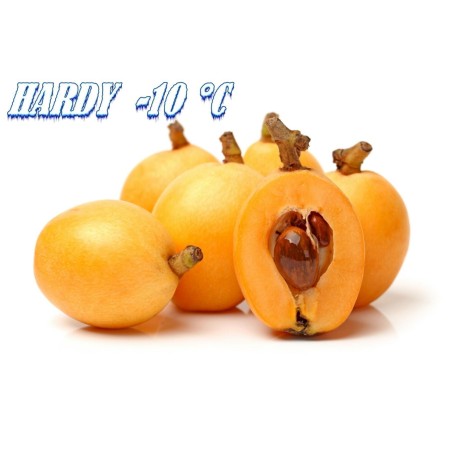
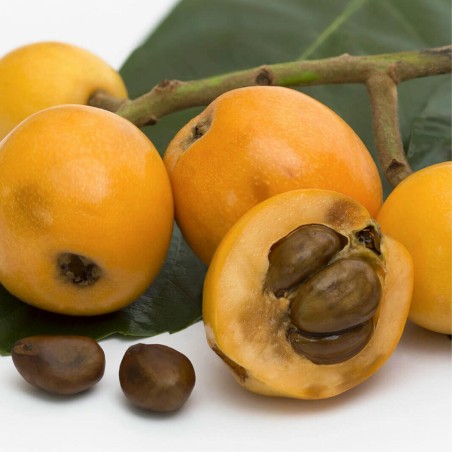
Loquat fruits, growing in clusters, are oval, rounded or pear-shaped, 3–5 centimetres (1–2 in) long, with a smooth or downy, yellow or orange, sometimes red-blushed skin. The succulent, tangy flesh is white, yellow or orange and sweet to subacid or acid, depending on the cultivar.
Each fruit contains from one to ten ovules, with three to five being most common. A variable number of the ovules mature into large brown seeds (with different numbers of seeds appearing in each fruit on the same tree, usually between one and four). The skin, though thin, can be peeled off manually if the fruit is ripe. In Egypt, varieties with sweeter fruits and fewer seeds are often grafted on inferior quality specimens.[citation needed]
The fruits are the sweetest when soft and orange. The flavour is a mixture of peach, citrus and mild mango.
Culinary use The loquat has a high sugar, acid, and pectin content. It is eaten as a fresh fruit and mixes well with other fruits in fresh fruit salads or fruit cups. The fruits are also commonly used to make jam, jelly, and chutney, and are often served poached in light syrup. Firm, slightly immature fruits are best for making pies or tarts. The fruit is sometimes canned. The waste ratio, however, is 30 percent or more, due to the seed size. The fruit is also processed into confections.
Alcoholic beverages Loquats can also be used to make light wine. It is fermented into a fruit wine, sometimes using just the crystal sugar and white liquor. In Italy nespolino liqueur is made from the seeds, reminiscent of nocino and amaretto, both prepared from nuts and apricot kernels. Both the loquat seeds and the apricot kernels contain cyanogenic glycosides, but the drinks are prepared from varieties that contain only small quantities (such as Mogi and Tanaka), so there is no risk of cyanide poisoning.
Medicinal Loquat syrup is used in Chinese medicine for soothing the throat and is a popular ingredient for cough drops. The leaves, combined with other ingredients and known as pipa gao (枇杷膏; pinyin: pípágāo; literally "loquat paste"), it acts as a demulcent and an expectorant, as well as to soothe the digestive and respiratory systems. In Japan, loquat leaves are dried to make a mild beverage known as biwa cha by brewing them using the traditional Japanese method. Biwa cha is held to beautify skin and heal inflammatory skin conditions such as psoriasis and eczema and to heal chronic respiratory conditions such as bronchitis. Eaten in quantity, loquats have a gentle but noticeable sedative effect, lasting up to 24 hours.
History The loquat is originally from China (the Chinese name is pipa, cognate with the pipa instrument) where related species can be found growing in the wild. It was introduced into Japan and became naturalised there in very early times, it has been cultivated there for over 1,000 years. It has also become naturalised in Georgia, Armenia, Afghanistan, Australia, Azerbaijan, Bermuda, Chile, Kenya, India, Iran, Iraq, South Africa, the whole Mediterranean Basin, Pakistan, New Zealand, Réunion, Tonga, Central America, Mexico, South America and in warmer parts of the United States (Hawaii, California, Texas, Louisiana, Alabama, Florida, Georgia, and South Carolina). Chinese immigrants are presumed to have carried the loquat to Hawaii. It has been cultivated in Japan for about 1,000 years and presumably the fruits and seeds were brought back from China to Japan by the many Japanese scholars visiting and studying in China during the Tang Dynasty.
The loquat was often mentioned in ancient Chinese literature, such as the poems of Li Bai.
Cultivation Over 800 loquat cultivars exist in Asia. Self-fertile variants include the 'Gold Nugget' and 'Mogi' cultivars.[19] The loquat is easy to grow in subtropical to mild temperate climates where it is often primarily grown as an ornamental plant, especially for its sweet-scented flowers, and secondarily for its delicious fruit. The boldly textured foliage adds a tropical look to gardens, contrasting well with many other plants. It is popular in the American South.
There are many named cultivars, with orange or white flesh. Some cultivars are intended for home-growing, where the flowers open gradually, and thus the fruit also ripens gradually, compared to the commercially grown species where the flowers open almost simultaneously, and the whole tree's fruit also ripens together.
Japan is the leading producer of loquats followed by Israel and then Brazil. In Europe, Spain is the main producer of loquat.
In temperate climates it is grown as an ornamental with winter protection, as the fruits seldom ripen to an edible state. In the United Kingdom, it has gained the Royal Horticultural Society's Award of Garden Merit.
In the highland parts of Central America, the loquat has become naturalized, and is often found growing wild in areas that have been disturbed but abandoned, its seeds having been dispersed by birds. Below 1000 meters, the fruit remains inedible for its high acidity, but above it, the wild fruit is appreciated and much harvested for its sweet, fruity flavor. It is occasionally planted for living fenceposts, as the tree is long-lived, not much subject to disease, and the wood is hard and durable. Good quality logs are much sought-after by furniture makers in Central America, who prize its hardness and durability.
In the US, the loquat tree is hardy only in USDA zones 8 and above, and will flower only where winter temperatures do not fall below 30 °F (−1 °C). In such areas, the tree flowers in autumn and the fruit ripens in late winter.
Are you sure that you want to report this comment?
Report sent
Your report has been submitted and will be considered by a moderator.
Your report cannot be sent
Review sent
Your comment has been submitted and will be available once approved by a moderator.
Your review cannot be sent
🌍 Worldwide Shipping from the EU
We ship worldwide from the European Union using registered air mail with signature confirmation upon delivery.
📦 Tracking Your Order Log in to your account and navigate to Order History > Details to find your tracking number.
You will receive email notifications for each stage of your order. If you don’t see these messages, please check your Spam/Junk folder or contact your email provider. Alternatively, search online for how to unblock sender emails.
OUR EMAIL SERVICE IS WORKING
You will receive email notifications for each stage of your order. If you don’t see these messages, please check your Spam/Junk folder or contact your email provider.
📧 How to Ensure Emails from Our Online Shop Always Land in Your Gmail or any other email provider'sInbox and Aren't Marked as Spam or Blocked:
Add the Sender to your Google or any other email provider's contacts. We can't help you if your settings are not like this. Contact your email provider for help.
Step 1: Open Gmail and find an email from us xxxxxxxxxxxx@xxx.com Do not try to send us an email directly to this address; we will not receive it. Every contact is exclusively through the contact form in our online shop! If you can’t find our email, it might have been blocked. In that case, proceed with Step 4 below.
Step 2: Hover over the sender’s name or email address at the top of the email.
Step 3: Click the "Add to Contacts" icon (the little person icon).
This will help Gmail recognize us as a trusted sender, ensuring our emails go straight to your inbox and not to spam.
Create a Filter to Prevent Emails from Being Marked as Spam or Blocked
Step 1: Open Gmail and click on the gear icon in the top-right corner, then select "See all settings".
Step 2: Go to the "Filters and Blocked Addresses" tab.
Step 3: Click "Create a new filter".
Step 4: In the "From" field, enter the email address you want to whitelist (e.g., our shop’s email).
Step 5: Click "Create filter".
Step 6: In the next window, check the box labeled "Never send it to Spam".
Step 7: Click "Create filter" to save.
This will ensure our emails always land in your inbox and won’t get marked as spam or blocked by mistake.
Track your package via:
Aftership
17Track
Posta.hr (for tracking numbers like RGxxxxxxHR)
⚠️ Important Notices
Cash on delivery is NOT available.
Always provide a valid mobile number with country code when ordering (e.g., +365 456 7686 576).
Do not order to P.O. Boxes, or if you cannot be home to sign for the package, parcels cannot be left with neighbors.
If a package sent to a P.O. Box is lost or undelivered, no refund will be issued.
⚖️ Customer Responsibility for Legal Compliance The customer is responsible for ensuring that the product is legal to import into their country, including complying with all import regulations, obtaining necessary permits, and paying applicable customs duties, taxes, and other fees. Please check your local laws before ordering to avoid any issues with customs or delivery.
📦 Lost, Returned & Reshipping Packages
Brazil & Mexico Customers: We cannot refund packages lost or destroyed by customs.
If your package is returned, we will refund only the product cost — shipping costs are non-refundable.
Return postage (€2) and any reshipping costs must be covered by the customer.
If a package is returned to us for any reason, you are responsible for paying the return shipping (€2) plus the cost to resend the package.
🚚 Shipment Delivery Registered shipments require a signature.
If your tracking shows that the package is still at the origin post office, it is in transit — contact your local post office for updates.
Unfortunately, neither we nor the post office through which your order was sent can help you with the question of where your order is. When you see that your package is in your country, you MUST contact your post office with the tracking number and discuss the matter with them. We send all orders by official state mail.
We are not responsible for delivery times and cannot track shipments on your behalf.
📅 Delivery Options & Estimated Times
Delivery Option
Processing Time
Notes
Priority Delivery
Ships in 1–7 business days
Prioritizes order processing (not guaranteed faster delivery); delays possible during holidays (3–10 days)
Secured Delivery
Ships in 1–7 business days
Available for orders up to €150; refund if lost
Standard Delivery
Ships in 7–10 business days
More economical; delays possible during holidays (7–14 days)
Estimated Delivery Time:
Within the EU: 3–20 days
Worldwide: 5–30 days
USA Examples: Delivered in 13, 17, 19, 22, or 27 days.
Note: Delivery times depend on your location and local postal system. COVID-19 or holiday seasons may cause additional delays.
💰 Shipping Costs Shipping and handling fees are calculated automatically at checkout based on the parcel weight and destination.
⏰ Order Processing Hours We do not process or ship orders on Saturdays or Sundays.
💳 Payment Options
Bank Transfer (SEPA / IBAN / SWIFT-BIC) Include your order reference in the payment description (e.g., "SGS-19811702"). Orders without payment within 7 days will be automatically cancelled.
PayPal Payments are accepted in Euros only. Please select Euros during checkout.
Card Payment We accept Visa, MasterCard, American Express, CB, Diners Club, Discover, China UnionPay, JCB, and Discover.
⚠️ Transaction Fees Customers are responsible for any bank or PayPal transaction fees. Please ensure accurate payment details for faster order processing.
📢 Final Notes Before placing your order, always check our website for special notices, holiday schedules, or specific shipping conditions that might affect your purchase.
Important Notice: Digital Invoices
To help reduce paper waste, we do not include a printed invoice with your order. You can easily download and print your invoice at any time by visiting your Order History in your account profile